
Solutions and Solubility Curves

Presentation
•
Chemistry
•
9th - 12th Grade
•
Hard
Standards-aligned

Erica Britton
FREE Resource
17 Slides • 33 Questions
1

2

3
Multiple Choice

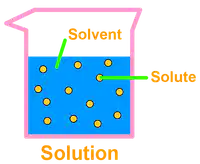
Which of the following refers to the substance that is being dissolved in a solution?
4
Multiple Choice
5

6
Multiple Choice
7
Multiple Choice
8
Multiple Choice

What type of bonds form partial charges allowing it to dissolve or like molecules?
9
Multiple Choice
10
Multiple Choice
11
Multiple Choice

Which of the following is a reason why oil (a non-polar substance) does not mix with water?
12

13
Multiple Choice
14
Multiple Choice
15
Multiple Choice
16
Multiple Choice
17

18
Match
19
20
Multiple Choice
21
22
Match
23
24

25
Multiple Choice
26
Multiple Choice
27

28

29

30

31

32

33

34

35
Multiple Choice

Most substances increase in solubility as temperature increases, why don't HCl, NH3, and SO2?
36
Multiple Choice
If you halve the amount of water you dissolve a solute in (so 50 g instead of 100 g of water), what do you do to the amount of solute to find the saturation point?
37
Multiple Choice
If you have 250 g of water, how many grams of NH3 will dissolve in 40 oC water?
38
Multiple Choice
How many grams of KNO3 will fall out of solution if 145 g are dissolved in 60oC water?
39
Multiple Choice
How many more grams of NaNO3 do you need to 85 g of the solute in 70 oC of water?
40
Multiple Choice
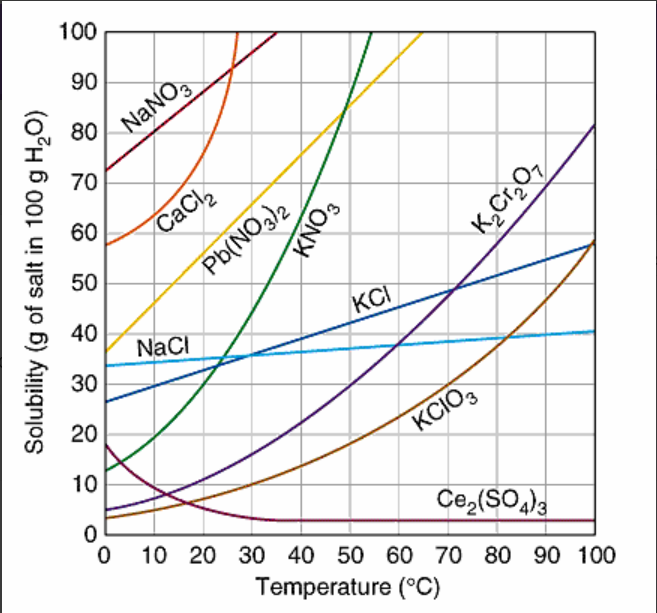
Which substance is MOST soluble at 0oC?
41
Multiple Choice
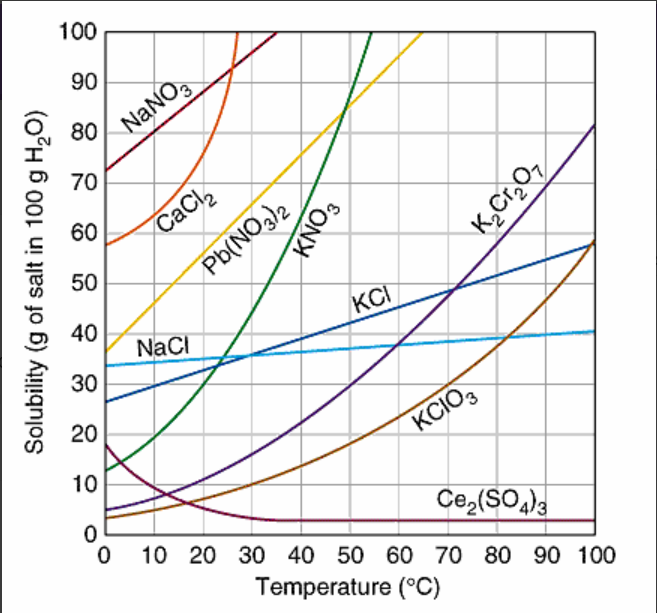
How many grams of K2Cr2O7, are soluble in 100 g of water at 95oC?
42
Multiple Choice

At approximately what temperature does the solubility of sodium chloride, NaCl, match the solubility of potassium dichromate, K2Cr2O7?
43
Multiple Choice
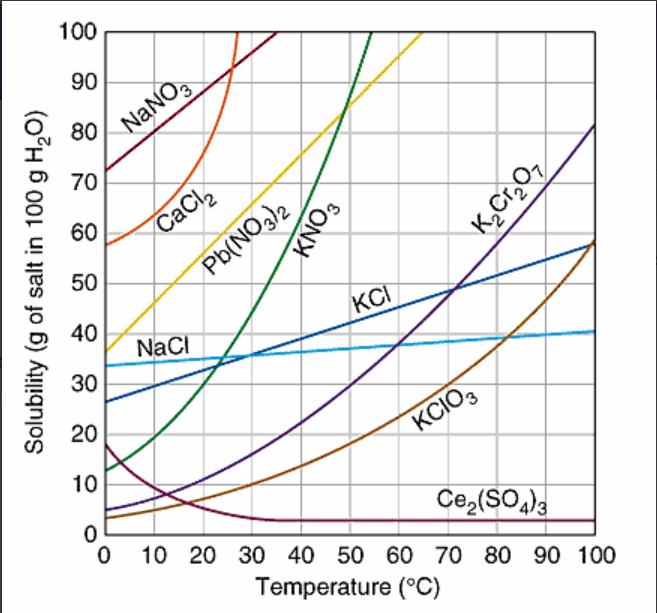
When 42 grams of potassium chloride, KCl, is dissolved in 100 grams of water at 50oC, the solution can be correctly described as:
44
Multiple Choice
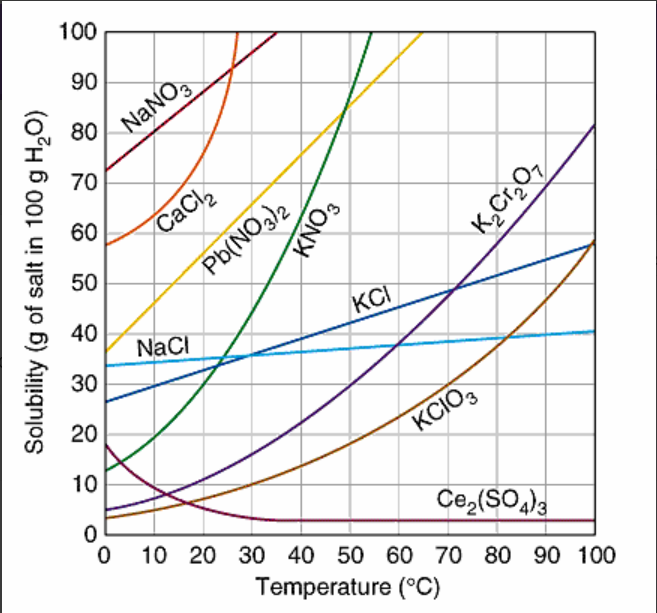
When 20 grams of potassium chlorate, KClO3, is dissolved in 100 g of water at 80oC, the solution can be correctly describe as:
45
Multiple Choice
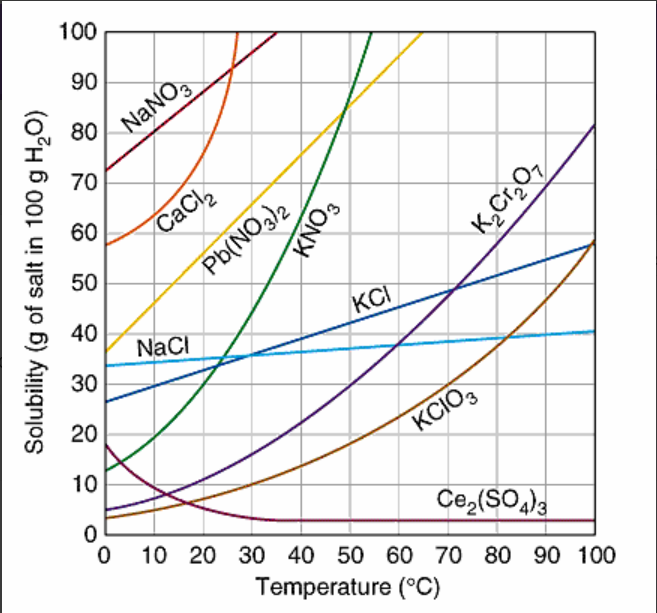
What temperature does the solubility of NaCl match KNO3?
46
Multiple Choice
47
Multiple Choice
48
Multiple Choice
49
Multiple Choice

Which solute is most likely a gas?
50
Multiple Choice
Show answer
Auto Play
Slide 1 / 50
SLIDE
Similar Resources on Wayground

43 questions
Lesson 1: Common Lab Equipment
Lesson
•
9th - 12th Grade
44 questions
Bronsted
Lesson
•
9th - 12th Grade
47 questions
Our Water World
Lesson
•
9th - 12th Grade
47 questions
Ionic Compounds
Lesson
•
9th - 12th Grade
45 questions
Energy, Frequency & Wavelength Classwork
Lesson
•
9th - 12th Grade
46 questions
Chemistry Unit 6 Lesson 2: VSEPR Theory Geometry
Lesson
•
10th - 12th Grade
47 questions
2021-22 Unit 3: Photoshop
Lesson
•
9th - 12th Grade
45 questions
Evolution -
Lesson
•
9th - 12th Grade
Popular Resources on Wayground
15 questions
Fractions on a Number Line

Quiz
•
3rd Grade
10 questions
Probability Practice
Quiz
•
4th Grade
15 questions
Probability on Number LIne
Quiz
•
4th Grade
20 questions
Equivalent Fractions
Quiz
•
3rd Grade
25 questions
Multiplication Facts
Quiz
•
5th Grade
22 questions
fractions
Quiz
•
3rd Grade
6 questions
Appropriate Chromebook Usage
Lesson
•
7th Grade
10 questions
Greek Bases tele and phon
Quiz
•
6th - 8th Grade
Discover more resources for Chemistry
20 questions
Predicting Products
Quiz
•
9th - 12th Grade
11 questions
Balancing Chemical Equations
Lesson
•
9th Grade
10 questions
Exploring Types of Chemical Reactions

Interactive video
•
6th - 10th Grade
19 questions
Stoichiometry, % yield, Limiting Reactants
Quiz
•
10th Grade
20 questions
Types of Chemical Reactions
Quiz
•
9th - 12th Grade
10 questions
Exploring Ionic and Covalent Bonding Concepts
Interactive video
•
6th - 10th Grade
7 questions
GCSE Chemistry - Balancing Chemical Equations #4
Interactive video
•
9th - 10th Grade
24 questions
Unit 2 (Part 1) Bonding Review
Quiz
•
12th Grade