
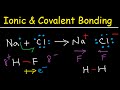
Exploring Ionic and Covalent Bonding Concepts

Interactive Video
•
Chemistry
•
6th - 10th Grade
•
Practice Problem
•
Easy

Emma Peterson
Used 45+ times
FREE Resource
10 questions
Show all answers
1.
MULTIPLE CHOICE QUESTION
30 sec • 1 pt
What is the main difference between ionic and covalent bonding?
Ionic bonds involve transferring electrons, while covalent bonds involve sharing electrons.
Ionic bonds involve sharing electrons, while covalent bonds involve transferring electrons.
Ionic bonds occur between non-metals, while covalent bonds occur between metals.
Ionic bonds are weaker than covalent bonds.
2.
MULTIPLE CHOICE QUESTION
30 sec • 1 pt
In an ionic bond, what happens to the electrons?
They are shared equally between atoms.
They are shared unequally between atoms.
They are transferred from one atom to another.
They remain with the same atom.
3.
MULTIPLE CHOICE QUESTION
30 sec • 1 pt
What type of charge does a sodium ion acquire after losing an electron?
Double negative
Neutral
Negative
Positive
4.
MULTIPLE CHOICE QUESTION
30 sec • 1 pt
What is the force that holds ions together in an ionic bond?
Electrostatic force
Magnetic force
Nuclear force
Gravitational force
5.
MULTIPLE CHOICE QUESTION
30 sec • 1 pt
In a covalent bond, how are electrons distributed between atoms?
They are transferred from one atom to another.
They are shared between atoms.
They are lost to the environment.
They are absorbed by the nucleus.
6.
MULTIPLE CHOICE QUESTION
30 sec • 1 pt
What type of bond is formed when electrons are shared equally between two atoms?
Nonpolar covalent bond
Metallic bond
Polar covalent bond
Ionic bond
7.
MULTIPLE CHOICE QUESTION
30 sec • 1 pt
Which of the following bonds is considered polar covalent?
Na-Cl
O-O
H-F
H-H
Access all questions and much more by creating a free account
Create resources
Host any resource
Get auto-graded reports

Continue with Google

Continue with Email

Continue with Classlink

Continue with Clever
or continue with

Microsoft
%20(1).png)
Apple

Others
Already have an account?
Popular Resources on Wayground

15 questions
Fractions on a Number Line

Quiz
•
3rd Grade
10 questions
Probability Practice
Quiz
•
4th Grade
15 questions
Probability on Number LIne
Quiz
•
4th Grade
20 questions
Equivalent Fractions
Quiz
•
3rd Grade
25 questions
Multiplication Facts
Quiz
•
5th Grade
22 questions
fractions
Quiz
•
3rd Grade
6 questions
Appropriate Chromebook Usage

Lesson
•
7th Grade
10 questions
Greek Bases tele and phon
Quiz
•
6th - 8th Grade
Discover more resources for Chemistry
20 questions
Predicting Products
Quiz
•
9th - 12th Grade
11 questions
Balancing Chemical Equations
Lesson
•
9th Grade
10 questions
Exploring Types of Chemical Reactions
Interactive video
•
6th - 10th Grade
19 questions
Stoichiometry, % yield, Limiting Reactants
Quiz
•
10th Grade
20 questions
Types of Chemical Reactions
Quiz
•
9th - 12th Grade
13 questions
Endothermic/Exothermic Reactions
Quiz
•
7th Grade
7 questions
GCSE Chemistry - Balancing Chemical Equations #4
Interactive video
•
9th - 10th Grade
12 questions
Percent Yield
Quiz
•
10th Grade