Search Header Logo
  1. Resource Library
  2. Science
  3. Chemistry
  4. Organic Chemistry
  5. High School Organic Chemistry
High School Organic Chemistry

High School Organic Chemistry

Assessment

Presentation

Science

10th Grade

Hard

Created by

Joseph Anderson

FREE Resource

69 Slides • 50 Questions

1

Organic Chemistry

2

media

3

let's talk groups!

  • Groups (also called families) are the vertical (up and down) columns on the periodic table

  • There are 18 groups on the periodic table BUT only groups 1 and 2 and 13-18 follow any sort of pattern.

  • The group number can help you quickly figure out the number of valence electrons.

media

4

The Group Pattern

  • The bolded number at the top of the group tell the number of valence electrons the group has.

  • Group 1 has 1 valence electron

  • Group 2 has 2 valence electrons            

  • Group 13 has 3 valence electrons      

  • Group 14 = 4, 15 = 5, 16 = 6, 17 = 7

  • Group 18 has 8 valence electrons (a full outer shell, except for Helium)

media

5

media

6

Multiple Choice

Valence electrons are

1

the electrons in the outer most energy level

2

all the electrons in the atom

7

Multiple Choice

Question image

What are the vertical columns on the Periodic Table called?

1

groups

2

periods

3

nonmetals

4

metals

5

metalloids

8

Multiple Choice

Question image

Which elements have a full set of valence electrons?

1

period 1

2

group 1

3

period 18

4

group 18

9

Multiple Choice

Question image

Which elements have 5 valence electrons?

1

period 5

2

group 5

3

period 15

4

group 15

10

Multiple Choice

Question image

What do the vertical columns on the periodic table tell us?

1

The number of orbitals

2

The number of valence electrons (electrons on the outer most shell)

11

media

12

Electron Shells

  • Each element in each period have the same number of electron shells.

  • Hydrogen (1e-) and Helium (2e-) are in period 1 and have 1 electron shell.

  • Lithium (3e-), Carbon (6e-), Oxygen (8e-), and Neon (10e-) are all in period 2 and have 2 electron shells.

media

13

Multiple Choice

What are the columns referred to on the Periodic Table of Elements?

1

Families or groups

2

Periods

14

Multiple Choice

What are the rows referred to on the Periodic Table of Elements?

1

Families or groups

2

Periods

15

media

16

Multiple Choice

Atomic Mass equals the combined number of

1

Protons and Electrons

2

Electrons and Neutrons

3

Protons and Neutrons

17

Multiple Choice

Question image

Which elements have 7 valence electrons?

1

period 7

2

group 17

3

period 17

4

group 7

18

Multiple Choice

Question image

The chemical symbol for an element is always represented by only 1 letter

1

True

2

False

19

Organic Chemistry- The study of carbon & carbon compounds.

Organic compounds are the primary constituents of all living organisms.


media

20

​What is organic chemistry?

The study of carbon compounds.

Carbon

  • ​the backbone of biological molecules

media
media

21

media

22

Why is carbon essential to life on Earth?

  • 6th element on the periodic table

  • A compound found mainly in living things is known as an organic compound.

  • Carbon is the main element in organic compounds

media

23

Significance of Carbon

media
media

24

media

25

Multiple Choice

Carbon is essential to life because it is the main element in inorganic compounds.

1

True

2

False

26

Carbon makes organic compounds, so what?

  • A compound is a substance that consists of two or more elements.

  • The smallest particle of a compound is called a molecule.

  • Consider water: two hydrogen atoms and one oxygen. Held together by chemical bonds.

  • A chemical bond is a force that holds molecules together; they are formed from reactions.

media

27

Multiple Choice

What is the an important element for living things.

1

Neon

2

Hydrogen

3

Helium

4

Carbon

28

media

29

Multiple Choice

Question image

Which of these element(s) will C form bonds with?

1

C

2

H

3

O

4

N

5

all of these

30

Multiple Choice

Question image

What type of compounds have at least 1C atom bonded to at least 1H atom?bon

1

inorganic

2

organic

3

ionic

31

Multiple Choice

Which of the following is an organic compound that makes up living things?

1

carbohydrates

2

salts

3

oxides

4

hydrocarbons

32

Carbon and Covalent bonds

media
  • ​Carbon has 4 valence electrons (outer shell electrons)

  • ​Allows for several types of covalent bonds.

33

Covalent Bonds

  • Covalent bonds exist between NONMETAL and NONMETAL.

    —Example: H2, H2O, NO3, CH4

    —

  • Covalent bonds SHARE electrons.

  • Shared electrons don’t belong to either atom.

media

34

Multiple Choice

Question image

How many bonds will a C atom form?

1

1

2

2

3

3

4

4

35

Multiple Choice

Question image
What two types of atoms make a covalent bond?
1

2 Nonmetals

2

1 Nonmetal and 1 Metal

3

2 Metals

4

2 Noble Gases

36

Multiple Choice

Question image
How are covalent bonds explained?
1

When one atom takes the other atom's electron

2

When the atom shares an electron with an another atom

3

When the two nucleus merge

4

When the neutrons leave the nucleus

37

Organic Compounds

  • Covalently bonded compounds containing carbon, excluding carbonates and oxides.

  • Few exceptions, such as Na2CO3, CO, and CO2, that are considered inorganic.

  • All organic compounds contain carbon atoms.

  • Aspirin, polyethylene in plastic bags, citric acid in the fruit, and amino acids in animals are all examples of organic compounds.

media

38

Carbon and Covalent bonds

media
  • ​able to form chains

  • ​able to form rings

media

39

Carbon atom is unique

  • Ability to form long chains and rings of covalently bonded atoms.

  • Catenation, the covalent bonding of an element to itself to form chains or rings.

  • Carbon atoms bind readily to elements with similar electronegativities.

media

40

media

41

Carbon atom is unique

  • Hydrocarbons are composed of only carbon and hydrogen; they are the simplest organic compounds

  • Other organic compounds contain hydrocarbon backbones to which other elements, primarily O, N, S, and the halogens, are attached.

media

42

Multiple Choice

Question image
Which of the following elements is required in an organic compound?
1

nitrogen

2

oxygen

3

carbon

4

sodium

43

Carbon atom is unique

  • Carbon is able to form 4 covalent bonds (4 valence electrons) with other carbon or other elements.

  • The bonding capabilities of carbon also allow for different arrangements of atoms

media

44

Fill in the Blank

How many valency does carbon have

45

media

46

Multiple Choice

C stands for?
1

cat

2

calcium

3

carbon

4

crypton

47

media

48

Multiple Choice

Question image

How many chemical bonds can each carbon atom form?

1

one

2

two

3

three

4

four

49

media

50

Macromolecule Formation

  • Monomers

    • ​small units that can join together to form polymers

  • ​Polymers

    • ​large compounds formed from combinations of many monomers

media

51

Multiple Choice

Which of the following is NOT a unique nature of carbon?

1

Forms 4 strong covalent bonds

2

It can form only one type of bond

3

It has the ability to form stable bonds with itself

4

It can form multiple bonds

52

Multiple Choice

Which type of bonding is present within organic molecules?

1

Covalent bond

2

Ionic bond

3

Metallic bond

4

Hydrogen bond

53

Multiple Choice

How many unpaired electrons does carbon have when it is excited?

1

2

2

3

3

4

4

5

54

Multiple Choice

This unique ability of carbon is defined as the ability of atoms to form stable bonds.

1

Polar Bonding

2

Carbonation

3

Covalent Bonding

4

Catenation

55

Multiple Choice

Which two elements do most organic compounds contain?

1

Carbon and hydrogen

2

Carbon and oxygen

3

Oxygen and hydrogen

4

Carbon and nitrogen

56

​Worksheet

57

Characteristics of Organic Compounds


  • Mostly built up of only three elements- carbon, hydrogen and oxygen. Other elements like halogen, nitrogen as well as phosphorous are also present but to a lesser extent.


media

58

Characteristics of Organic Compounds

  • Possess complex structures and high molecular weights

  • Their properties are decided by certain active atom or group of atoms known as the functional group.

  • They are mostly insoluble in water but soluble in organic solvents.


media

59

4 types of polymers

  • ​Carbohydrates

  • ​Lipids

  • ​Proteins

  • ​Nucleic acids

media

60

Characteristics of Organic Compounds

  • They are combustible in nature

  • They have low melting points – due to weak intermolecular forces.

  • Chemical reactions involving organic compounds proceed at slower rates.

  • They react slower than ionic compounds – due to strong covalent bonds between atoms.

media

61

Multiple Choice

The four organic compounds found in living things are?
1

Carbohydrates, Lipids, Nucleic Acids, and Oxygen

2

Carbohydrates, Lipids, Proteins, and Carbon

3

Carbohydrates, Lipids, Proteins, Nucleic Acids

4

Carbon, Lipids, Proteins, Nucleic Acids

62

Open Ended

Give at least four (4) characteristics of organic compounds.

63

media

64

Representing Organic Molecules

Simply shows the number of each type of atom present. It tells you nothing about the bonding within the compound

media

65

Macromolecule Chart Carbohydrates

  • Elements

    • ​C

    • ​H

    • ​O

  • Monomer

    • ​C, H, O in a 1-2-1 ratio

media

66

Representing Organic Molecules

Gives the simplest possible whole number ratio of the different types of atom within the compound.

media

67

Macromolecule Chart​

​Carbohydrates

  • Function(s)

    • ​energy

    • storage

    • structure

  • Examples

    • glucose

    • ​starch

    • ​glycogen

media

68

Representing Organic Molecules

A text-based, each carbon atom is listed separately, with atoms attached to it following. An exception is cyclic parts of molecules, e.g. benzene, where the carbons are grouped.

media

69

Macromolecule Chart​ Carbohydrates

  • Function(s)

    • ​energy

    • ​storage

    • ​structure

media

70

Representing Organic Molecules

Shows all of the atoms and all of the bonds present in an organic compound. The bonds are represented as lines.

media

71

Macromolecule Chart​ Carbohydrates

  • Examples

    • ​glucose

    • ​starch

    • ​glycogen

    • sucrose

media

72

Representing Organic Molecules

Similar to the displayed formula-not all bonds are shown, although all atoms are still indicated using subscript numbers. Carbon-hydrogen bonds are often simplified.

media

73

Macromolecule Chart​: Carbohydrates

  • Unusual Information

  • Monosaccharide

    • simple sugar

      glucose

media

74

Representing Organic Molecules

In a skeletal formula, most hydrogen atoms are omitted, and line ends or vertices represent carbons. Functional groups and atoms other than carbon or hydrogen are still shown. Easiest to draw & commonly used.

media

75

Macromolecule Chart​: Carbohydrates

  • Unusual Information

  • Disaccharide

    • 2 simple sugars

    • sucrose

media

76

Multiple Choice

Question image

The formula is an example of ...

1

Skeletal formula

2

Structural formula

3

Displayed formula

4

Condensed formula

77

Macromolecule Chart​: Carbohydrates

  • Unusual Information

  • Polysaccharide

    • many simple sugars

    • starch/glycoge

media

78

Multiple Choice

Question image

This represents a...

1

Condensed formula

2

Structural formula

3

Displayed formula

4

Skeletal formula

79

Multiple Choice

The monomer Glucose/Monosaccharides make up the polymer....

1

Proteins

2

Lipids

3

Nucleic Acids

4

Carbohydrates

80

Multiple Choice

Question image

This is an example of...

1

Molecular formula

2

Empirical formula

3

Condensed formula

4

Displayed formula

81

Multiple Choice

What is the ratio carbon:hydrogen:oxygen in carbohydrates?
1
1:1:1
2
1:2:1
3
2:1:1
4
2:1:2

82

Fill in the Blank

Question image

What is the molecular formula of the compound?

83

Multiple Choice

Question image

This molecule could be the building block of...

1

nucleic acids

2

proteins

3

lipids

4

polysaccharides

5

waxes

84

Open Ended

What have you learned from today's lesson? List as many as you can.

85

media

86

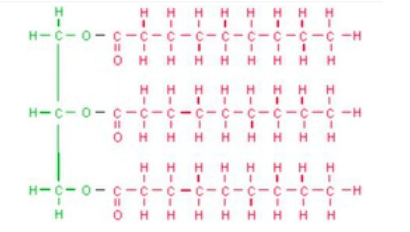
Macromolecule Chart​ Lipids

  • Elements

    • ​C

    • ​H

  • Monomer

    • ​Glycerol

      • ​3 Carbons

      • ​1 alcohol

      • ​3 fatty acid chain

media

87

Macromolecule Chart​ Lipids

  • Function(s)

    • ​store energy

    • ​biological membranes

    • waterproof covering

    • ​hormones

    • ​structural support

media

88

Macromolecule Chart​ Lipids

  • Examples

    • ​fats

    • ​oils

    • ​waxes

    • steroids

    • ​corn oil

    • ​hormones

media

89

Macromolecule Chart​ Lipids

  • Unusual Information

  • Saturated

    • Each C in fatty acid chain has single bond with another C

media

90

Macromolecule Chart​ Lipids

  • Unusual Information

  • Monounsaturated

    • Have 1 C in fatty acid chain with a double bond to another C

media

91

Macromolecule Chart​ Lipids

  • Unusual Information

  • Polyunsaturated

    • 2 or more C in fatty acid chain have double bond with another C

media

92

Multiple Choice

Question image
Is this hydrocarbon saturated or unsaturated? 
1
saturated
2
unsaturated

93

Multiple Choice

The monomer Fatty acids make up the polymer....

1

Proteins

2

Lipids

3

Nucleic Acids

4

Carbohydrates

94

Multiple Choice

Question image
Which biomolecule is this a picture of?
1
Protein
2
Nucleic Acid
3
Lipid
4
Carbohydrate

95

media

96

Macromolecule Chart​: Nucleic Acids

  • Elements

    • ​C

    • ​H

    • ​N

    • ​O

    • ​Phosphate (PO4)

media

97

Macromolecule Chart​: Nucleic Acids

  • Monomer

    • ​Nucleotides

      • ​5 carbon sugar

      • ​phosphate group

      • ​nitrogenous base

media

98

Macromolecule Chart​: Nucleic Acids

  • Function(s)

    • ​store and transmit genetic information

    • ​biological membranes

    • blueprint for making proteins

media

99

Macromolecule Chart​: Nucleic Acids

  • Examples

    • ​Deoxyribonucleic acid

      • DNA

    • RIbonucleic Acid

      • RNA

media
media

100

Macromolecule Chart​: Nucleic Acids

  • Unusual Information

  • in charge of characteristics of life

  • ​at least 2 nucleotides combined by a covalent bonds

media

101

Multiple Choice

What are the monomers of DNA?
1
glycerols
2
amino acids
3
fatty acids
4
nucleotides

102

Multiple Choice

Question image
Building block of ...
1
carbohydrates
2
proteins
3
lipids
4
nucleic acids

103

Multiple Choice

The monomer Nucleotides make up the polymer....

1

Proteins

2

Lipids

3

Nucleic Acids

4

Carbohydrates

104

media

105

Macromolecule Chart​: Proteins

  • Elements

    • ​C

    • ​H

    • ​N

    • ​O

media

106

Macromolecule Chart​: Proteins

  • Monomer

    • ​Amino Acids

      • ​Amino group (NH)

      • ​Carboxyl group (COOH)

      • ​H off central C

      • ​R-group

media

107

Macromolecule Chart​: Proteins

  • Function(s)

    • ​controls rate of reactions for life processes

    • ​forms bones and muscles

media

108

Macromolecule Chart​: Proteins

  • Function(s)

    • ​transports substances in / out of cells

    • helps fight diseases

media

109

Macromolecule Chart​: Proteins

  • Examples

    • ​Collagen

    • Carotene

    • ​Enzymes

    • ​Hemoglobin

media

110

Macromolecule Chart​: Proteins

  • Unusual Information

  • more than 20 amino acids (aa) formed in nature

  • ​bind to other aa by binding amino group to carboxyl group

media

111

Macromolecule Chart​: Proteins

  • Unusual Information

  • ​form poly peptide chains

  • ​Fold into complex shapes

media

112

Multiple Choice

Proteins are composed of what smaller subunits?
1
amino acids
2
nucleic acids
3
fatty acids
4
nucleotides

113

Multiple Choice

Question image
Which biomolecule is this a picture of? (Hint: it is made of amino acids)
1
Proteins
2
Nucleic Acids
3
Lipids
4
Carbohydrates

114

Multiple Choice

Question image
Which macromolecule is this?
1
carbohydrate
2
lipid
3
protein
4
nucleic acid

115

media

116

Multiple Choice

Which group of biomolecules provides quick energy to organisms?
1
proteins
2
carbohydrates
3
lipids
4
nucleic acids

117

Multiple Choice

Which group of organic molecules serve as long-term energy storage and waterproof coverings?
1
proteins
2
carbohydrates
3
lipids
4
nucleic acids

118

Multiple Choice

Which group of organic molecules speed up chemical reactions and serve as immune defense mechanisms?
1
proteins
2
carbohydrates
3
nucleic acids
4
lipids

119

Multiple Choice

Genetic information is stored in which class of organic compounds?
1
proteins
2
lipids
3
nucleic acids
4
carbohydrates

Organic Chemistry

Show answer

Auto Play

Slide 1 / 119

SLIDE