
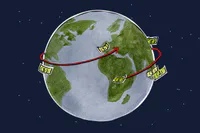
Globalization and International Trade

Presentation
•
Social Studies
•
9th - 12th Grade
•
Hard

Joseph Anderson
FREE Resource
17 Slides • 30 Questions
1


2


Globalization:
●Globalization- the interconnectedness of the
world.
●Why do countries trade with each other?
○People have always traded, but over
time technology and advancements have
allowed for that trade to expand to other
parts of the world.
3
Multiple Choice
One of the key things that has allowed trading to expand globally is __________.
farming
technology
war
arrows on a map
4

The Economic Shift:
●People were once nomadic hunters and gatherers
●The domestication of plants and animals (farming)
○Allows people to settle & stay in one place - Civilization
●Domino Effect….
○Domestication of Plants & Animals leads to Food Surplus
■Food Surplus leads to Population Boom
●Food Surplus & Population Boom leads to job Specialization & Complex Institutions (Religion, Codified Laws, Government, etc.)
○Job Specialization leads to Trading
■Trading - Record Keeping and Writing
●Trading & Record Keeping and Writing - Hierarchies
●The hierarchies created by these trading systems have played a major role in
the way the world’s countries still operate and trade today.
5
Multiple Choice
One of the key things that has allowed people to settle in one place is __________.
farming
technology
war
arrows on a map
6
Multiple Choice
The chain of events that led people from being hunters and gatherers to having settled in civilizations is known as a _______ effect.
domino
farm
nomad
road
7


Factors the Influence International Trade
●Demand for a country’s goods and services
●Political Stability
●Interest Rates
●Exchange Rates - How much our currency is worth when you trade it for
another country’s currency
●Export- to transport goods to another place for
trade.
●Import- to bring in a good or service from another
area for trade.
●Interdependence- people relying on each other for
goods, services, and ideas.
●Trade- buying, selling, or exchanging of goods and
services.
8
Multiple Choice
This is what one place sends out to another place when trading
export
import
interdependence
trade
9
Multiple Choice
This is what one place brings in from another place when trading
export
import
interdependence
trade
10
Multiple Choice
People rely on each other for goods and services. This is
export
import
interdependence
trade
11
Multiple Choice
The buying, selling, and exchanging of goods and services
export
import
interdependence
trade
12
Multiple Choice
The difference in value when one currency is traded for another.
interest rate
exchange rate
demand rate
trade rate
13


Why do Countries Trade?
Countries trade because…
●
they cannot produce a product domestically.
●
to have a wider variety of goods available to consumers.
●
even if a they can produce a product, if another country specializes it
that item, buying it from them may increase quality and decrease the
price.
●
they wish to conserve limited resources.
●
other countries have an advantage (absolute and comparative- we will
talk about this later…)
14

Strike a Balance
When countries trade, it is important to keep a balance of goods exported
and imported.
●
balance of trade- refers to the value of all goods and services exported
minus the value of all goods and services imported.
●
trade surplus- If a country’s exports exceed its imports
●
trade deficit- If the country imports more than it exports
Balance of Payments
●
how countries keep track of all monetary transactions in the
international market.
●
the difference between the money a country pays out for imports and
the money a country gets paid from other countries for exports
15
Multiple Choice
A country's exports exceed that country's imports
balance of trade
trade surplus
trade deficit
limited resources
16
Multiple Choice
A country's imports exceed that country's exports
balance of trade
trade surplus
trade deficit
limited resources
17
Multiple Choice
The calculation of the value of all goods and services exported minus the value of all goods and services imported.
balance of trade
trade surplus
trade deficit
limited resources
18

How Do Nations Achieve A Trade Advantage?
●
Technology
○
Manufactured goods are produced in countries with advanced
technology (machines & factories)
●
Natural Resources
○
The US has a lot of natural resources (metals, coal, oil, water,
good farmland, etc) & exports a lot of natural resources.
○
Nations such as Japan and China have more limited natural
resources and must import a lot.
●
Government Regulation
○
Governments use trade barriers to protect domestic jobs and
○
industries from foreign competition.
■
Trade Restrictions, Tariffs, Quotas
19
How Do Nations Achieve A Trade Advantage?
●
Technology
○
Manufactured goods are produced in countries with advanced
technology (machines & factories)
●
Natural Resources
○
The US has a lot of natural resources (metals, coal, oil, water,
good farmland, etc) & exports a lot of natural resources.
○
Nations such as Japan and China have more limited natural
resources and must import a lot.
●
Government Regulation
○
Governments use trade barriers to protect domestic jobs and
○
industries from foreign competition.
■
Trade Restrictions, Tariffs, Quotas
20
Multiple Select
Three major factors in a nation achieving a trade advantage are
technology
natural resources
if the country decides it wants an advantage
government regulations
21

Government Regulation
Trade restrictions- any sort of penalty a country puts on the importation of
products from another country.
●Trade Sanctions (imposing barriers to trade)
○Embargo
■Most extreme (usually political)
■Prohibits trade with other nations.
■Prohibits access to certain products from other nations.
○Tariff
■Taxes on imports from other countries
■to increase revenue in a nation and to encourage consumption of
domestic products.
○Quotas
■a law that limits the amount of a particular imported good.
22
Multiple Choice
The most extreme form of government regulation is
quota
embargo
tariff
any sanction is extreme
23
Multiple Choice
Regulation through taxing of imports
quota
embargo
tariff
there is no such thing as a tax on imports
24
Multiple Choice
Setting a limit on how much of a product can be imported
quota
embargo
tariff
there is no such thing as a limit on imports
25

Government Regulation
Tariffs
●Approximately 94 percent of U.S.
merchandise imports are industrial
(non-agricultural) goods.
●The United States currently has an
average import tariff rate of 2% on
industrial goods.
●One-half of all industrial goods
imports enter the United States
duty free (no tariffs)
Quotas
●limit of the amount of imported
goods that are allowed
●The US currently has ZERO absolute trade quotas in the US.
●The US DOES have Tariff free
quotas- no taxes on goods to a
certain amount.
●EX:
○Limits on milk, sugar, and beef
(Argentina has 20k ton limit on
beef before it’s taxed)
○Limits on European steel
26
Multiple Choice
When there is no tax on an import
quota
duty free
tariff
balance
27
Multiple Choice
The US has multiple absolute trade quotas
TRUE
FALSE
28
Multiple Choice
The US has tariff free trade quotas
TRUE
FALSE
29


World Trade Organization (WTO)
●Designed to eliminate protectionism
○Placing trade barriers like high
tariffs on imports and limiting the
number of foreign goods to protect
local businesses - usually hurts more
than it helps).
●Effective in getting countries to agree to
specific rules and helps settle disputes,
but has also been accused of favoring rich
countries and not doing enough to protect
the environment or people.
30
Multiple Choice
The main purpose of the WTO is
eliminating protectionism
increasing protectionism
31

Absolute Advantage
●If 2 countries or businesses have
the same amount of resources, one
can produce more than the other
using fewer resources.
●the ability of a country or business
to produce a particular good better
and more effectively.
●the efficiency of producing a single
product.
Comparative Advantage
●one country or business can
produce a good or service at a
lower opportunity cost than
another.
●When multiple things could be
produced, compare which option is
the best
●Comparing your options, which one
has a lower opportunity cost?
Even if a country has an absolute advantage in several goods
and services, it will usually specialize and produce goods and
services in which it has a comparative advantage.
32
Multiple Choice
If a country has an absolute advantage in several goods
and services, it will always produce those things.
TRUE
FALSE
33
Multiple Choice
The ability of a country or business to produce a particular good better and more effectively.
absolute advantage
comparative advantage
34
Multiple Choice
When multiple things could be produced, compare which option is the best
absolute advantage
comparative advantage
35
Multiple Choice
Takes into consideration only the efficiency of one single product.
absolute advantage
comparative advantage
36
Multiple Choice
Takes into consideration the opportunity costs.
absolute advantage
comparative advantage
37

Absolute Advantage
● Oil Production
○ Nations in the Middle East have
easier access to oil, therefore they
have an absolute advantage.
● Coffee production
○ Central and South American
countries have ideal climate and
soil for growing coffee beans.
● Phones
○ Apple makes 1000 phones per day
with 100 employees and Samsung
makes 900 phones per day with
100 employees.
Comparative Advantage
● Canada and Mexico
○ Canada can grow avocados or make
maple syrup. It is cheaper and
easier to make maple syrup. Mexico
has the ideal climate for avocados.
Canada is better off putting
resources into maple syrup and
importing avocados.
● A technology company
○ The company can produce 10
smartphones or 10 computers using
the same resources, but computers
have a higher profit. The company
would choose to make computers.
38
Multiple Choice
Canada can both produce avocados, but they choose to produce maple syrup because
Canada has an absolute advantage in avocado
Canada has a comparative advantage in avocado
Canada has an absolute advantage in maple syrup
Canada has a comparative advantage in maple syrup
39

The video is in Canvas slides if you need additional information.
40

Comparative Advantage
Liz and Joe each own a vegan restaurant .
Liz can spend all her time producing either
40 salads or 40 smoothies an hour. She can
split her time equally and produce 20 salads
and 20 smoothies an hour.
For each additional smoothie Liz produces,
she must decrease her production of salads
by one., and for each additional salad she
Liz produces, she must decrease her
production of smoothies by one.
Liz’s OC of producing 1 smoothie is 1 salad.
Liz’s OC for producing 1 salad is 1 smoothie.
Joe can spend all his time producing either
30 salads an hour or 6 smoothies per hour.
Therefore, he can make a salad in 2 minutes
or a smoothie in 10 minutes. For each
additional smoothie Joe produces, he must
decrease his production of salads by 5. And
for each additional salad Joe produces, he
must decrease his production of smoothies
by 1/5 of a smoothie.
Joe’s OC of producing 1 smoothie is 5 salads
Joe’s OC producing 1 salad is 1/5 smoothie
What should Liz produce? What about Joe?
41
Multiple Choice
Based on the information provided, what should Liz produce?
smoothies
salads
42
Multiple Choice
Based on the information provided, what should Joe produce?
smoothies
salads
43

Specialization and Comparative Advantage
Specialization occurs when
persons, businesses, or nations
use their available resources to
focus on producing one or a few
items they are best suited.
Interdependence happens
when countries specialize in
certain goods. People depend on
each other for the different
goods and services.
Comparative Advantage and Trade
●When specialization in a good occurs
(assuming there is a comparative
advantage), total output will grow.
●As long as the opportunity cost of
producing the goods differs across the two
individuals, both can gain from
specialization and trade.
Ex: South American countries specialize in
coffee production. The US depends on South
American countries to keep up with the coffee
demand . Those same countries rely on the US
for computer equipment..
44
Multiple Choice
Middle Eastern countries producing oil is an example of
specialization
quotas
tariffs
interdependence
45
Multiple Choice
Two countries that rely on each other for traded items have a(n)
specialization
advantage
problem
interdependence
46


If a country can produce everything it needs, why would it trade?
Even if a country like the United
States has an absolute advantage
with Panama in both milk and
cookies, it might be cheaper to
produce cookies in Panama which
gives them a comparative
advantage. In this case, it is more
efficient for the US to specialize in
producing milk, and Panama to
specialize in producing cookies.
When we specialize and trade, products become cheaper for consumers.
47
Multiple Choice
The goal of trading with comparative advantage in mind is to
get quality products for a lower price
to tax as much as possible
to make sure we don't start a war
to support local business
Show answer
Auto Play
Slide 1 / 47
SLIDE
Similar Resources on Wayground

39 questions
The Executive Branch
Lesson
•
8th - 12th Grade
39 questions
Introduction to Industrialization & the Gilded Age
Lesson
•
10th - 11th Grade
41 questions
Problem- Solving
Lesson
•
KG
41 questions
6 Main Nutrients
Lesson
•
9th - 12th Grade
41 questions
Unit 6 revew
Lesson
•
9th - 12th Grade
41 questions
The Slave Trade U4LB
Lesson
•
9th - 12th Grade
40 questions
The Progressive Movement
Lesson
•
9th - 12th Grade
40 questions
Figurative Language Lesson
Lesson
•
9th - 11th Grade
Popular Resources on Wayground
8 questions
Spartan Way - Classroom Responsible

Quiz
•
9th - 12th Grade
15 questions
Fractions on a Number Line
Quiz
•
3rd Grade
14 questions
Boundaries & Healthy Relationships
Lesson
•
6th - 8th Grade
20 questions
Equivalent Fractions
Quiz
•
3rd Grade
3 questions
Integrity and Your Health
Lesson
•
6th - 8th Grade
25 questions
Multiplication Facts
Quiz
•
5th Grade
9 questions
FOREST Perception
Lesson
•
KG
20 questions
Main Idea and Details
Quiz
•
5th Grade
Discover more resources for Social Studies
44 questions
QSE 3 Review
Quiz
•
10th Grade
38 questions
Unit 6 Key Terms
Quiz
•
11th Grade - University
8 questions
1990's Review
Quiz
•
11th Grade
10 questions
Boss Battle- Quizziz
Quiz
•
12th Grade
55 questions
Unit 12: World War I
Quiz
•
8th - 12th Grade
22 questions
25-26 Standard 3
Quiz
•
11th Grade
35 questions
Early Cold War Review
Quiz
•
9th - 12th Grade
20 questions
Unit 8.1 World War I Quizizz
Quiz
•
10th Grade