
Processes of Law

Presentation
•
Social Studies
•
12th Grade
•
Practice Problem
•
Hard

Amy Schneider
Used 2+ times
FREE Resource
10 Slides • 2 Questions
1

Processes of Law
Unit 6- 13
This Photo by Unknown author is licensed under CC BY-NC-ND.
2


Lesson Overview
• Students Will Be Able To:
oSequentially order steps of the criminal and civil law processes.
oIdentify the roles of people in the civil law
process.
oIdentify why someone would choose to
waive the right to a jury trial.
oCompare and contrast the processes of
criminal and civil law.
• Vocabulary:
oArraignment, Bench Trial, Due Process,
Grand Jury, Hung Jury, Indict, Miranda
Warning, Waive


3


Essential Question- What are the processes of criminal and civil law?
Why do you
think the
Founding
Fathers
(Framers) put
"Due Process"
in the
Constitution?
4


The Criminal Justice Process Begins
• The US Constitution has multiple (many) protections for people accused of crimes
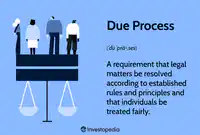
• Due Process- the requirement that the government must follow established laws before it deprives (takes away) a person's rights
• The Miranda Warning- a set of legal rights that must be stated to a person upon placing them under arrest
o Right to Remain Silent
o Right to an attorney


5
6
Multiple Choice

"You have the right to remain silent" is a statement of which constitutional right?
the right to trial by jury
the right to a speedy trial
the right to an attorney
the right against self incrimination
7

The Criminal Justice System in Court
• These are the major steps in a criminal court steps in Pennsylvania
o Indictment
An Indictment- is when the court examines the initial evidence against the accused and decides if there is enough evidence to formally accuse them of a crime
This decision can be made by a judge or a Grand Jury- jury of citizens who evaluate the evidence and decide whether to formally accuse/charge someone with a crime
o Arraignment
An Arraignment- is a court hearing where the accused person hears the charges and is asked to plead not guilty or guilty
At this point they would also be considered a Defendant
o Plea
A defendant may choose to plead guilty and settle the case outside of a trial
These types of pleas usually involve lighter sentences
They can also choose to plead not guilty, and it moves onto a trial
Why do you
think there
are different
steps in this
process?
What do
they all
mean for the
defendant?
8

o Trial
If the defendant pleads not guilty the next step/phase is the trial
The Prosecution and the Defense gather evidence to support their cases
In a jury trial, the jury decides whether the defendant is guilty or innocent and the judge decides the sentence
A defendant can Waive- or give up their right to a jury trial. In which case the judge will be the one deciding the verdict
9


Civil Cases Before the Trial
• These cases do not begin with an arrest but
with a complaint filed in court (This is suing
either someone or a group)
• The plaintiff files the complaint and normally
hires an attorney that might also specialize in
that area (Workplace Injury, Malpractice,
etc...)
• They may be seeking money (damages) for the issue or asking the court to make sure the
conduct/injustice is stopped
• The defendant receives the complaint and
answers it court, from here it can go to a trial,
or the sides can settle
10


Jury Trial versus a Bench Trial
• Pennsylvania protects the right to a jury trial in a civil case, states are not required to do this
• A Bench Trial- is a trial without a jury, where the
judge makes the decision
o A defendant can request this as opposed to a jury trial
• In criminal cases a jury (usually 12 people) must
reach a unanimous verdict
• In a civil trial there needs to be a supermajority
(5/6 of the jury) to reach a decision
• Hung Jury- this is where the jury cannot reach a
verdict and the judge can either conduct a new
trial with a different jury or drop the charges
11
Multiple Select
What reasons (2) might cause a person to choose a bench trial over a jury trial?
The person believes human sympathy, rather than legal codes will benefit them in the trial
The person wants the process to be over quickly
The person does not want the trial's outcome to depend only on one person
The person cannot afford high legal fees
12

Essential Question- What are the processes of criminal and civil law?
• Officers must inform arrested people of their right to remain silent and their right to an attorney.
• Processes of criminal and civil law include multiple steps before a trial.
• One can waive the right to a jury trial.
Processes of Law
Unit 6- 13
This Photo by Unknown author is licensed under CC BY-NC-ND.
Show answer
Auto Play
Slide 1 / 12
SLIDE
Similar Resources on Wayground

11 questions
The Sociological Perspective
Lesson
•
12th Grade
9 questions
18 ENERO GABINO BARREDA
Lesson
•
12th Grade
11 questions
Equilibrium-Shortage-Surplus
Lesson
•
11th - 12th Grade
8 questions
Symbolic Interactionism and Deviance
Lesson
•
12th Grade
10 questions
Grit/Growth Mindset
Lesson
•
12th Grade
9 questions
Enlightenment Philosophers
Lesson
•
12th Grade
8 questions
Race - the Power of an Illusion
Lesson
•
12th Grade
9 questions
Yo nunca, nunca...
Lesson
•
12th Grade
Popular Resources on Wayground
15 questions
Fractions on a Number Line

Quiz
•
3rd Grade
14 questions
Boundaries & Healthy Relationships
Lesson
•
6th - 8th Grade
13 questions
SMS Cafeteria Expectations Quiz
Quiz
•
6th - 8th Grade
20 questions
Equivalent Fractions
Quiz
•
3rd Grade
25 questions
Multiplication Facts
Quiz
•
5th Grade
12 questions
SMS Restroom Expectations Quiz
Quiz
•
6th - 8th Grade
20 questions
Main Idea and Details
Quiz
•
5th Grade
10 questions
Pi Day Trivia!
Quiz
•
6th - 9th Grade
Discover more resources for Social Studies
33 questions
Macroeconomics Test Review
Quiz
•
12th Grade
39 questions
Unit 7 Key Terms
Quiz
•
11th Grade - University
41 questions
Midterm Review 2025
Quiz
•
12th Grade
38 questions
Unit 6 Key Terms
Quiz
•
11th Grade - University
48 questions
Asia: Countries Map Test
Quiz
•
9th - 12th Grade
15 questions
Unit 6A WWI Vocab
Quiz
•
12th Grade
15 questions
Debt/Credit Assessment
Quiz
•
9th - 12th Grade
5 questions
8a- Qualifications for Congress
Lesson
•
9th - 12th Grade