
- Resource Library
- Science
- Physical Science
- Mid Term (physical Science, Chemistry & Environmental Science)
Mid Term (Physical Science, Chemistry & Environmental Science)
Presentation
•
Science
•
9th - 12th Grade
•
Hard
+7
Standards-aligned
Dr. L Jacobs
Used 1+ times
FREE Resource
10 Slides • 34 Questions
1
2
3
Multiple Choice
4
Multiple Choice
5
Multiple Choice
What causes the heat that we feel on a hot, sunny day?
decomposers
the nitrogen cycle
too much oxygen in the air
the greenhouse effect
6
7
Multiple Choice
Which organisms take in carbon dioxide?
humans
trees
deer
birds
8
Multiple Choice
Which one of these does not add CO2 to the atmosphere?
cooking with gas
planting trees
burning wood
riding in a bus
9
Multiple Choice
How does carbon get cycled back into the earth?
through decomposers
through the greenhouse effect
through the burning of fossil fuels
through photosynthesis
10
11
Multiple Choice
How does carbon dioxide cycle back and forth between plants and animals?
Plants give off carbon dioxide, and animals take in carbon dioxide.
Animals breathe out carbon dioxide, and plants take in carbon dioxide.
Plants and animals both breathe in carbon dioxide.
Plants and animals both breathe out carbon dioxide.
12
Multiple Choice
Combustion is another word for _______________.
photosynthesis
the carbon cycle
the geosphere
burning
13
Multiple Choice
What happens to carbon that has been in the soil for millions of years?
It ceases to be carbon.
It makes the Earth warmer.
It turns into fossil fuels like oil and coal.
It gets cycled back into plants through their roots.
14
15
Multiple Choice
What happens when gases, like carbon dioxide, get trapped in the atmosphere?
The temperature of the planet rises.
Plants produce more oxygen.
The amount of greenhouse gas decreases.
The number of decomposers increases.
16
Multiple Choice
17
Multiple Choice
Which of the following adds to the greenhouse effect and global warming?
the conservation of national forests
decreasing the amount of air pollution that is created by cars and buses
the lessening of carbon emissions into the air
the burning of too much fossil fuel
18
19
Multiple Select
How do living organisms return carbon to the atmosphere in the carbon cycle?
respiration
decomposition
photosynthesis
transpiration
20
21
Multiple Choice
22
23
Multiple Choice
24
25
Multiple Choice
26
27
Multiple Choice
28
Multiple Choice
29
Multiple Choice
30
Multiple Choice
31
Multiple Choice
32
Multiple Select
When plants and animals die -
they become part of the soil
the amount of carbon doubles - because it is created
carbon moves into the soil and the air
all carbon is destroyed
all carbon changes into oxygen
33
Multiple Select
When animals _____, they release CO2
inhale
exhale
inhale and exhale
die
excrete wastes
34
Multiple Choice
Besides fuel, oil can be used to make _____ which can be used for water bottles and parts of iPods
CH4
gold
CO2
plastic
35
Multiple Select
The carbon cycle is a biogeochemical cycle meaning
bio= life
geo= Earth, sediment
chemical = acid, base
chemical= movement of atoms
carbon is in the atmosphere, biosphere, lithosphere; and hydrosphere
36
Multiple Select
Carbon can exist in 4 spheres
atmosphere
globosphere
biosphere
hydrosphere
lithosphere
37
Multiple Select
If oil is made from decomposed dinosaurs and plastic is made from oil,
all plastic dinosaurs are made of real dinosaurs
real dinosaurs were made of plastic
the plastic keys on my computer/i Pad are from real dinosaurs
dinosaurs did not exist
the plastic on my i Phone or i Pod is from real dinosaurs
38
Multiple Select
Carbon from a polar bear can end up on your peanut butter and jelly sandwich when
the polar bear dies and CO2 moves into the atmosphere
the polar bear inhaled CO2 from a peanut plant growing in the Artic
the polar bear eats peanut butter
CO2 moves from the atmosphere to the peanut plant
you eat peanut butter [crushed peanuts from the peanut plant]
39
Multiple Select
How can a carbon atom from a dinosaur end up in an iPod?
dinosaurs ate plants or other dinosaurs
in the movie Jurassic Park, a dinosaur ate a person who had an iPod in his pocket
dinosaurs died and their bodies became a deposit of hydrocarbons [oil]
oil is used to make plastic which can be molded into parts of an iPod
humans drill for oil
40
Multiple Select
Carbon has been on Earth for billions of years; meaning carbon
from a T-Rex could be in you
only exists as a gas
never moves
continually cycles between the atmosphere, biosphere, lithosphere, and hydrosphere
41
Match
Match the vocabulary word to the definition.
A non-renewable energy source like coal, oil, and natural gas formed from the remains of ancient organisms.
A natural resource that can be replenished naturally over time, such as solar or wind energy.
The process of converting waste materials into reusable materials to reduce waste and pollution.
A gas that is a major contributor to climate change, primarily produced by burning fossil fuels.
The practice of planting trees to restore forests that have been cut down or degraded.
Fossil fuels
Renewable energy
Recycling
Carbon dioxide
Reforestation
Fossil fuels
Renewable energy
Recycling
Carbon dioxide
Reforestation
42
Hotspot
The process by which plants use sunlight, water, and CO2 to create food (glucose) and release oxygen.
43
Labelling
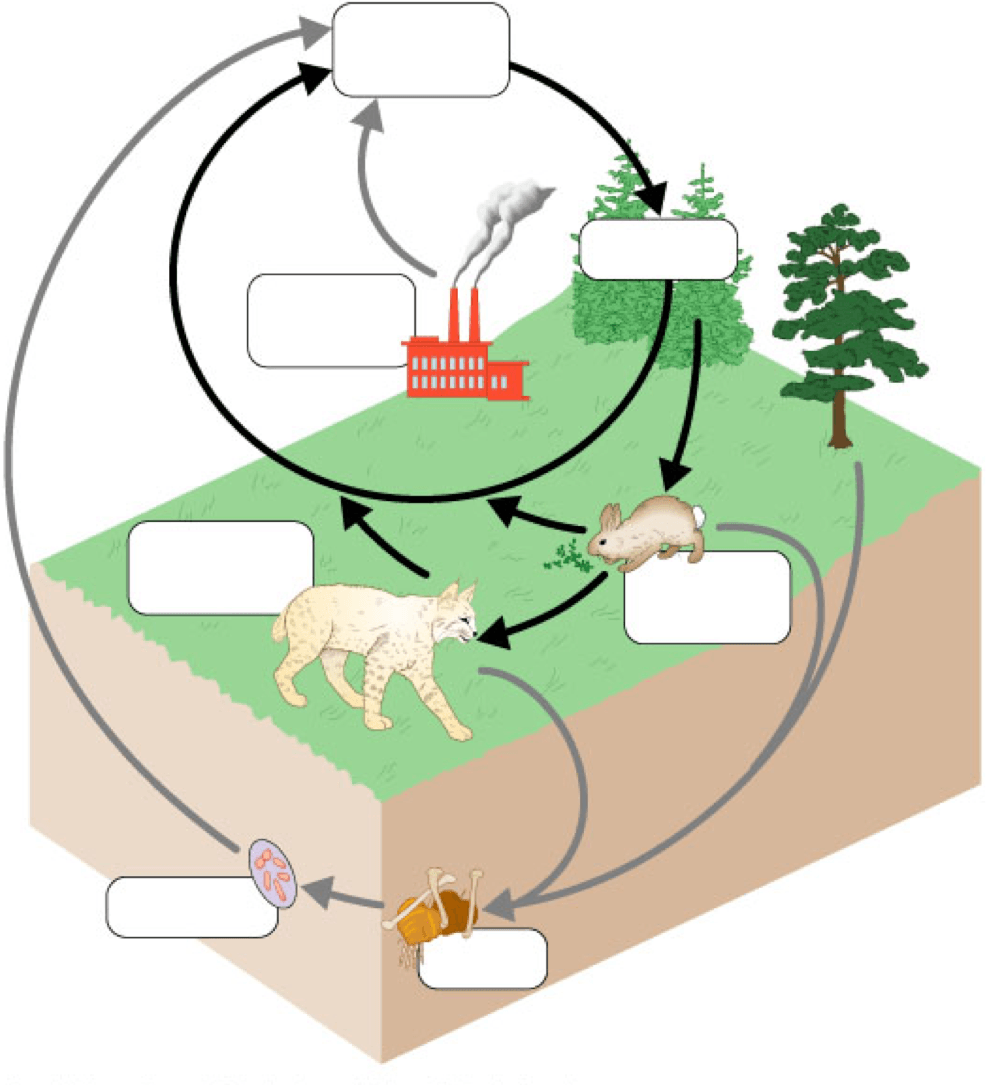
Label the Carbon Cycle
The Atmosphere
Fossil Fuels
Decomposition
Photosynthesis
Cellular Respiration
Combustion
44
Poll
How do you think you did on this assignment?
What grade do you think you made on this assignment?
100%-90%
I did a great job!
90%-80%
I did an okay job!
80%-70%
I could do better, but I tried!!
70-60%
I tried as best I could!
60% or less
I need to study!!
Show answer
Auto Play
Slide 1 / 44
SLIDE

Similar Resources on Wayground
38 questions
Earth's Many Layers
Lesson
•
9th - 12th Grade
39 questions
Physical Science Periodic Table
Lesson
•
9th - 12th Grade
39 questions
Empirical Mole Calculation
Lesson
•
9th - 12th Grade
39 questions
Atoms in Physical Science
Lesson
•
9th - 12th Grade
39 questions
Molecular Formula Calculation
Lesson
•
9th - 12th Grade
35 questions
Color (light Waves)
Lesson
•
9th - 12th Grade
35 questions
History of the Atom
Lesson
•
10th - 12th Grade
Popular Resources on Wayground
15 questions
Fractions on a Number Line
Quiz
•
3rd Grade
14 questions
Boundaries & Healthy Relationships
Lesson
•
6th - 8th Grade
13 questions
SMS Cafeteria Expectations Quiz
Quiz
•
6th - 8th Grade
20 questions
Equivalent Fractions
Quiz
•
3rd Grade
25 questions
Multiplication Facts
Quiz
•
5th Grade
12 questions
SMS Restroom Expectations Quiz
Quiz
•
6th - 8th Grade
20 questions
Main Idea and Details
Quiz
•
5th Grade
10 questions
Pi Day Trivia!
Quiz
•
6th - 9th Grade
Discover more resources for Science
10 questions
Exploring the Layers of the Earth
Interactive video
•
6th - 10th Grade
25 questions
Naming Ionic and Covalent Compounds
Quiz
•
9th Grade
35 questions
DNA Structure and Replication
Quiz
•
10th Grade
33 questions
Unit 5 Chemical Reactions Review
Quiz
•
9th - 12th Grade
24 questions
U8 Respiratory System Review
Quiz
•
12th Grade
20 questions
The Cell Cycle and Mitosis
Quiz
•
9th Grade
9 questions
Explore Homeostasis and Feedback Mechanisms
Quiz
•
9th - 12th Grade
10 questions
Exploring the Human Respiratory System
Interactive video
•
6th - 10th Grade