Search Header Logo
  1. Resource Library
  2. Science
  3. Biology
  4. Enzyme Activity
  5. Biomolecule Terms 2 Enzymes
Biomolecule terms 2 - Enzymes

Biomolecule terms 2 - Enzymes

Assessment

Presentation

Science

9th - 12th Grade

Medium

NGSS
MS-ESS1-1, HS-PS1-4, HS-LS1-6

+9

Standards-aligned

Created by

Stacey Ramay

Used 52+ times

FREE Resource

12 Slides • 30 Questions

1

media

2

Multiple Choice

Enzymes are composed of which of the following monomers? 
1

amino acids

2

proteins

3

nucleotides

4

monosaccharides

3

Multiple Choice

Question image
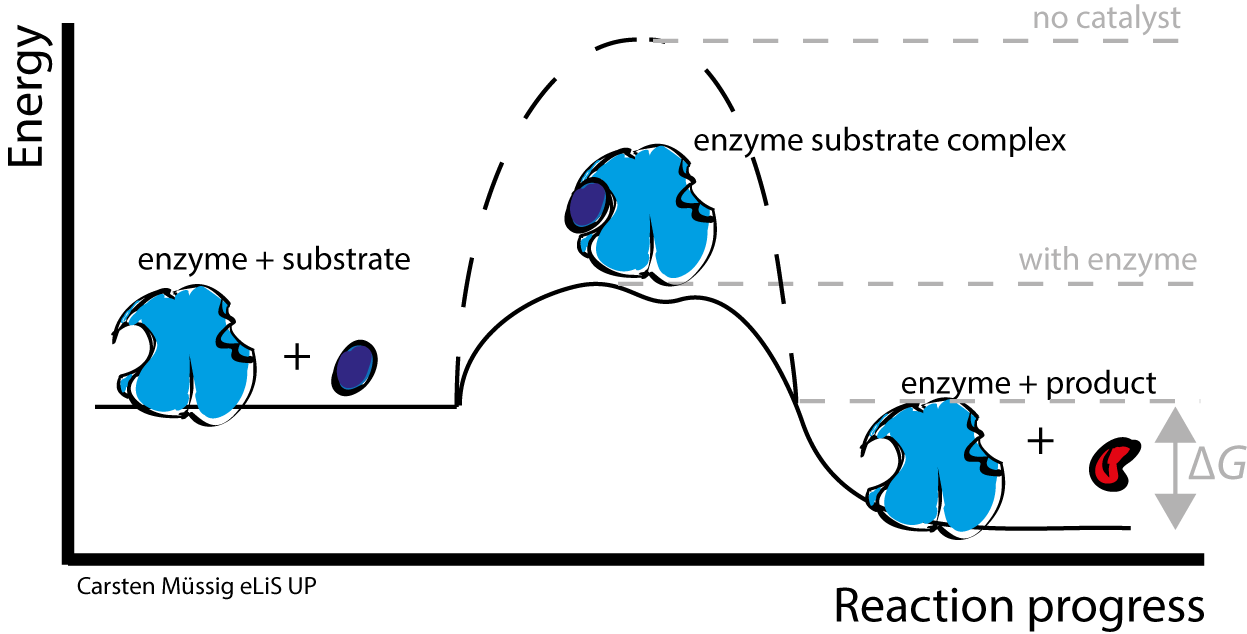
An enzyme speeds up a reaction by
1

lowering the activation energy.

2

raising the activation energy.

3

releasing energy.

4

absorbing energy.

4

Multiple Choice

What makes an enzyme specific?
1

Size

2

Shape

3

Name

4

Location it is found in

5

Multiple Choice

An enzyme speeds up a chemical reaction in the cell but can only be used once.  True or False? 
1

true

2

false

6

Multiple Choice

Enzymes are able to speed up chemical reactions because they - 
1

increase the temperature inside the cell

2

reduce the friction between the reactants

3

make the raw materials more chemically reactive

4

lower the activation energy of the reaction

7

Multiple Choice

What 3 letters do enzymes typically end in?
1

-ose

2

-ase

3

-ese

4

-tic

8

media

9

Multiple Choice

What is the primary role of enzymes inside of living cells? 
1

store genetic information

2

store energy

3

they help fight infections

4

speed up chemical reactions 

10

Multiple Choice

Based on their role in the cell, enzymes can also be classified as –
1

inhibitors

2

catalysts

3

sources of energy

4

vitamins

11

media

12

media

13

Multiple Choice

Which model will temporarily change shape when stimulated by its proper substrate.

1

Induced fit model

2

Lock and Key model

3

both

4

neither

14

media

15

Multiple Choice

Each enzyme only has 1 substrate that will fit its active site.  What is this called?
1

reusable

2

catalyst

3

specific

4

fragile

16

Multiple Choice

Question image

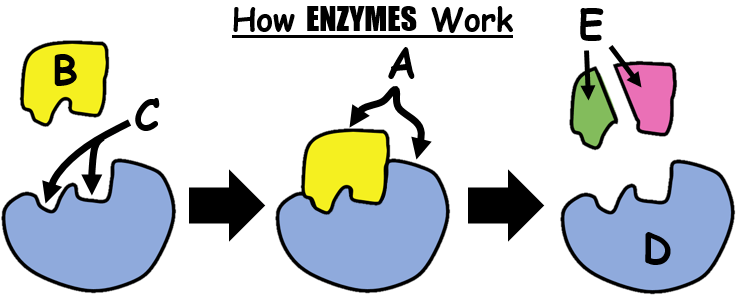
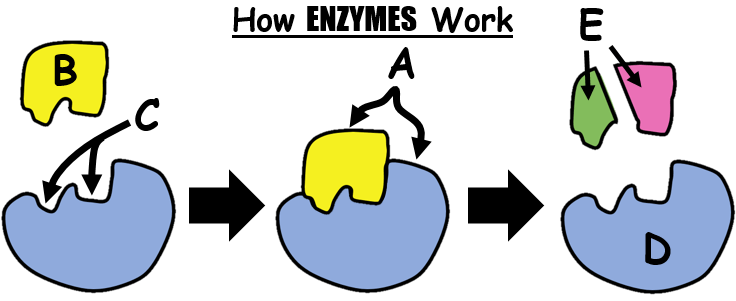
Identify what is labeled with the letter D

1

active site

2

enzyme

3

substrate

4

products

17

Multiple Choice

Question image
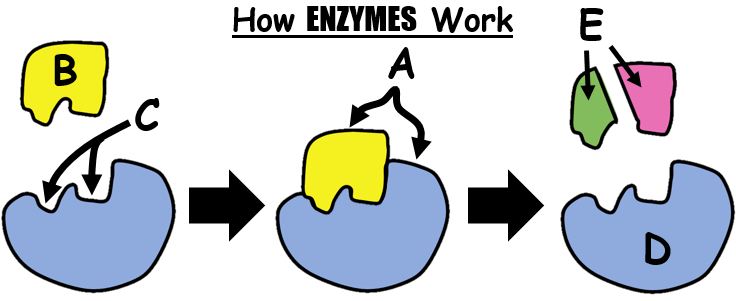
In the diagram, what is letter A? 
1

product

2

substrate

3

enzyme-substrate complex

4

active site

18

media

19

media

13.

ENZYME INHIBITORS

A substance that prevents

the substrate from

interacting with the

enzyme.

8

20

Multiple Choice

Any substance that is acted upon by an enzyme is called a(n)?
1

Coenzyme

2

Substrate

3

Vitamin

4

Polypeptide

21

Multiple Choice

In a chemical reaction, bonds are broken and new bonds are formed that create new substances. The bonds that are broken are called what?
1

Reactants

2

Products

3

Atoms

4

Catalysts

22

Multiple Choice

Question image
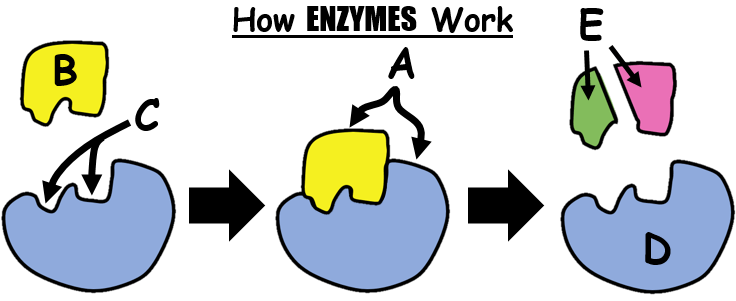
Letter B...
1

active site

2

enzyme

3

substrate

4

products

23

Multiple Choice

Enzymes have an area where reactants called substrates can be brought together in an enzyme-catalyzed reaction. This area on the enzyme is called the
1

enzyme substrate complex.

2

reaction site.

3

active site.

4

lock and key.

24

Multiple Choice

After the enzyme and substrate bind together and perform the reaction, what does the substrate become?
1

another substrate

2

an enzyme

3

a product

4

an active site

25

Multiple Choice

Question image
Letter E...
1

active site

2

enzyme

3

substrate

4

products

26

media

27

media

28

Multiple Choice

Enzymes need certain environmental conditions in order to function properly.  What happens when enzymes are heated to a high temperature?
1

they die

2

they denature

3

they change their amino acid sequence

4

they work better

29

media

30

Multiple Choice

What is an inhibitor?

1

the region of an enzyme that attaches to a substrate

2

a change in the shape of a protein

3

substance that can bind to an enzyme and prevent the substrate from binding

4

macromolecules that contain carbon, hydrogen, oxygen, and nitrogen

31

media

32

Multiple Choice

what part do the competitive inhibitors attach to?
1

subtrate

2

active site

3

somewhere other than enzyme

33

media

34

Multiple Choice

Non-competitive inhibitors block the active site

1

true

2

false

35

Multiple Choice

The role of enzymes in the cell is best summarized by which of the following statements?

1

Enzymes control the rate and process of chemical reactions in our body by helping break and form chemical bonds

2

Enzymes carry the genetic information needed for our cells to function.

3

Enzymes send electrical signals through the bodies of multicellular organisms.

4

Enzymes are the main energy storage molecules within our cells.

36

Multiple Choice

Question image
Which of the following conclusions can be drawn from this graph?
1

The optimum pH of the enzyme is 6.6.

2

This enzyme works best in highly acidic environments

3

The enzyme’s activity increases as pH increases 7.0 to 9.0

4

The enzyme’s activity is greater around pH of 8.0 .

37

Multiple Choice

Sucrase has an optimum temperature of 37 C and an optimum pH of 6.2. What would happen if the pH changed to 3?
1

Sucrase would continue to work the same

2

The reaction sucrase catalyzes would speed up

3

The reaction sucrase catalyzes would slow down

38

Multiple Choice

The enzyme amylase helps the body breakdown starch in food and functions optimally at body temperature (37 C). A young child runs a fever of 40C for 24 hours.  Predict the effect this may have on his digestion.
1

Digestion will increase because starch molecules are colliding faster with the enzyme.

2

Digestion will increase because enzyme activity improves at higher temperature.

3

Digestion will decrease because starch molecules are colliding faster with the enzyme.

4

Digestion will decrease because the shape of the enzyme is altered past optimal temperature.

39

Multiple Choice

Enzymes are an example of

1

Lipids

2

Carbohydrate

3

Protein

4

Nucleic Acid

40

Multiple Choice

In a chemical reaction, ________ are what you have at the end

1

Products

2

Molecules

3

Reactants

4

Substances

41

Multiple Choice

Each enzyme only has 1 substrate that will fit its active site.  What is this called?
1

reusablility

2

denaturation

3

specificity

4

fragility

42

Multiple Choice

Question image
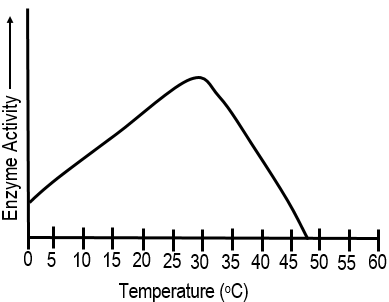
Based on the graph, what is the optimal temperature for this enzyme? 
1

15oC

2

40oC

3

30oC

4

35oC

media

Show answer

Auto Play

Slide 1 / 42

SLIDE