

Work, Power and Machines AMA and IMA

Presentation
•
Science, Physics
•
9th - 12th Grade
•
Practice Problem
•
Medium

Emily Ramon
Used 61+ times
FREE Resource
20 Slides • 20 Questions
1
Work, Power and Machines AMA and IMA
I can understand work, input, output and simple machines.
2
Background on Simple Machines:
A machine is a device that does work. Most machines consist of a number of elements, such as gears and ball bearings, that work together in a complex way. Nonetheless, no matter how complex they are, all machines are based in some way on six types of simple machines.

3
Fill in the Blank
4
The 6 simple machines are:
the inclinded plane
the lever
the screw
the wedge
the wheel and axle
the pulley

5
Principles of Simple Machines:
*Machines simply transmit mechanical work from one part of a device to another part.
*A machine produces force and controls the direction and the motion of force, but it cannot create energy.
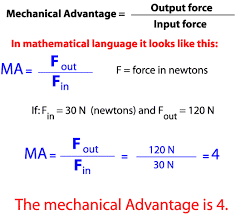
*A machine's ability to do work is measured by two factors. These are (1) mechanical advantage and (2) efficiency.
6
7
Multiple Choice
8
9
Fill in the Blank
10
Inclined Plane
The inclined plane is a simple device that hardly looks like a machine at all. The mechanical advantage increases as the slope of the incline decreases. But the load will then have to be moved a greater distance.

11
Inclined Plane
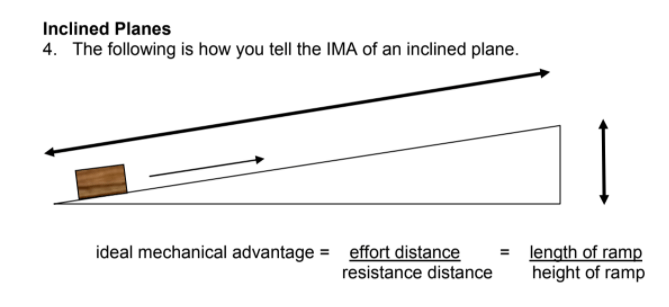
The ideal mechanical advantage (IMA) of an inclined plane is the length of the incline divided by the vertical rise, the so-called run-to-rise ratio. The mechanical advantage increases as the slope of the incline decreases, but then the load will have to be moved a greater distance. L = Length of the incline and h = distance of resistance.
12
Fill in the Blank

What is the IMA of this ramp? Remember: IMA = Distance effort (L) / Distance resistance (h)
13
Fill in the Blank

What is the IMA of this ramp? Remember: IMA = distance effort (L) / Distance resistance (h)
14
AMA of an Inclined Plane
Actual Mechanical Advantage AMA
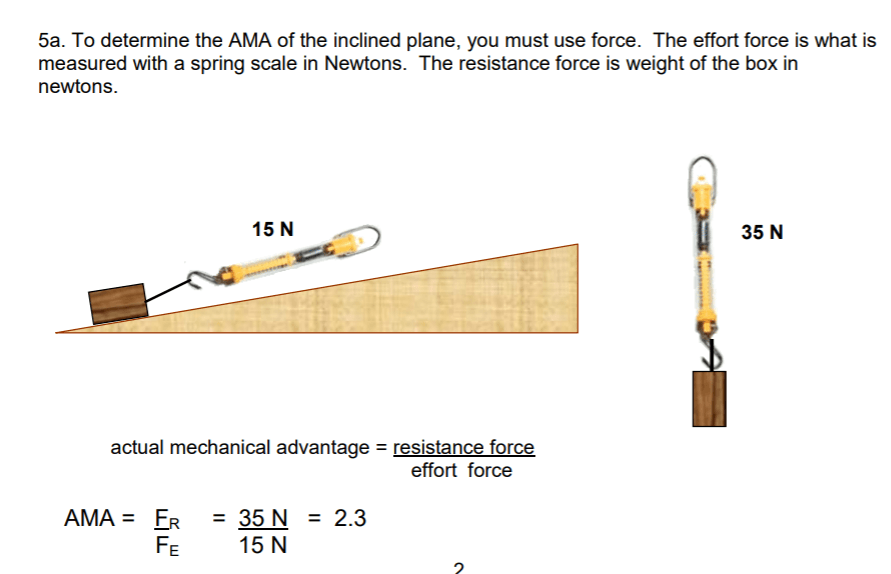
- Actual machines have friction.
- They do not have as high of a mechanical advantage as ideal machines because some of the effort is lost in overcoming friction.
- AMA = actual measured resistance force actual measured effort force
15
Fill in the Blank

Calculate the AMA of the ramp below. Remember: AMA = Force resistance/Force effort
16
Efficiency
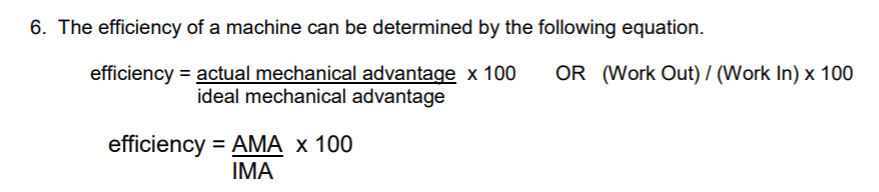
Efficiency. The efficiency of a machine is the ratio between the work it supplies and the work put into it.
Efficiency = AMA/IMA x 100
17
Fill in the Blank

Determine the efficiency based on the following diagram.
18
MA of Levers
A lever is a bar resting on a pivot. Force (effort) applied at one point is transmitted across the pivot (fulcrum) to another point which moves an object (load).

19
IMA of Levers
The ideal mechanical advantage (IMA) - ignoring internal friction - of a lever depends on the ratio of the length of the lever arm where the force is applied divided by the length of the lever are that lifts the load. The IMA of a lever can be less than or greater than 1 depending on the class of the lever. There are three classes of levers, depending on the relative positions of the effort is applied, load, and fulcrum.
20
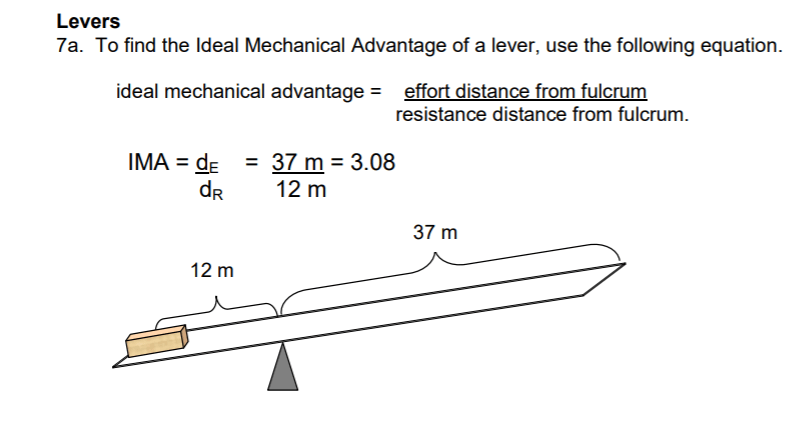
Calculating the IMA of a lever
*Determine the effort distance from the fulcrum
*Determine the resistance distance from the fulcrum
*Divide the Effort distance by the Resistance distance\
*IMA = dE/dR
21
Fill in the Blank

Determine the IMA for the following lever.
Remember IMA= dE/dR.
22
Fill in the Blank

Determine the IMA for the following lever.
Remember: IMA = dE / dR
23
AMA of levers
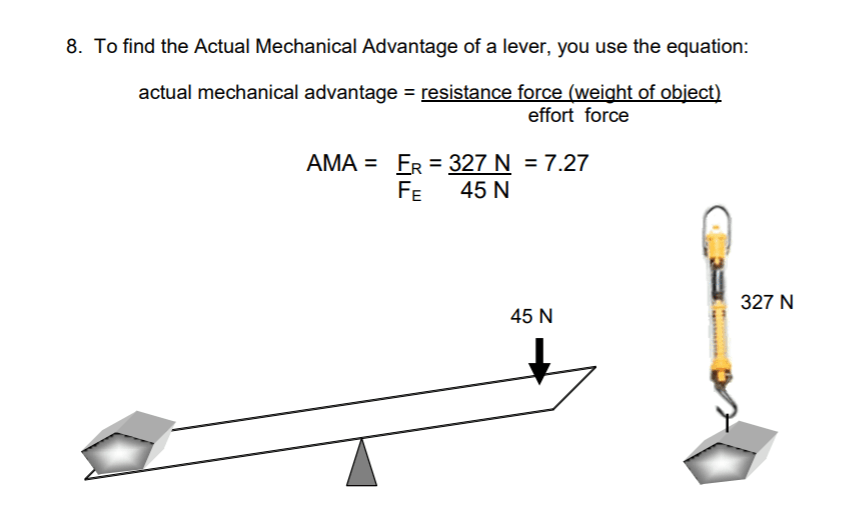
The differences between the three types of levers, is the location of the fulcrum to the input force and output force. Regardless of the type of lever, they all use the same equations to find AMA and IMA. The general formula for the actual mechanical advantage (AMA) of levers: AMAlever = Fo(output force) Fi (input force) also written as AMA = resistant force (weight of object) / effort force
24
Fill in the Blank

Find the AMA of the following lever.
Remember: Resistance force (weight of the object) / effort force
25
Fill in the Blank

Find the AMA of the following lever:
Remember: AMA= resistance force (weight of the object) / effort force
26
27
Efficiency of Levers
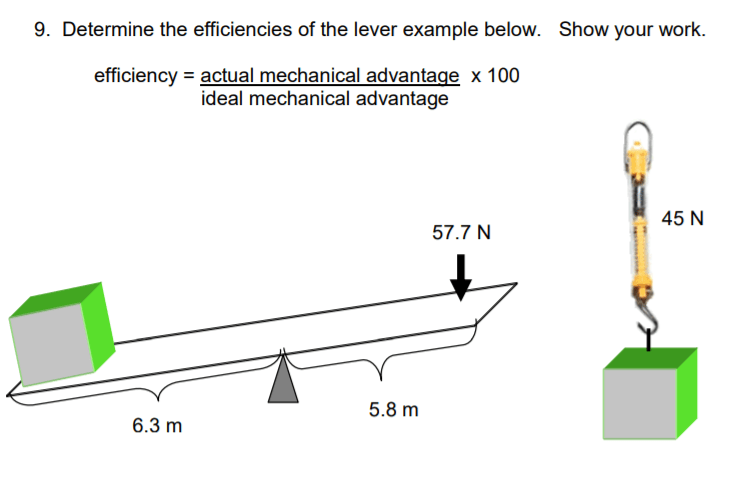
Find the AMA = Fo / Fi = 45N/57.7N= 0.78
Find the IMA = dE / dR = 5.8m/6.3m= 0.92
Efficiency = AMA/IMA x 100 = .078/0.92 x 100 =
28
Multiple Choice

Find the AMA = Fo / Fi = 45N/57.7N= 0.78
Find the IMA = dE / dR = 5.8m/6.3m= 0.92
Efficiency = AMA/IMA x 100 = .078/0.92 x 100 =
29
Mechanical Advantage of Pulleys
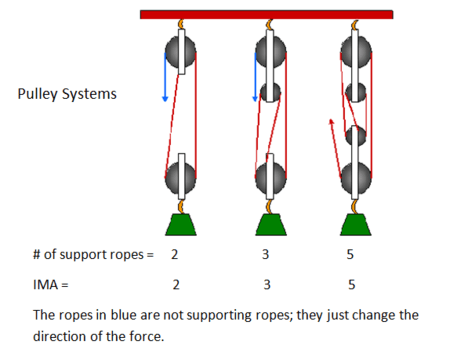
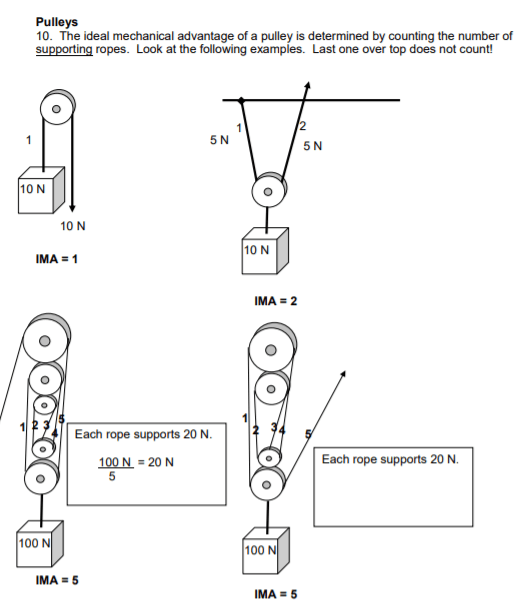
In a pulley, the ideal mechanical advantage is equal to the number of rope segments pulling up on the object. The more rope segments that are helping to do the lifting work, the less force that is needed for the job.
30
Mechanical Advantage of Pulleys
In a pulley, to find the amount of force each rope holds, divide the total force by the total number of support ropes.
31
Fill in the Blank

Determine the IMA of the following pulley.
32
Fill in the Blank

Determine the IMA of the following pulley.
33
Fill in the Blank

Determine the IMA of the following pulley.
34
Fill in the Blank

Determine the IMA of the following pulleys.
35
Fill in the Blank

Determine the amount of force on each rope. Remember the last rope over the top is not a supporting rope.
36
Fill in the Blank

Determine the amount of force on each rope. Remember the last rope over the top is not a supporting rope.
37
Wheel and Axle
Radius = 1/2 the length of the inside of the circle
Diameter = the whole length of the inside of the circle.

38
Fill in the Blank

What is the IMA of the wheel and axle? The Radius of the axle is 1.5. The radius of the wheel will be 1/2 of the diameter given.
39
Fill in the Blank

What is the IMA of the wheel and axle.
40
Work, Power and Machines AMA and IMA
I can understand work, input, output and simple machines.
Show answer
Auto Play
Slide 1 / 40
SLIDE


