Formation of our Solar System
Presentation
•
Science
•
6th - 9th Grade
•
Medium
+5
Standards-aligned
Jennifer LaSanta
Used 155+ times
FREE Resource
6 Slides • 14 Questions
1
Formation of our Solar System & Review
2
Multiple Choice
Which of the following is the correct order of the objects from largest to smallest?
sun, solar system, Milky Way, universe
universe, Milky Way, solar system, sun
Milky Way, sun, solar system, universe
solar system, universe, sun, Milky Way
3
Multiple Choice
If a star is 27 light years from Earth, when we look at it in the night sky we are actually seeing it ___________ _______ ago because it takes that long for the light to reach us.
27 minutes
27 days
27 years
27 times of playing Stairway to Heaven on repeat
4
Multiple Choice
Any object with mass has gravity.
True
Sometimes
False
Never
5
Multiple Choice
As distance between two objects increase the pull of gravity
Increases
Decreases
Stays the same
6
Multiple Choice
Two factors effecting the magnitude of the force of gravity between 2 objects are...
mass and distance
mass and matter
distance and weight
weight and mass
7
Multiple Choice
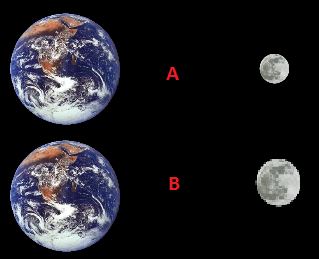
Which system has the greater gravitational attraction between the two objects (if any)?
System A
System B
Same gravitational attraction fro System A and System B
8
Multiple Choice
What is the period of rotation?
How long it takes a planet to orbit the sun
How fast a planet orbits the sun
How fast a planet spins
How elliptical a planet's orbit is
9
Multiple Choice
What is the period of revolution?
How long it takes a planet to orbit the sun
How long it takes a planet to spin around
How fast a planet spins
How elliptical a planet's orbit is
10
Multiple Choice
Kepler's 2nd Law states that a planet's velocity (speed and direction) is ____ when farther from the sun.
fastest
slowest
unchanged
the same
11
Multiple Choice
If a planet is closer to the sun, its orbit will be _____ than one farther away.
longer
slower
bigger
shorter
12
13
Multiple Choice
A person would weigh less on the moon than on the Earth because...
the moon has less mass, and therefore less gravity
the moon has more mass, and therefore less gravity
the moon has less mass, and therefore more gravity
the moon has more mass, and therefor more gravity
14
Multiple Choice
A person would weigh more on Jupiter than on the Earth because---
Jupiter has less mass, and therefore less gravity
Jupiter has more mass, and therefore less gravity.
Jupiter has less mass, and therefore more gravity.
Jupiter has more mass, and therefore more gravity
15
Multiple Choice
If Earth's mass was cut in half, what would happen to your mass?
increase because gravitational force increases
decrease because gravitational force decreases
decrease because gravitational force increases
nothing, mass is not affected by gravitational force
16
17
The Formation of Our Solar System
The Nebular Theory Steps:
The formation of our solar system began from a nebula.
A gravitational attraction among particles caused them to drift toward the center of the cloud.
As the cloud contracted (pulled in), it began to rotate (spin).
As more gas and dust were pulled toward the center of the cloud, it began to rotate faster and flattened into a disk.
18
The Formation of Our Solar System
The Nebular Theory Steps:
The formation of our solar system began from a nebula.
4. The core of the cloud became so dense that nuclear fusion began-and our Sun was born!
5. The remaining gas and dust combined together to form our planets and their moons.
Planetesimals are the beginning stages of making a planet.
19
The Solar System Today
Our Sun –
The heart of our solar system –
is a yellow dwarf star, a hot ball of Hydrogen & Helium.
Its gravity holds the solar system together, keeping everything from the biggest planets to the smallest particles of debris in its orbit.
20
Multiple Choice
OUR solar system formed from:
the solar meteoroids
the solar nebula
Formation of our Solar System & Review
Show answer
Auto Play
Slide 1 / 20
SLIDE

Similar Resources on Wayground
14 questions
The Basics of Electricity
Lesson
•
6th - 8th Grade
14 questions
Models of Elements, Compounds, and Mixtures
Lesson
•
6th - 8th Grade
16 questions
Earth’s Atmosphere
Lesson
•
6th - 8th Grade
17 questions
Experimental Variables
Lesson
•
6th - 8th Grade
17 questions
Plate Tectonics
Lesson
•
6th - 8th Grade
17 questions
Cell Organelles & Plant vs Animal Cells
Lesson
•
7th - 9th Grade
16 questions
Geologic Time
Lesson
•
6th - 9th Grade
15 questions
DNA Notes_Day1_2021
Lesson
•
6th - 8th Grade
Popular Resources on Wayground
8 questions
Spartan Way - Classroom Responsible
Quiz
•
9th - 12th Grade
15 questions
Fractions on a Number Line
Quiz
•
3rd Grade
14 questions
Boundaries & Healthy Relationships
Lesson
•
6th - 8th Grade
20 questions
Equivalent Fractions
Quiz
•
3rd Grade
3 questions
Integrity and Your Health
Lesson
•
6th - 8th Grade
25 questions
Multiplication Facts
Quiz
•
5th Grade
9 questions
FOREST Perception
Lesson
•
KG
20 questions
Main Idea and Details
Quiz
•
5th Grade
Discover more resources for Science
22 questions
Phases of the moon
Quiz
•
8th Grade
20 questions
Rocks and The Rock Cycle
Quiz
•
6th Grade
20 questions
Flow of Energy
Quiz
•
7th Grade
20 questions
Waves and Wave Properties
Quiz
•
6th - 8th Grade
8 questions
Amoeba Sister Asexual vs Sexual Reproduction
Interactive video
•
8th Grade
10 questions
Exploring the Rock Cycle: Types and Formation
Interactive video
•
6th - 8th Grade
16 questions
Photosynthesis and Cellular Respiration Review
Quiz
•
7th Grade
20 questions
8th Grade Science STAAR Review
Quiz
•
8th Grade