

Entropy of Phases and Physical Changes

Presentation
•
Chemistry
•
9th - 12th Grade
•
Practice Problem
•
Easy
Standards-aligned

Matthew Martino
Used 40+ times
FREE Resource
9 Slides • 5 Questions
1
Entropy of Physical Changes
Comparing the freedom of the particles

2
Multiple Choice
True or False?
The particles of a liquid have more freedom of movement than the particles of a solid.
True
False
3
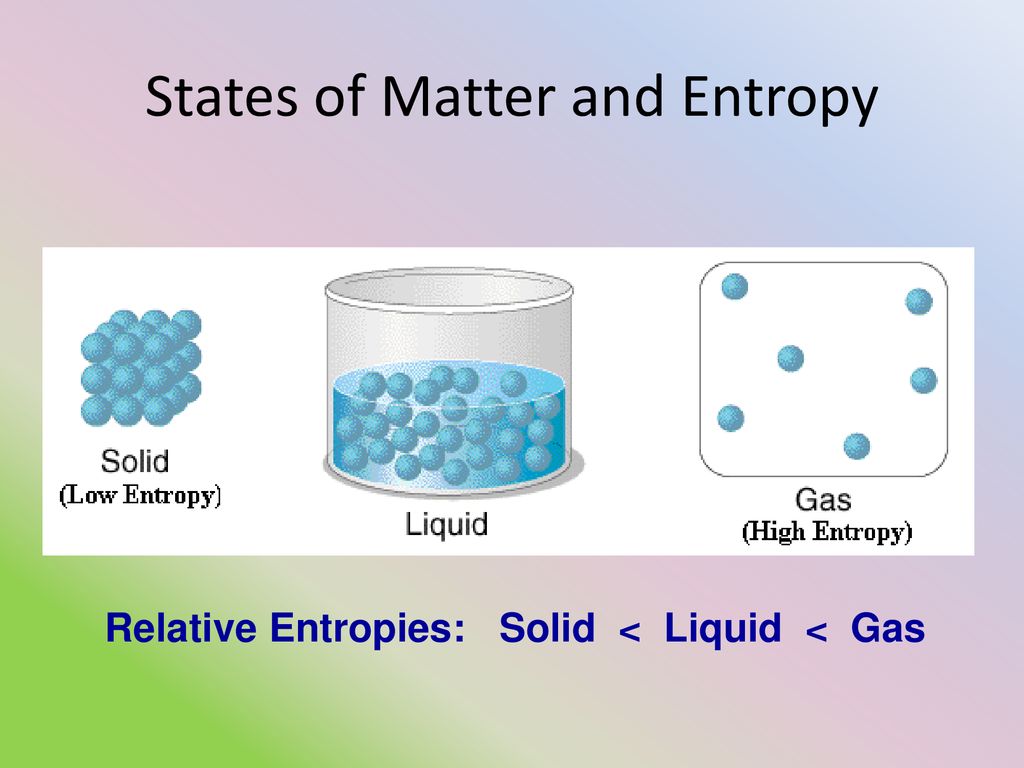
Particle Motion of the 3 States of Matter
Solids can only vibrate. They cannot flow. They hold their shape
Liquids can flow, but are still tightly packed.
Gases flow and have lots of freedom of motion. Fills the entire container and feels little attraction to other particles.

FYI: Terms "state" and "phase" are often used interchangeably
4
Entropy, S
The disorder, (randomness), of a system.
In chemistry, the amount of entropy is based on particle freedom.
IMPORTANT COMPARISONS
Solids < Liquids < Gases
Solids < Aqueous (dissolved)
Tie breaker can be # of moles if matter being compared is in same state
5
Multiple Choice

Which of the listed choices has the greatest (highest) entropy?
solid sodium
liquid mercury
liquid bromine
gaseous fluorine
6
Entropy Comparison question for formulas
Answer is choice 4
A sample of gas will have more randomness to its particle arrangement than liquid or solid.
What if question asked which had the least entropy?
Then, it would have been choice 1, the solid

7
Phase Changes
Since the states have different entropy levels, changes from one state to another either increases entropy or decreases entropy.
When heat is absorbed (ex: melting), entropy increases
When heat is released (ex: condensing), entropy decreases

8
Multiple Choice

Which of the listed phase changes results in an increase in entropy? (ΔS= +)
precipitation of iodine
condensation of methane
vaporization of bromine
freezing of water
9
Phase Change Question
Answer Choice 3 (vaporization)
It is the only phase change in which the arrangement of particles becomes less ordered
(i.e. more random, more dispersed)
(All other changes result in greater order, thus less entropy)

10
When a substance dissolves, the entropy of the system increases
Examples:
Dissolving salt in water
NaCl (s) --> Na+ (aq) + Cl- (aq)
or
dissolving solid sugar in water
C6H12O6 (s) --> C6H12O6 (aq)
aqueous > solid
in terms of entropy

11
Systems in nature tend toward lower energy and higher entropy
(It takes work to undo chaos)
Changes (chemical and physical) that result in greater entropy tend to be spontaneous.

12
Greater freedom of particle motion = greater entropy
13
Multiple Choice
Exit Question 1:
Which sample of water has the greatest entropy?
H2O (g)
H2O (s)
H2O (l)
14
Multiple Choice
Which phase change involves a decrease in entropy?
melting
(solid to liquid)
vaporizing
(liquid to gas)
freezing
(liquid to solid)
sublimation
(solid to gas)
Entropy of Physical Changes
Comparing the freedom of the particles
Show answer
Auto Play
Slide 1 / 14
SLIDE
Similar Resources on Wayground

10 questions
Adobe Photoshop Shortcut Keys
Lesson
•
9th - 12th Grade
10 questions
Computer Network
Lesson
•
9th - 12th Grade
10 questions
Graphing Linear Systems
Lesson
•
9th - 12th Grade
10 questions
Calculating heat of phase changes
Lesson
•
9th - 12th Grade
13 questions
Accuracy vs. Precision
Lesson
•
10th - 12th Grade
11 questions
The Atlantic Slave Trade
Lesson
•
9th - 12th Grade
11 questions
Revising & Editing
Lesson
•
9th - 12th Grade
10 questions
Karyotypes
Lesson
•
9th - 12th Grade
Popular Resources on Wayground
15 questions
Fractions on a Number Line

Quiz
•
3rd Grade
14 questions
Boundaries & Healthy Relationships
Lesson
•
6th - 8th Grade
13 questions
SMS Cafeteria Expectations Quiz
Quiz
•
6th - 8th Grade
20 questions
Equivalent Fractions
Quiz
•
3rd Grade
25 questions
Multiplication Facts
Quiz
•
5th Grade
12 questions
SMS Restroom Expectations Quiz
Quiz
•
6th - 8th Grade
20 questions
Main Idea and Details
Quiz
•
5th Grade
10 questions
Pi Day Trivia!
Quiz
•
6th - 9th Grade
Discover more resources for Chemistry
13 questions
Solubility Curves
Quiz
•
10th Grade
10 questions
Exploring Nuclear Fission and Fusion

Interactive video
•
6th - 10th Grade
5 questions
Exit Check 4.1 - Balancing Chemical Equations
Quiz
•
10th Grade
20 questions
Predicting Products
Quiz
•
9th - 12th Grade
8 questions
Labeling a Reaction
Quiz
•
9th - 12th Grade
92 questions
Chem Quarter 3 Review
Quiz
•
10th Grade
19 questions
Isotopes & Ions
Quiz
•
9th Grade
20 questions
Naming & Writing Chemical Formulas
Quiz
•
10th Grade