Relationships in Ecosystems Review
Presentation
•
Science
•
6th - 7th Grade
•
Practice Problem
•
Medium
+2
Standards-aligned
Maryanne Amenhar
Used 15+ times
FREE Resource
1 Slide • 19 Questions
1
Relationships in Ecosystems Review
2
Multiple Choice
How are changes in populations related to the availability of an ecosystem's resources?
Large populations need the same amount of resources as small populations.
As populations grow, ecosystems produce more resources in order to support the larger population.
Population sizes are limited by the amount of resources that are available.
Changes in population are independent of the availability of an ecosystem's resources.
3
Multiple Choice
Which of the following would most likely limit the number of mice in an ecosystem?
an increase in the amount of vegetation (food)
a decrease in the number of owls (predators)
a disease that infects baby mice
an increase in the amount of space available
4
Multiple Choice
All the different populations that live together in an area make up a(n)-
community
biome
ecosystem
biosphere
5
Multiple Choice
Which of the following is an example of an abiotic factor in an ecosystem?
roots
grass
birds
sunlight
6
Multiple Choice
What is the definition of abiotic?
non-living things in the ecosystem
producers
the place in an ecosystem where an organism lives
population
7
Multiple Choice
What is the definition of biotic?
living things in an ecosystem
nonliving things in an ecosystem
a characteristic that helps an organism survive and reproduce in its environment
squirrels
8
Multiple Choice
In this food web, which animals are in competition?
Hawks and coyotes
Squirrels and hawks
Antelopes and squirrels
Hawks and mountain lions
9
Multiple Choice
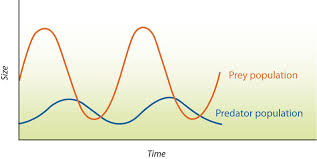
True or False: The population size of predators are equal to the population size of prey.
True
False
10
Multiple Choice
11
Multiple Choice
12
Multiple Choice
13
Multiple Choice
14
Multiple Choice
15
Multiple Choice
16
Multiple Choice
17
Multiple Choice
18
Multiple Choice
19
Multiple Choice
What is mutualism?
One organism benefits greatly and the other is not harmed
One organism benefits while the other is harmed
Close relationship where both organisms benefit
20
Multiple Choice
What is mutualism?
One organism benefits greatly and the other is not harmed
One organism benefits while the other is harmed
Close relationship where both organisms benefit
Relationships in Ecosystems Review
Show answer
Auto Play
Slide 1 / 20
SLIDE

Similar Resources on Wayground
15 questions
Change of Seasons
Lesson
•
6th - 8th Grade
15 questions
Moon Phases
Lesson
•
6th Grade
15 questions
Kinetic Theory of Matter
Lesson
•
6th - 8th Grade
15 questions
Energy Resources
Lesson
•
6th Grade
15 questions
Rocks and Minerals
Lesson
•
7th Grade
15 questions
Weight & Mass Review
Lesson
•
6th - 8th Grade
15 questions
Science Laboratory Safety
Lesson
•
6th - 8th Grade
15 questions
Solution, Colloid and Suspension
Lesson
•
6th Grade
Popular Resources on Wayground
8 questions
Spartan Way - Classroom Responsible
Quiz
•
9th - 12th Grade
15 questions
Fractions on a Number Line
Quiz
•
3rd Grade
14 questions
Boundaries & Healthy Relationships
Lesson
•
6th - 8th Grade
20 questions
Equivalent Fractions
Quiz
•
3rd Grade
3 questions
Integrity and Your Health
Lesson
•
6th - 8th Grade
25 questions
Multiplication Facts
Quiz
•
5th Grade
9 questions
FOREST Perception
Lesson
•
KG
20 questions
Main Idea and Details
Quiz
•
5th Grade
Discover more resources for Science
20 questions
Rocks and The Rock Cycle
Quiz
•
6th Grade
20 questions
Flow of Energy
Quiz
•
7th Grade
20 questions
Waves and Wave Properties
Quiz
•
6th - 8th Grade
10 questions
Exploring the Rock Cycle: Types and Formation
Interactive video
•
6th - 8th Grade
16 questions
Photosynthesis and Cellular Respiration Review
Quiz
•
7th Grade
15 questions
Punnett Squares
Quiz
•
6th Grade
25 questions
Cell Structure
Lesson
•
7th Grade
5 questions
Natural Selection
Interactive video
•
7th Grade