
IB Biology: B3.3-Intercostal Muscles as Antagonistic Muscles

Flashcard
•
Biology
•
9th - 12th Grade
•
Hard

Herbert Asiedu-Mante
FREE Resource
Student preview

7 questions
Show all answers
1.
FLASHCARD QUESTION
Front
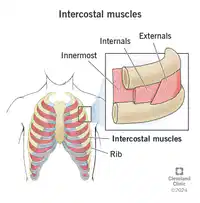
What are intercostal muscles?
Back
Intercostal muscles are the paired muscle sheets found between the ribs, made up of the external and internal intercostal muscles.

2.
FLASHCARD QUESTION
Front
Where do intercostal muscles originate and insert?
Back
Intercostal muscles use the ribs as their origin and insertion points.
3.
FLASHCARD QUESTION
Front
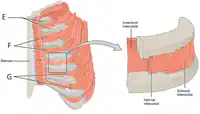
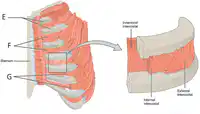
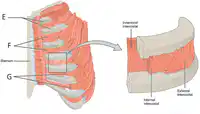
How do the external and internal intercostal muscles lie in relation to each other?
Back
The external and internal intercostal muscles lie at angles opposite each other.
4.
FLASHCARD QUESTION
Front
What happens when the external intercostal muscles contract?
Back
Contraction of the external intercostal muscles pulls the ribs and the ribcage upwards and outwards, increasing the volume of the chest during breathing in.

5.
FLASHCARD QUESTION
Front
What happens when the internal intercostal muscles contract?
Back
Contraction of the internal intercostal muscles pulls the ribs and the ribcage downwards and inwards, decreasing the volume of the chest during breathing out.

6.
FLASHCARD QUESTION
Front
Why don't both intercostal muscles contract at the same time?
Back
Both muscles are antagonistic, so they do not contract at the same time. When the external intercostal muscles contract, the internal ones relax and vice versa.
7.
FLASHCARD QUESTION
Front
What is the role of titin fibres in intercostal muscle contraction?
Back
Contraction of the external intercostal muscles stretches the internal intercostal muscles and the titin fibres, creating potential energy for the next contraction.

Access all questions and much more by creating a free account
Create resources
Host any resource
Get auto-graded reports

Continue with Google

Continue with Email

Continue with Classlink

Continue with Clever
or continue with

Microsoft
%20(1).png)
Apple

Others
Already have an account?


