
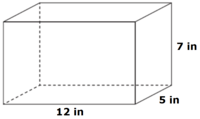
Surface Area of Prisms

Flashcard
•
Mathematics
•
8th Grade
•
Practice Problem
•
Hard
+4
Standards-aligned

Wayground Content
FREE Resource
Student preview

15 questions
Show all answers
1.
FLASHCARD QUESTION
Front
What is the formula for the lateral surface area of a prism?
Back
The lateral surface area (LSA) of a prism is calculated using the formula: LSA = Perimeter of the base × Height.
Tags
CCSS.7.G.B.6
2.
FLASHCARD QUESTION
Front
What does the 'B' represent in the total surface area formula of a prism?
Back
In the formula for total surface area of a prism, 'B' stands for the area of the base.
Tags
CCSS.7.G.B.6
3.
FLASHCARD QUESTION
Front
How do you calculate the area of a triangular base?
Back
Tags
CCSS.6.G.A.1
4.
FLASHCARD QUESTION
Front
What is the total surface area of a prism?
Back
The total surface area (TSA) of a prism is the sum of the lateral surface area and the areas of the two bases: TSA = LSA + 2B.
Tags
CCSS.7.G.B.6
5.
FLASHCARD QUESTION
Front
What is the height of a prism?
Back
The height of a prism is the perpendicular distance between the two bases.
Tags
CCSS.1.G.A.1
CCSS.2.G.A.1
6.
FLASHCARD QUESTION
Front
What is the perimeter of a base?
Back
The perimeter of a base is the total length around the base shape, calculated by adding the lengths of all its sides.
Tags
CCSS.3.MD.D.8
7.
FLASHCARD QUESTION
Front
How do you find the lateral surface area of a rectangular prism?
Back
For a rectangular prism, the lateral surface area can be calculated using the formula: LSA = 2 × Height × (Length + Width).
Tags
CCSS.7.G.B.6
Access all questions and much more by creating a free account
Create resources
Host any resource
Get auto-graded reports

Continue with Google

Continue with Email

Continue with Classlink

Continue with Clever
or continue with

Microsoft
%20(1).png)
Apple

Others
Already have an account?



