
Intra- and Intermolecular Forces Short

Flashcard
•
Chemistry
•
10th Grade
•
Practice Problem
•
Hard

Wayground Content
FREE Resource
Student preview

15 questions
Show all answers
1.
FLASHCARD QUESTION
Front
What is hydrogen bonding?
Back
A strong type of dipole-dipole attraction that occurs between molecules containing hydrogen bonded to highly electronegative atoms like nitrogen, oxygen, or fluorine.
2.
FLASHCARD QUESTION
Front
Define dipole-dipole forces.
Back
Intermolecular forces that occur between polar molecules, where positive and negative ends attract each other.
3.
FLASHCARD QUESTION
Front
What are London dispersion forces?
Back
Weak intermolecular forces arising from temporary dipoles in molecules, present in all molecules but more significant in nonpolar ones.
4.
FLASHCARD QUESTION
Front
How do intermolecular forces affect boiling points?
Back
The weaker the intermolecular forces, the lower the boiling point of the substance.
5.
FLASHCARD QUESTION
Front
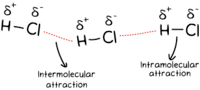
What is the difference between intramolecular and intermolecular forces?
Back
Intramolecular forces are the forces within a molecule (like covalent bonds), while intermolecular forces are the forces between molecules.
6.
FLASHCARD QUESTION
Front
Rank the following in order of strength: covalent bond, hydrogen bond, dipole-dipole attraction, London forces.
Back
Covalent bond > Hydrogen bond > Dipole-dipole attraction > London forces.
7.
FLASHCARD QUESTION
Front
What is a polar molecule?
Back
A molecule that has a net dipole moment due to the presence of polar bonds, resulting in a positive and negative end.
Access all questions and much more by creating a free account
Create resources
Host any resource
Get auto-graded reports

Continue with Google

Continue with Email

Continue with Classlink

Continue with Clever
or continue with

Microsoft
%20(1).png)
Apple

Others
Already have an account?



