
Sequences and Exponential Functions Flashcard

Flashcard
•
Mathematics
•
12th Grade
•
Practice Problem
•
Hard
+1
Standards-aligned

Wayground Content
Used 1+ times
FREE Resource
Student preview

15 questions
Show all answers
1.
FLASHCARD QUESTION
Front
Define an arithmetic sequence.
Back
An arithmetic sequence is a sequence of numbers in which the difference between consecutive terms is constant. This difference is called the common difference (d). For example, in the sequence 3, 6, 9, 12, the common difference is 3.
Tags
CCSS.HSF.BF.A.2
2.
FLASHCARD QUESTION
Front
What is the formula for the nth term of an arithmetic sequence?
Back
The nth term (a_n) of an arithmetic sequence can be calculated using the formula: a_n = a_1 + (n - 1)d, where a_1 is the first term and d is the common difference.
Tags
CCSS.HSF.BF.A.2
3.
FLASHCARD QUESTION
Front
Identify the common difference in the arithmetic sequence 5, 10, 15, 20.
Back
The common difference (d) in the sequence is 5, as each term increases by 5.
Tags
CCSS.HSF.BF.A.2
4.
FLASHCARD QUESTION
Front
What is an exponential function?
Back
An exponential function is a mathematical function of the form f(x) = a * b^x, where a is a constant, b is a positive real number, and x is the exponent. The base b determines the growth or decay rate.
5.
FLASHCARD QUESTION
Front
What is the difference between exponential growth and exponential decay?
Back
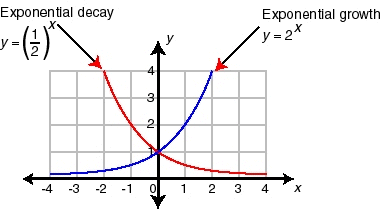
Exponential growth occurs when the base (b) of the exponential function is greater than 1 (e.g., f(x) = 2^x), leading to rapid increase. Exponential decay occurs when the base (b) is between 0 and 1 (e.g., f(x) = 0.5^x), leading to rapid decrease.
Tags
CCSS.HSF-IF.C.8B
6.
FLASHCARD QUESTION
Front
How do you find the sum of the first n terms of an arithmetic sequence?
Back
The sum (S_n) of the first n terms of an arithmetic sequence can be calculated using the formula: S_n = n/2 * (a_1 + a_n), where a_n is the nth term.
7.
FLASHCARD QUESTION
Front
What is a geometric sequence?
Back
A geometric sequence is a sequence of numbers where each term after the first is found by multiplying the previous term by a fixed, non-zero number called the common ratio (r). For example, in the sequence 2, 6, 18, 54, the common ratio is 3.
Tags
CCSS.HSF.BF.A.2
Access all questions and much more by creating a free account
Create resources
Host any resource
Get auto-graded reports

Continue with Google

Continue with Email

Continue with Classlink

Continue with Clever
or continue with

Microsoft
%20(1).png)
Apple

Others
Already have an account?
Similar Resources on Wayground

15 questions
Transformasi Fungsi
Flashcard
•
12th Grade
10 questions
Smart Online Shopper
Flashcard
•
KG - University
12 questions
Legal Writing Memo Flashcard
Flashcard
•
KG - University
9 questions
Special Places
Flashcard
•
KG - University
14 questions
CADEIA ALIMENTAR
Flashcard
•
KG
11 questions
Analizing Essay Titles
Flashcard
•
University
10 questions
I Wandered Lonely As A Cloud By William Wordsworth
Flashcard
•
12th Grade
Popular Resources on Wayground
15 questions
Fractions on a Number Line

Quiz
•
3rd Grade
20 questions
Equivalent Fractions
Quiz
•
3rd Grade
25 questions
Multiplication Facts
Quiz
•
5th Grade
29 questions
Alg. 1 Section 5.1 Coordinate Plane
Quiz
•
9th Grade
22 questions
fractions
Quiz
•
3rd Grade
11 questions
FOREST Effective communication

Lesson
•
KG
20 questions
Main Idea and Details
Quiz
•
5th Grade
20 questions
Context Clues
Quiz
•
6th Grade
Discover more resources for Mathematics
20 questions
SSS/SAS
Quiz
•
9th - 12th Grade
14 questions
Making Inferences From Samples
Quiz
•
7th - 12th Grade
23 questions
CCG - CH8 Polygon angles and area Review
Quiz
•
9th - 12th Grade
20 questions
Domain and Range Spiral Review
Quiz
•
9th - 12th Grade
10 questions
Dividing a polynomial by a monomial
Quiz
•
10th - 12th Grade
16 questions
Explore Triangle Congruence Theorems
Quiz
•
9th - 12th Grade
17 questions
Interpreting Graphs Of Functions
Quiz
•
8th - 12th Grade
15 questions
Explore Exponential Functions and Their Applications
Quiz
•
9th - 12th Grade