
- Resource Library
- Math
- Probability And Statistics
- Relative Frequency
- Understanding Frequency And Relative Frequency
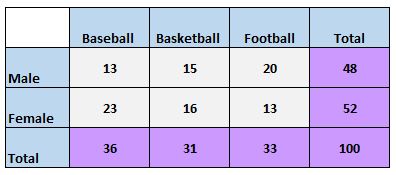
Understanding Frequency and Relative Frequency

Flashcard
•
Mathematics
•
9th - 12th Grade
•
Practice Problem
•
Hard
+4
Standards-aligned

Wayground Content
FREE Resource
Student preview

15 questions
Show all answers
1.
FLASHCARD QUESTION
Front
What is frequency in statistics?
Back
Frequency refers to the number of times a particular value or category occurs in a dataset.
Tags
CCSS.6.SP.B.5A
2.
FLASHCARD QUESTION
Front
What is relative frequency?
Back
Relative frequency is the ratio of the frequency of a particular value to the total number of observations, often expressed as a percentage.
Tags
CCSS.8.SP.A.4
3.
FLASHCARD QUESTION
Front
How do you calculate relative frequency?
Back
Relative frequency = (Frequency of the category / Total number of observations) x 100%.
Tags
CCSS.8.SP.A.4
4.
FLASHCARD QUESTION
Front
What does a frequency table represent?
Back
A frequency table organizes data to show how often each value or category occurs.
5.
FLASHCARD QUESTION
Front
What is the purpose of using percentages in data representation?
Back
Percentages help to compare different categories on a common scale, making it easier to understand proportions.
6.
FLASHCARD QUESTION
Front
If 15 out of 100 students prefer math, what is the relative frequency of students who prefer math?
Back
Relative frequency = (15/100) x 100% = 15%.
Tags
CCSS.7.SP.A.2
7.
FLASHCARD QUESTION
Front
What is the significance of the term 'marginal' in data analysis?
Back
'Marginal' refers to the additional or extra data points that provide insight into a specific category or outcome.
Tags
CCSS.8.SP.A.4
Access all questions and much more by creating a free account
Create resources
Host any resource
Get auto-graded reports

Continue with Google

Continue with Email

Continue with Classlink

Continue with Clever
or continue with

Microsoft
%20(1).png)
Apple

Others
Already have an account?



