
2.6 Solving Absolute Value Inequalities

Flashcard
•
Mathematics
•
8th - 10th Grade
•
Practice Problem
•
Hard

Wayground Content
FREE Resource
Student preview

15 questions
Show all answers
1.
FLASHCARD QUESTION
Front
What is an absolute value inequality?
Back
An absolute value inequality is an inequality that contains an absolute value expression, which measures the distance of a number from zero on the number line.
2.
FLASHCARD QUESTION
Front
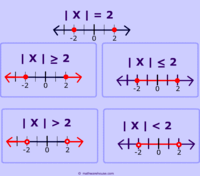
How do you solve the inequality |x| < a?
Back
To solve |x| < a, split it into two inequalities: -a < x < a.
3.
FLASHCARD QUESTION
Front
How do you solve the inequality |x| > a?
Back
To solve |x| > a, split it into two inequalities: x < -a or x > a.
4.
FLASHCARD QUESTION
Front
What does the solution |x| ≤ 3.5 represent?
Back
The solution -3.5 ≤ x ≤ 3.5 represents all values of x that are within 3.5 units from zero.
5.
FLASHCARD QUESTION
Front
What does the solution |3c - 5| < -2 indicate?
Back
The solution indicates 'No Solution' because absolute values cannot be negative.
6.
FLASHCARD QUESTION
Front
What is the first step in solving the inequality 3|d + 1| - 7 ≥ -1?
Back
The first step is to isolate the absolute value expression: 3|d + 1| ≥ 6.
7.
FLASHCARD QUESTION
Front
What is the significance of the 'or' in the solution d ≤ -3 or d ≥ 1?
Back
The 'or' indicates that either condition can satisfy the inequality, meaning both ranges are valid solutions.
Access all questions and much more by creating a free account
Create resources
Host any resource
Get auto-graded reports

Continue with Google

Continue with Email

Continue with Classlink

Continue with Clever
or continue with

Microsoft
%20(1).png)
Apple

Others
Already have an account?



