
Cell Membrane and Cell Transport

Flashcard
•
Biology
•
9th - 10th Grade
•
Practice Problem
•
Hard

Wayground Content
FREE Resource
Student preview

15 questions
Show all answers
1.
FLASHCARD QUESTION
Front
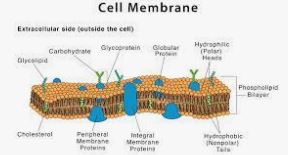
What is the structure of a phospholipid?
Back
A phospholipid consists of a hydrophilic (water-attracting) 'head' and two hydrophobic (water-repelling) 'tails'. This structure allows phospholipids to form bilayers in cell membranes.
2.
FLASHCARD QUESTION
Front
What does hydrophilic mean?
Back
Hydrophilic refers to substances that are attracted to water and can interact with it, such as the 'head' of a phospholipid.
3.
FLASHCARD QUESTION
Front
What does hydrophobic mean?
Back
Hydrophobic refers to substances that repel water and do not mix with it, such as the 'tails' of a phospholipid.
4.
FLASHCARD QUESTION
Front
What is the primary function of the cell membrane?
Back
The cell membrane regulates what enters and exits the cell, providing protection and structural support.
5.
FLASHCARD QUESTION
Front
What is active transport?
Back
Active transport is the process of moving molecules across a cell membrane from an area of lower concentration to an area of higher concentration, requiring energy (ATP).
6.
FLASHCARD QUESTION
Front
What is passive transport?
Back
Passive transport is the movement of molecules across a cell membrane without the use of energy, typically moving from high to low concentration.
7.
FLASHCARD QUESTION
Front
What role does ATP play in cellular processes?
Back
ATP (Adenosine Triphosphate) serves as the primary energy carrier in cells, providing energy for various cellular functions, including active transport.
Access all questions and much more by creating a free account
Create resources
Host any resource
Get auto-graded reports

Continue with Google

Continue with Email

Continue with Classlink

Continue with Clever
or continue with

Microsoft
%20(1).png)
Apple

Others
Already have an account?


