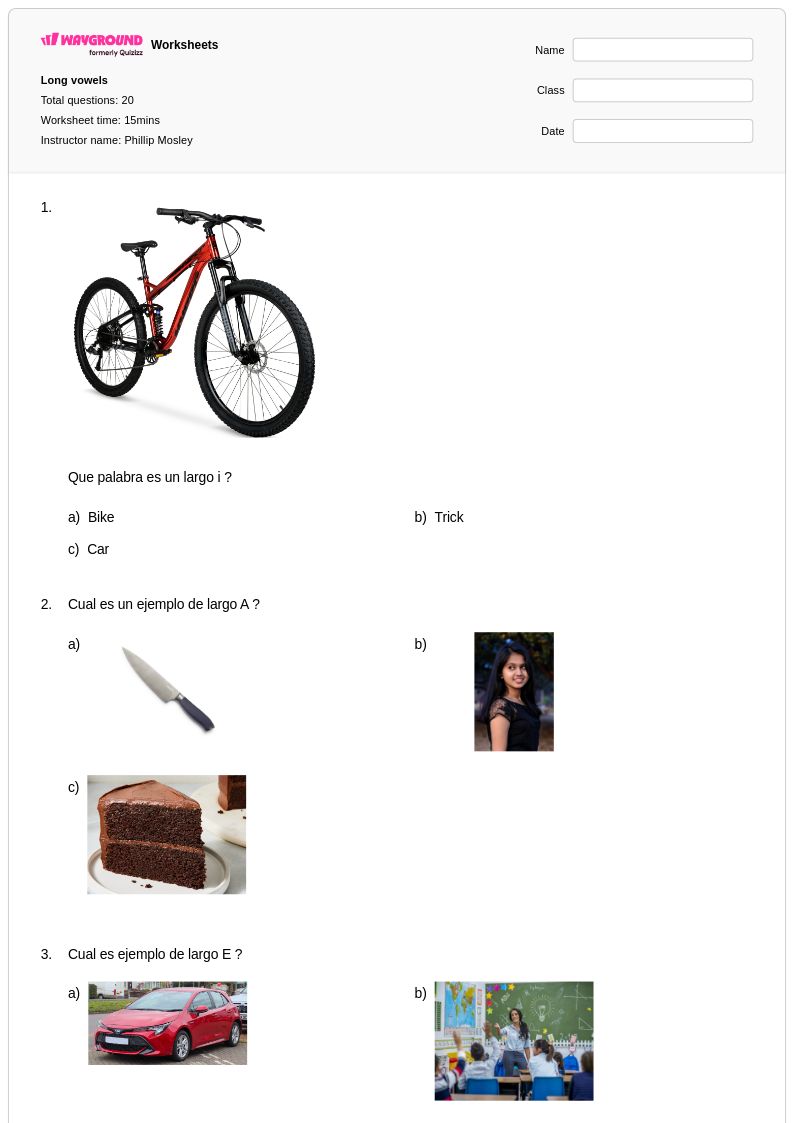
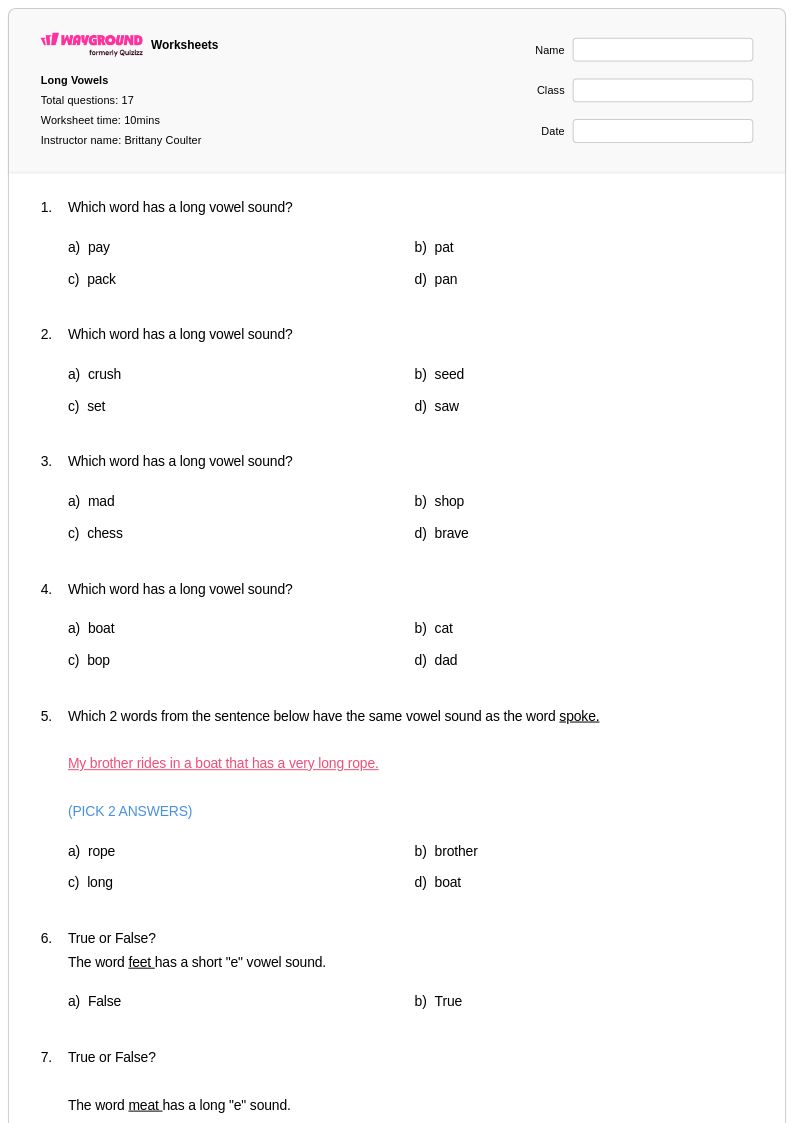
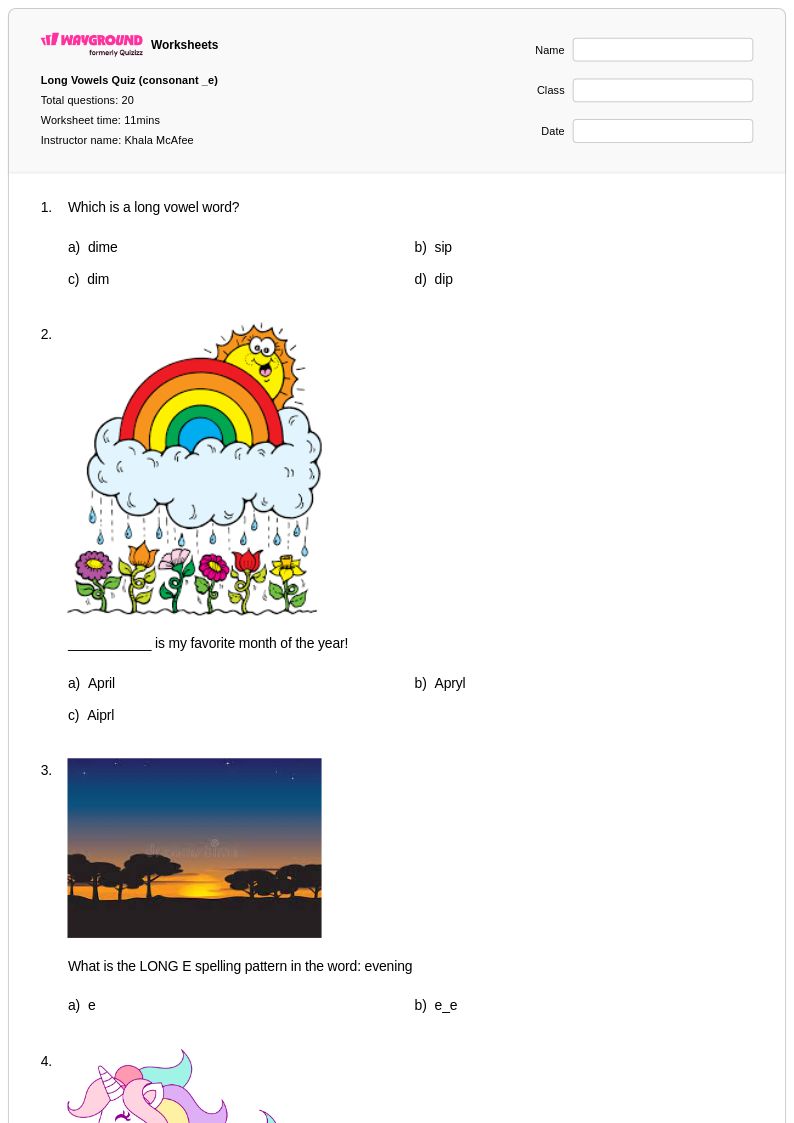
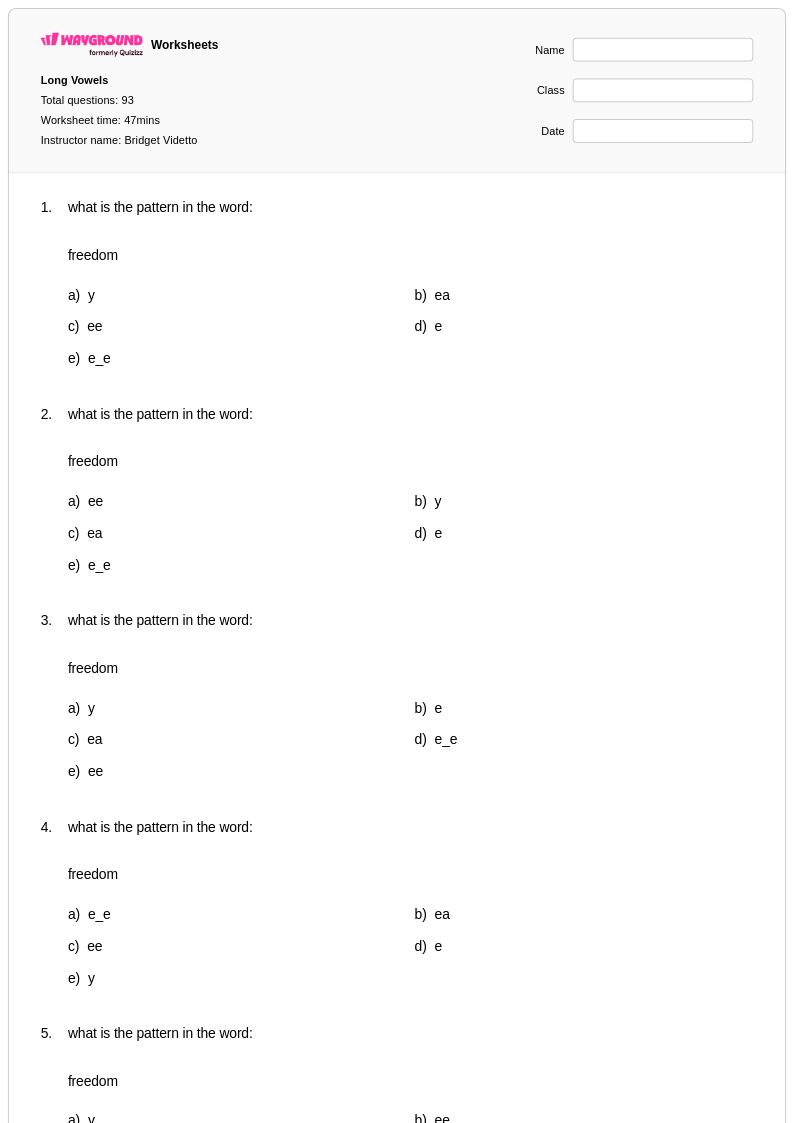
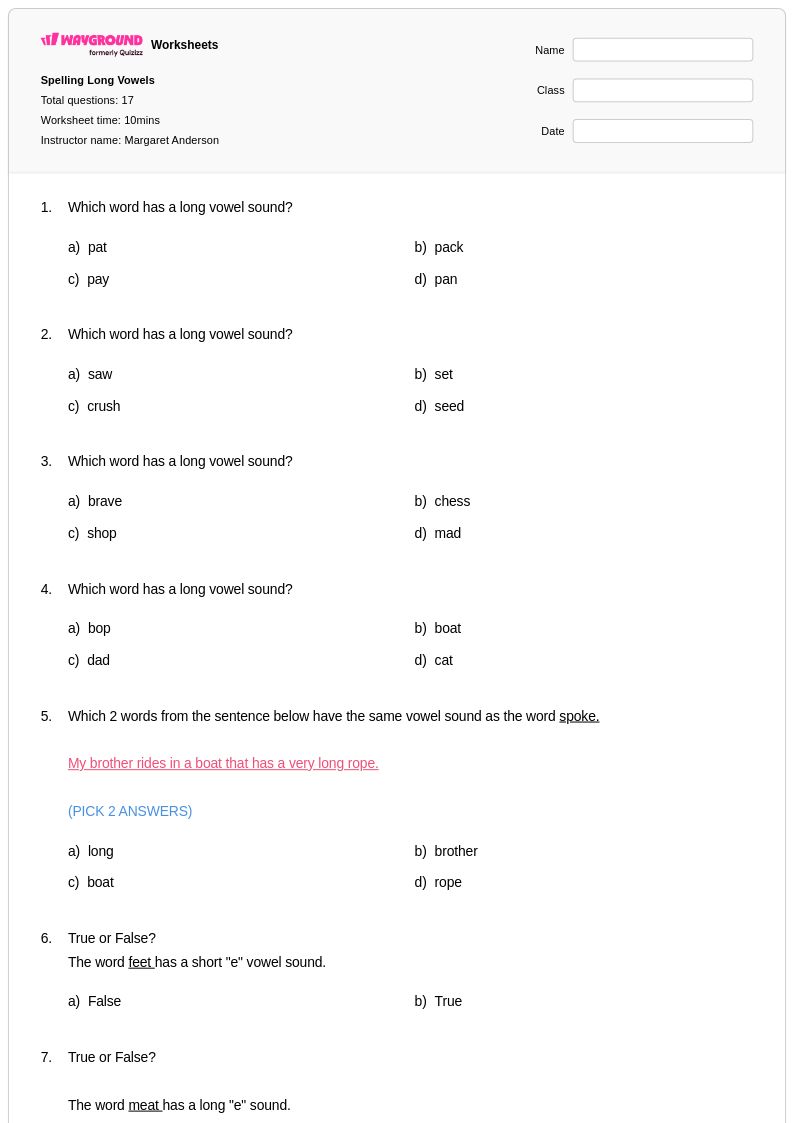
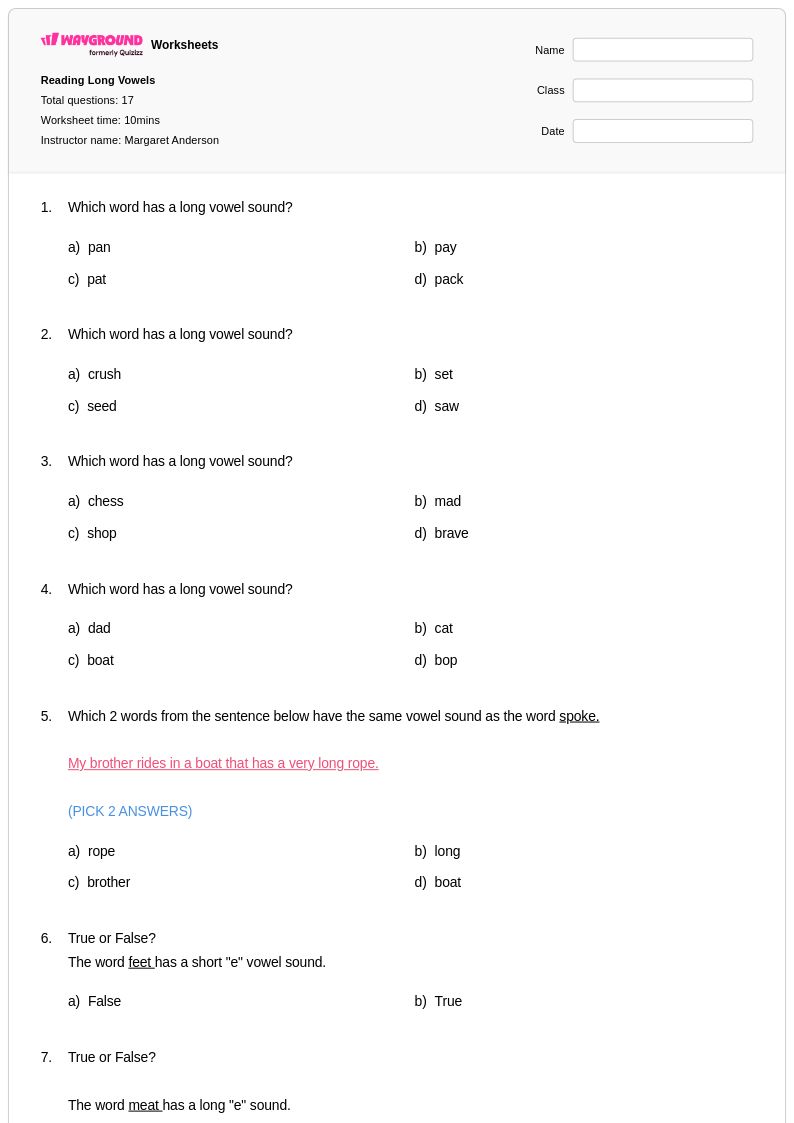
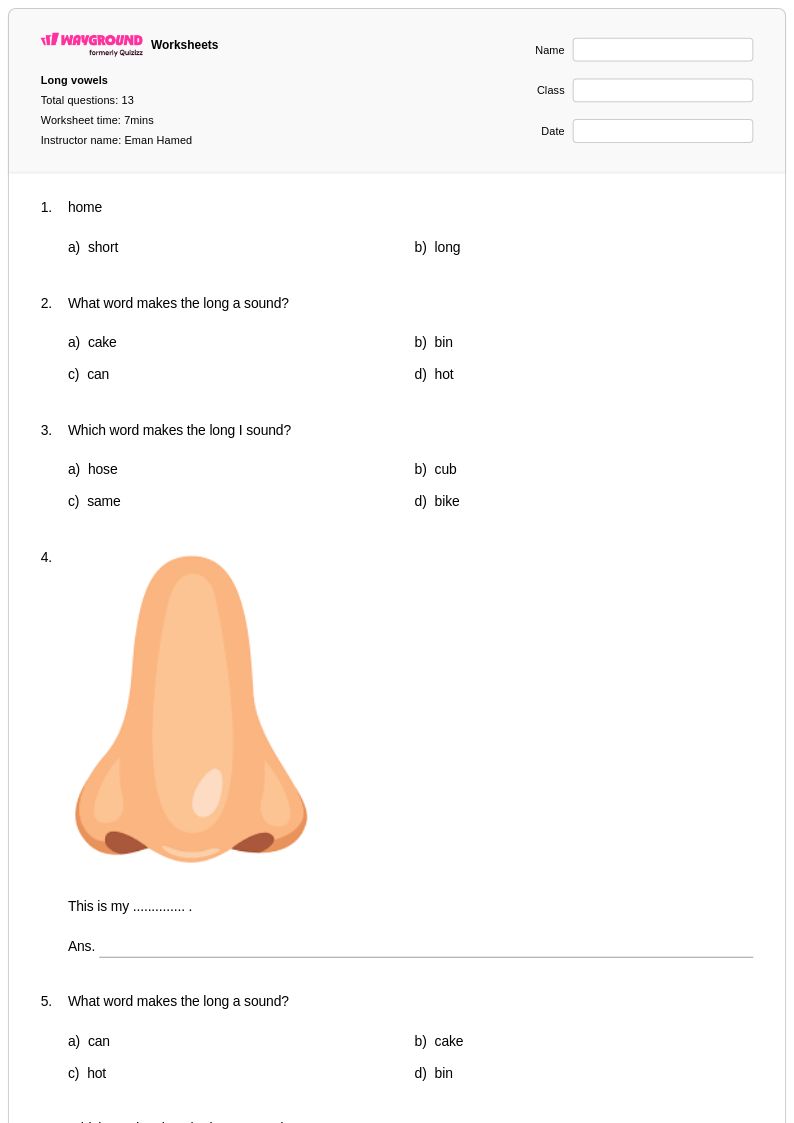
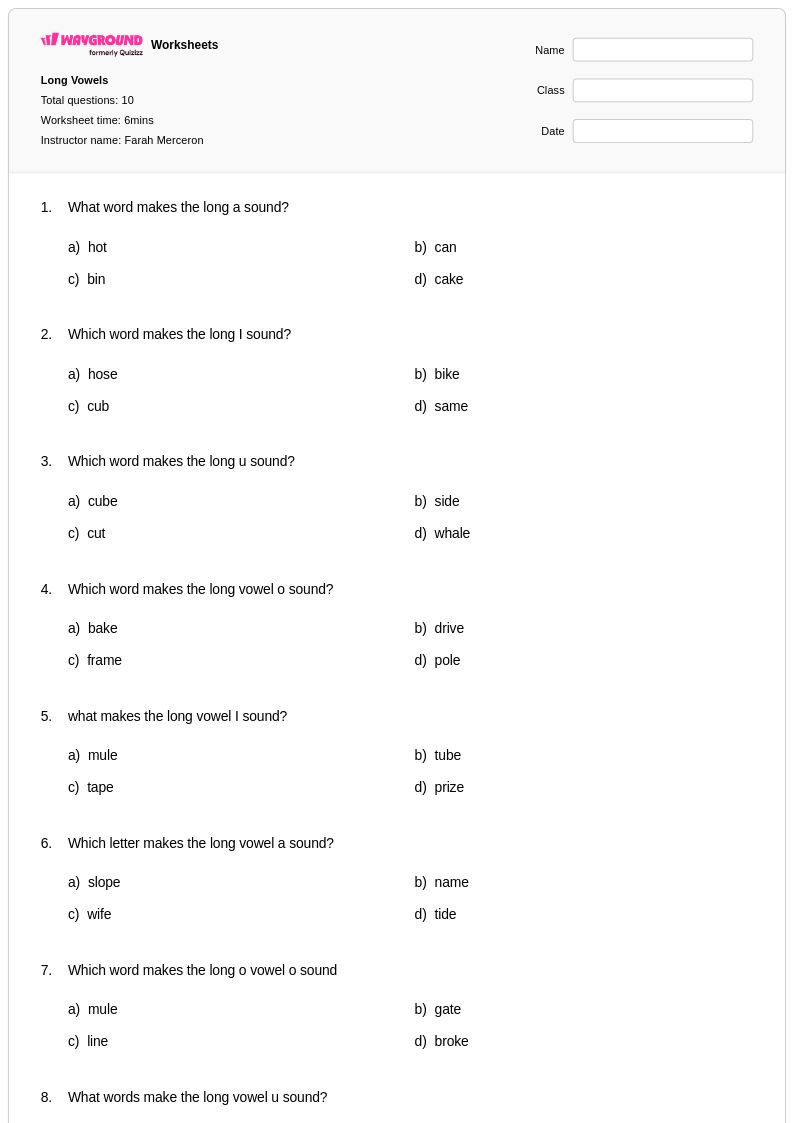
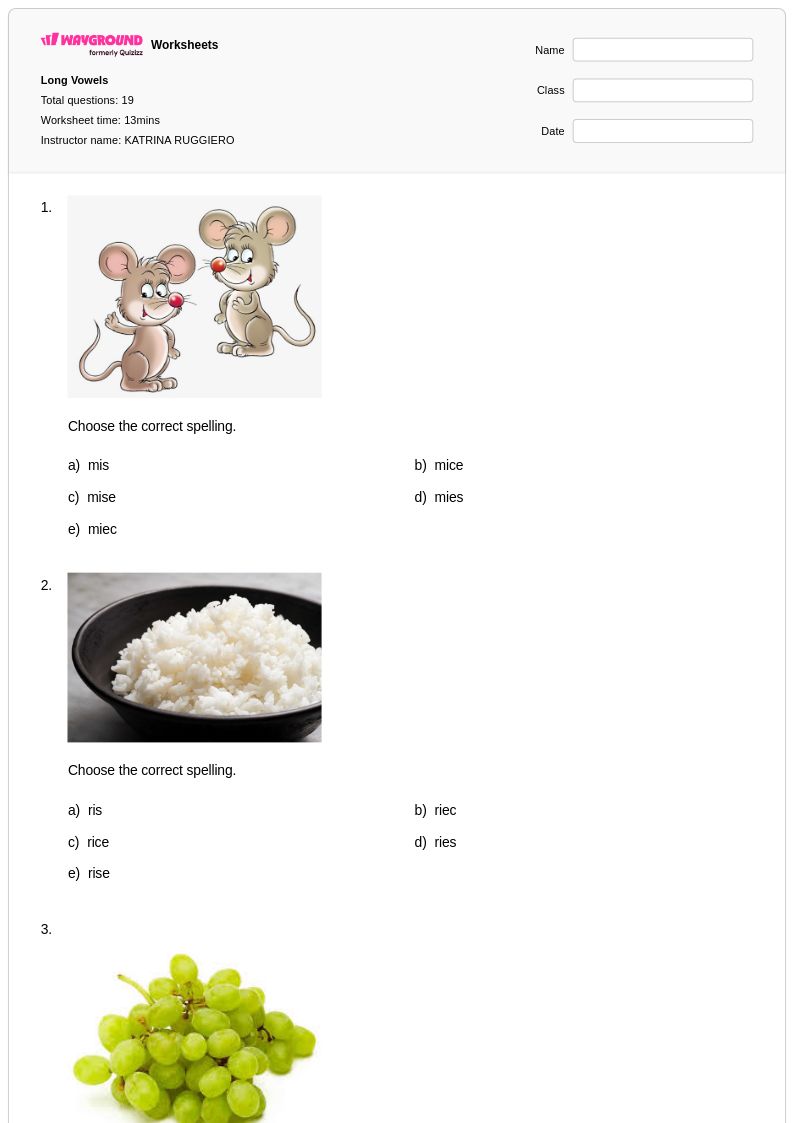
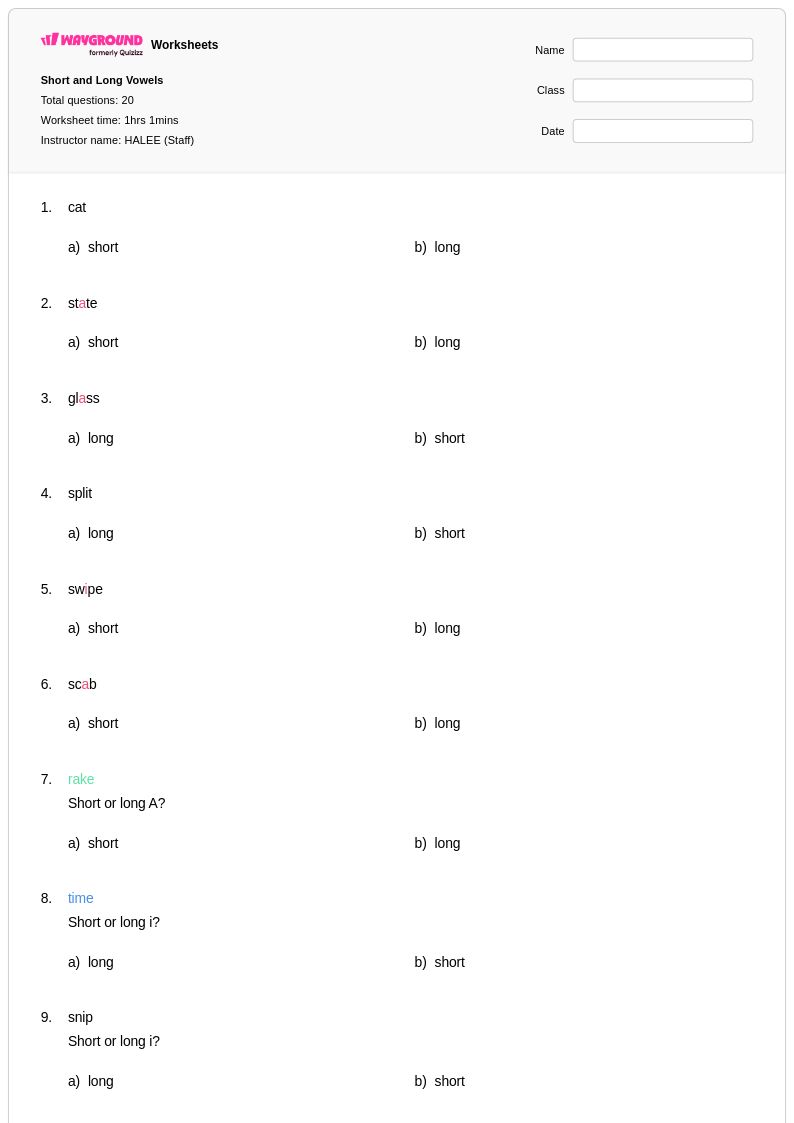
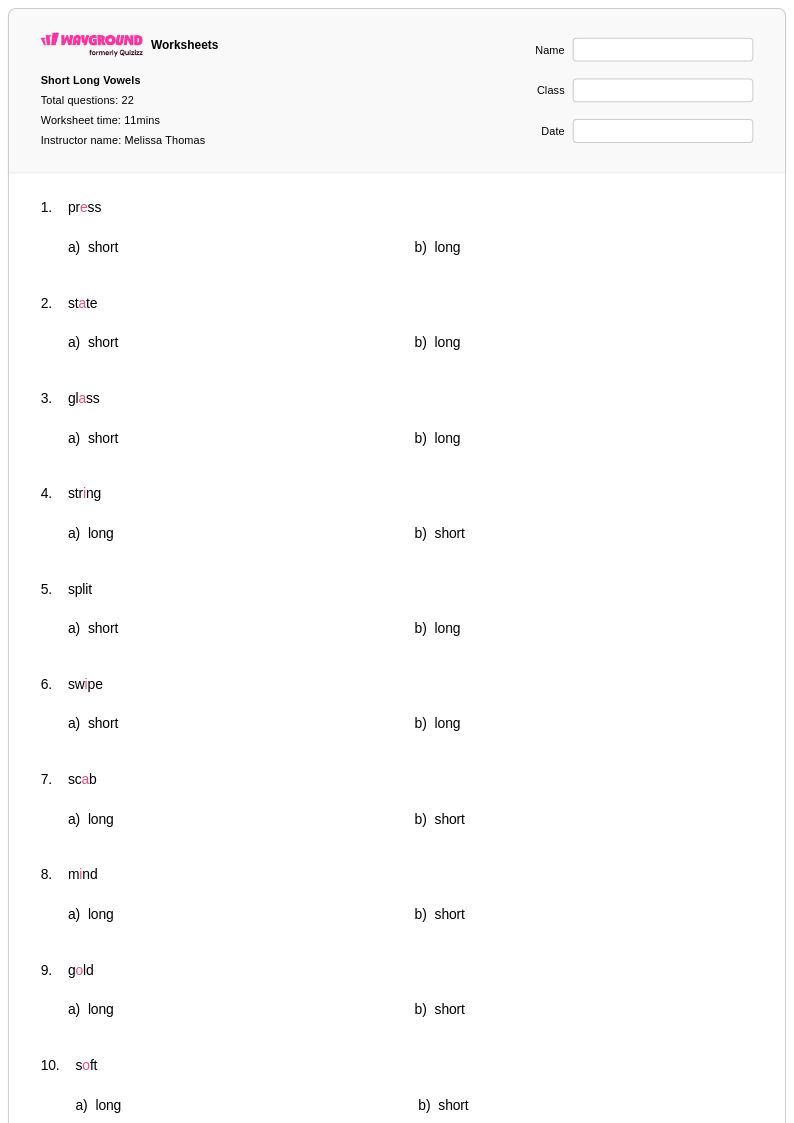
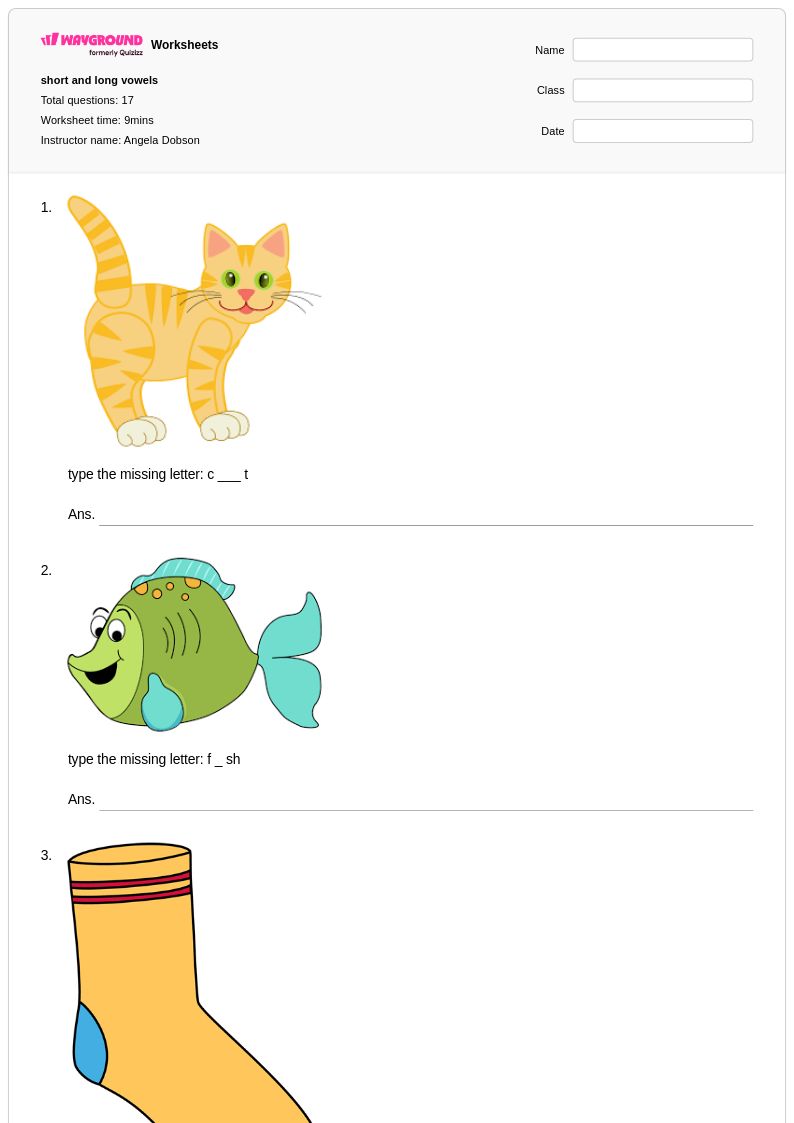
Explore Wayground's free Class 2 long vowels worksheets with printable PDFs, practice problems, and answer keys to help students master vowel sounds and improve their reading skills.
Explore printable Long Vowels worksheets for Class 2
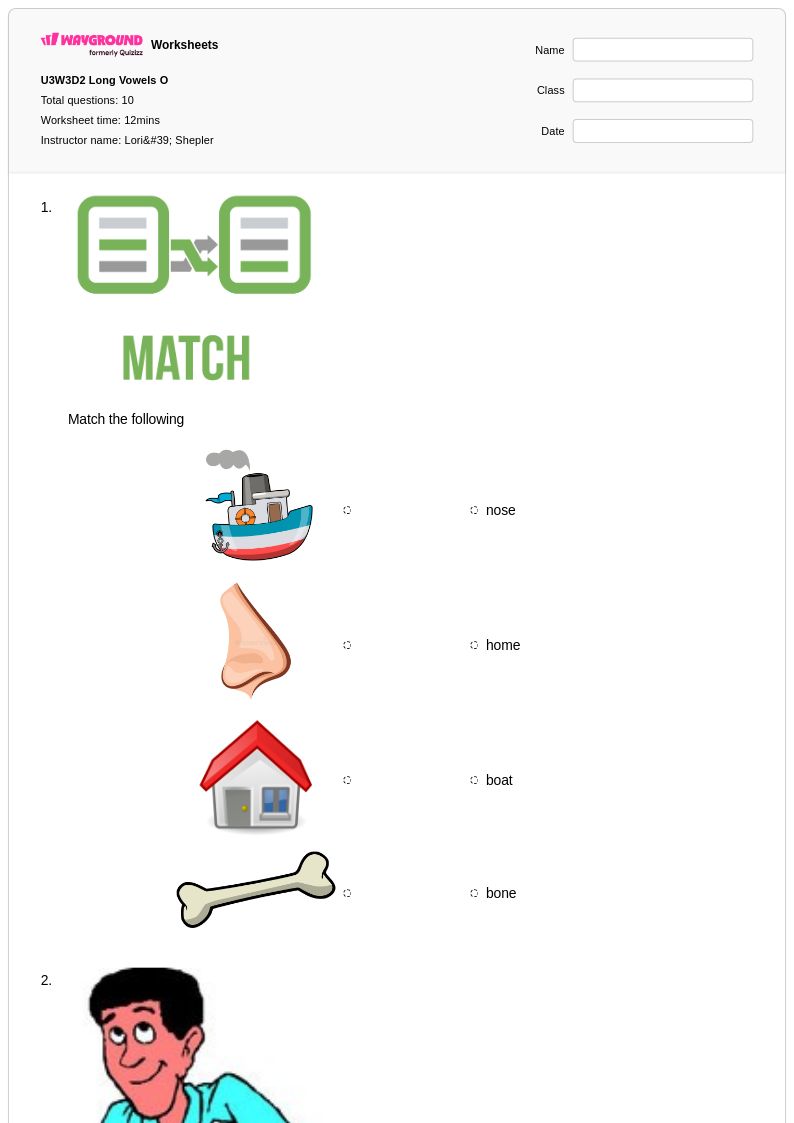
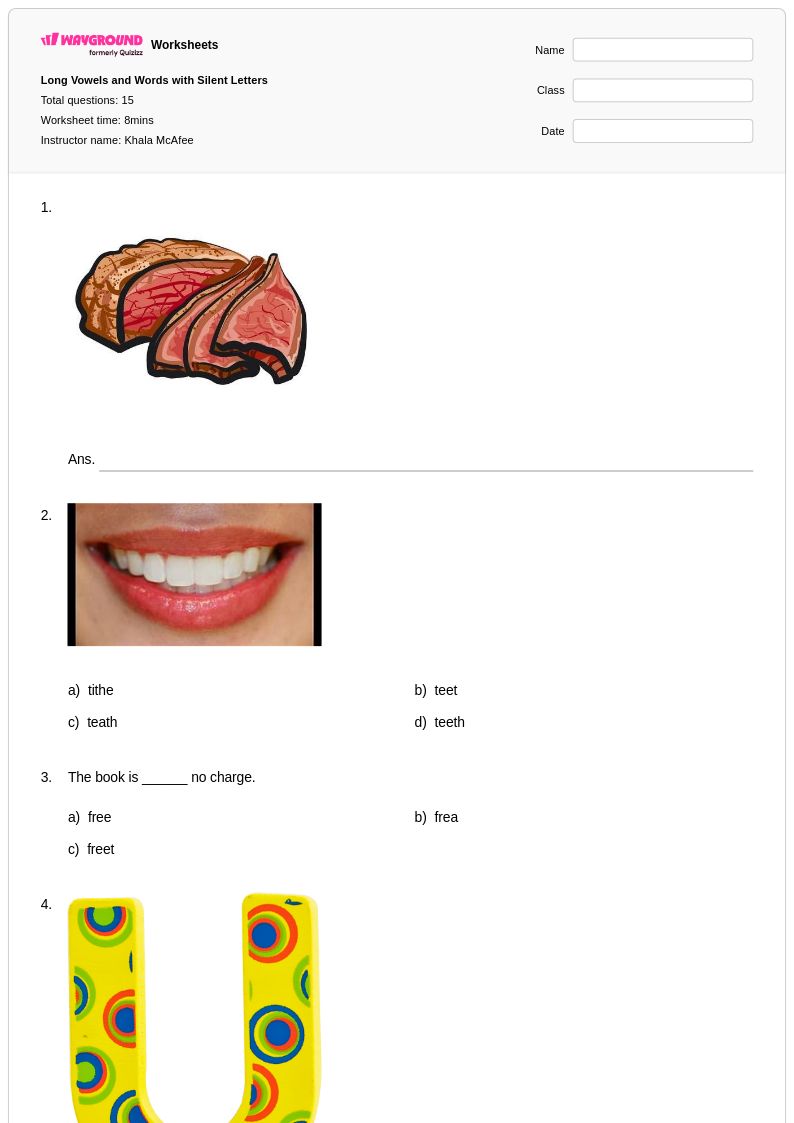
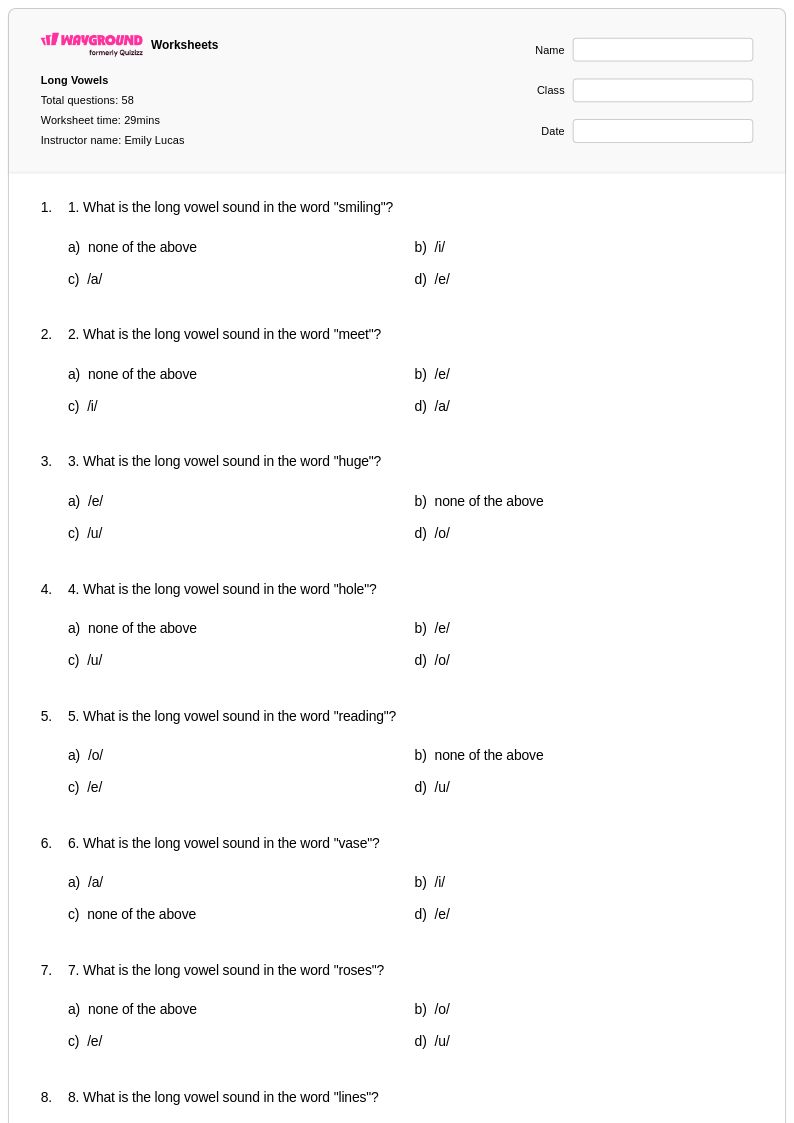
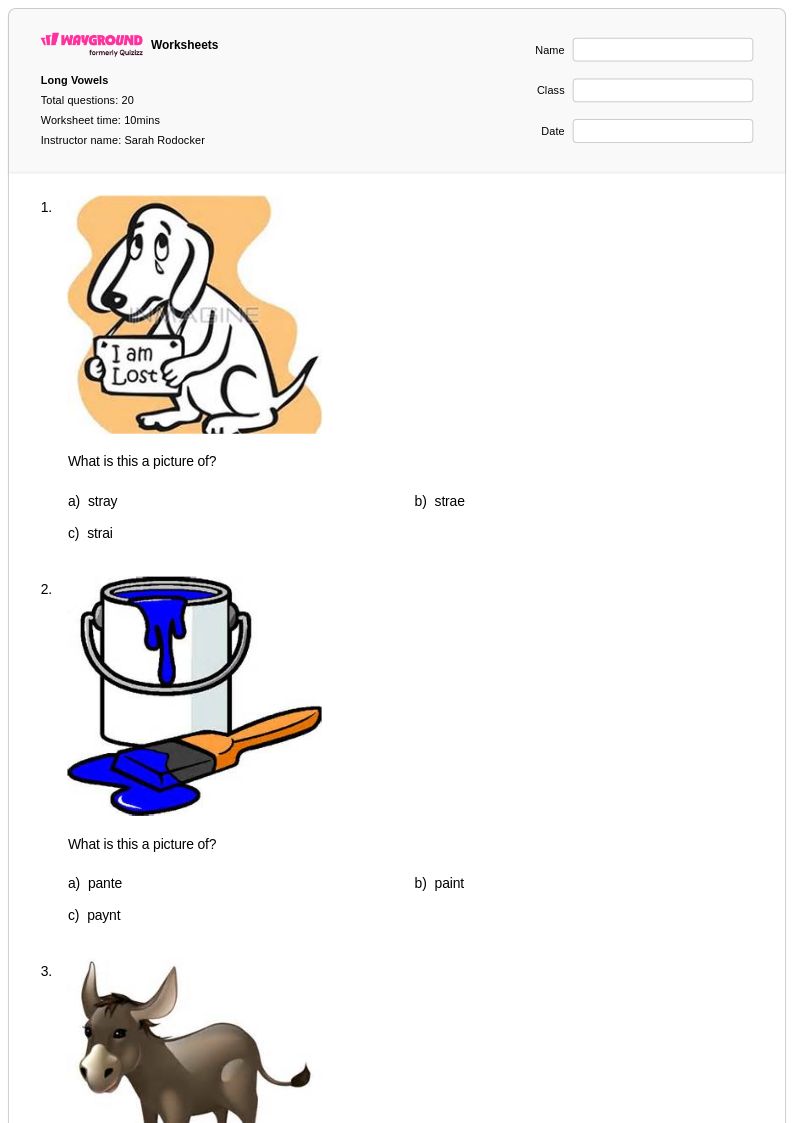
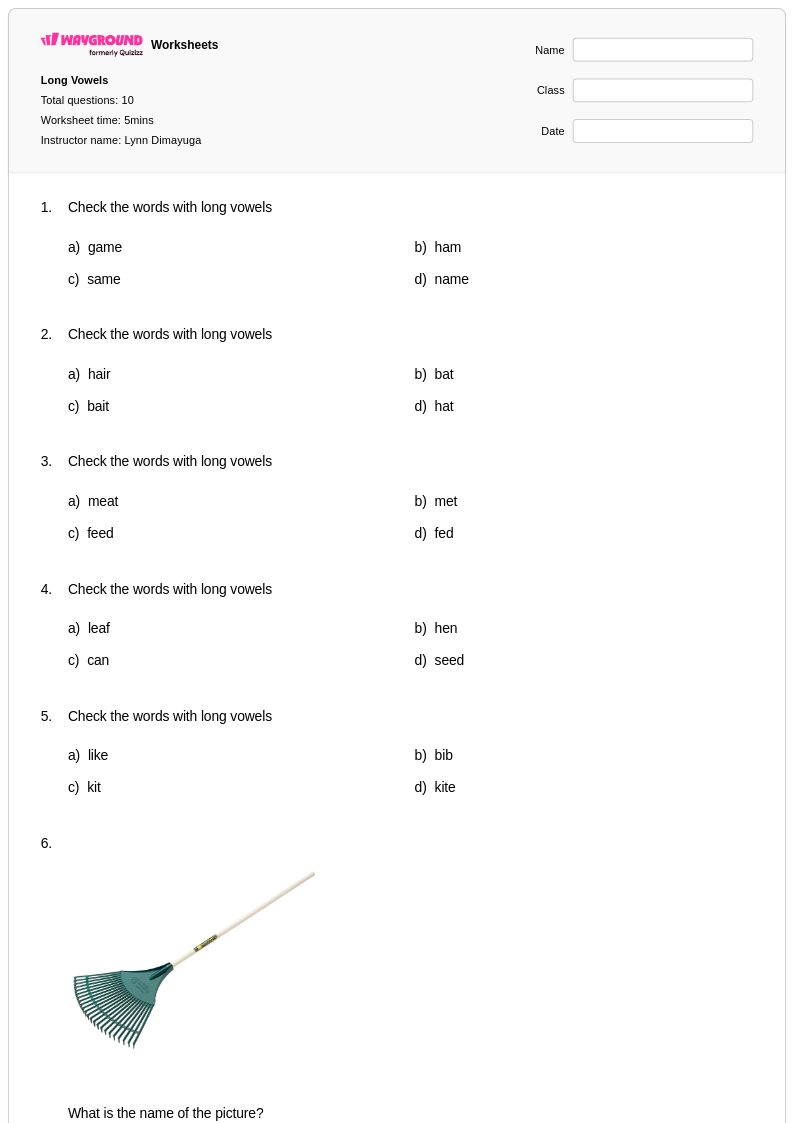
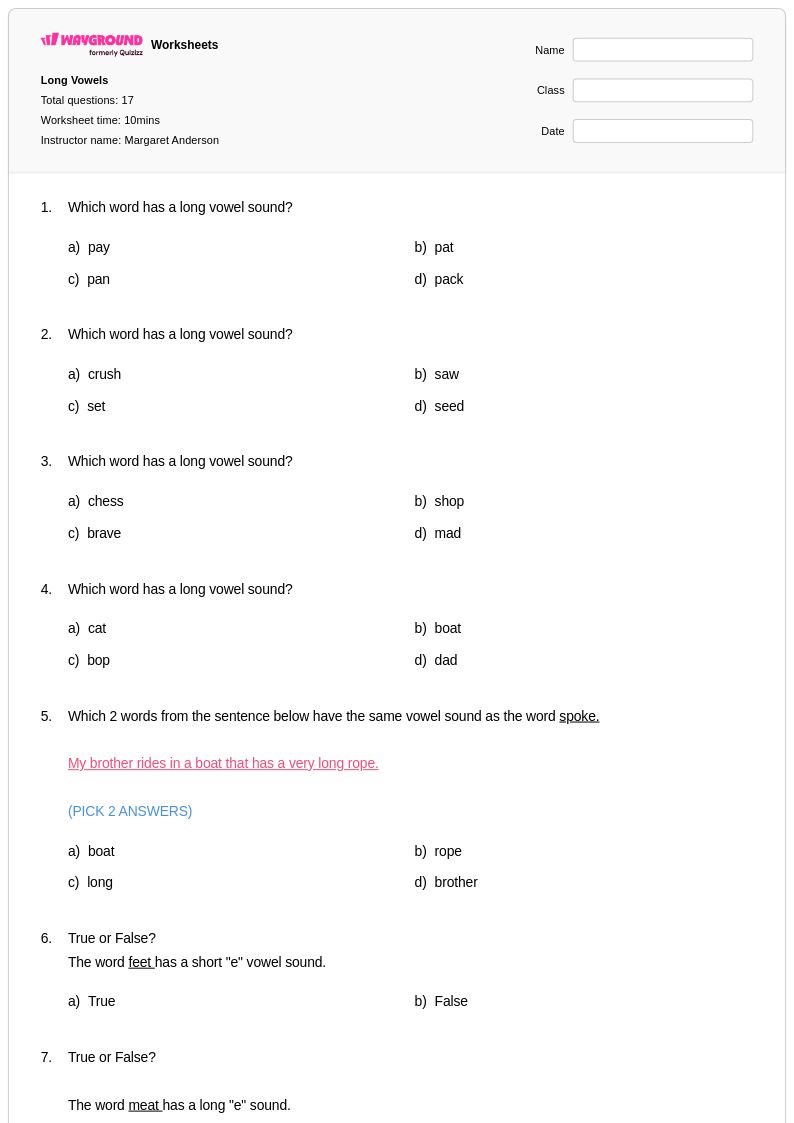
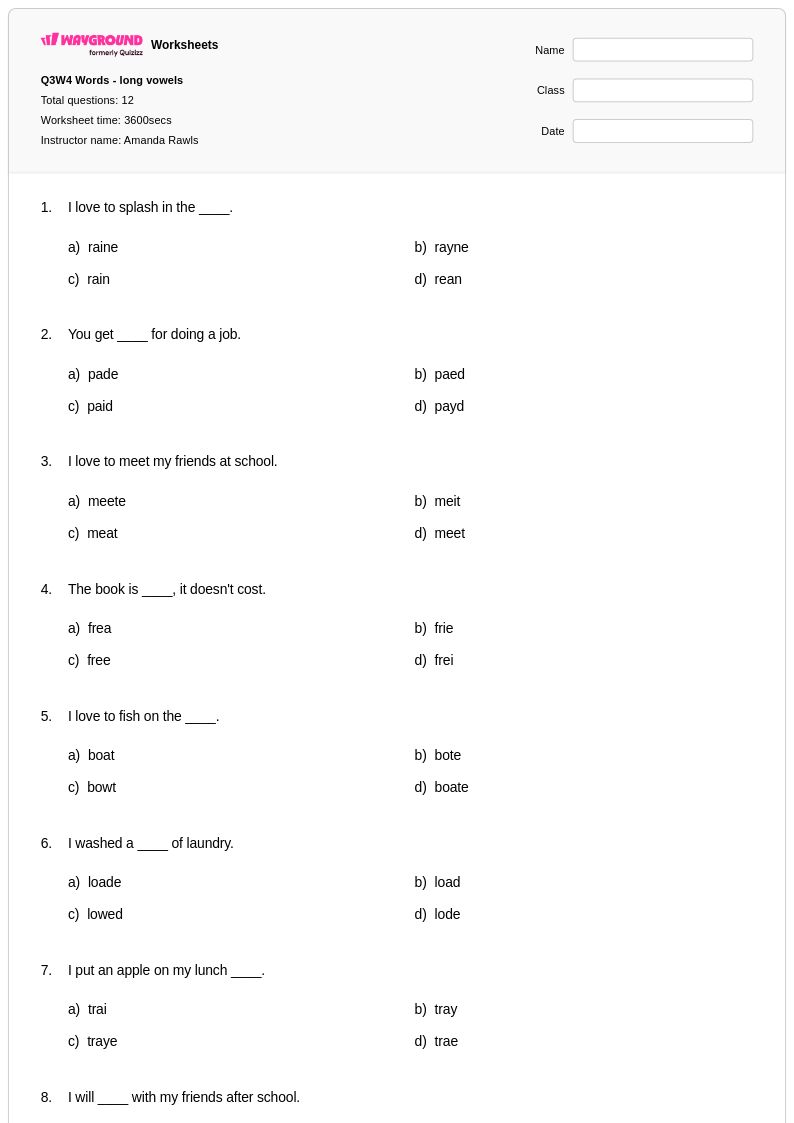
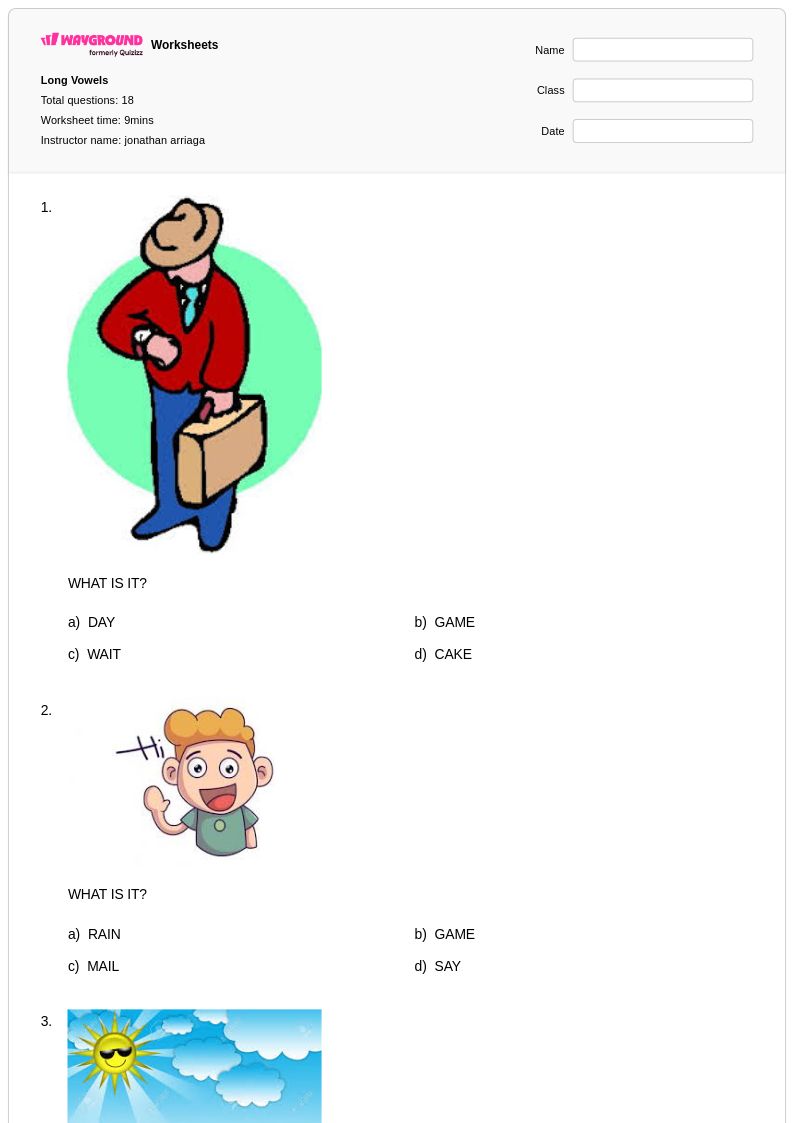
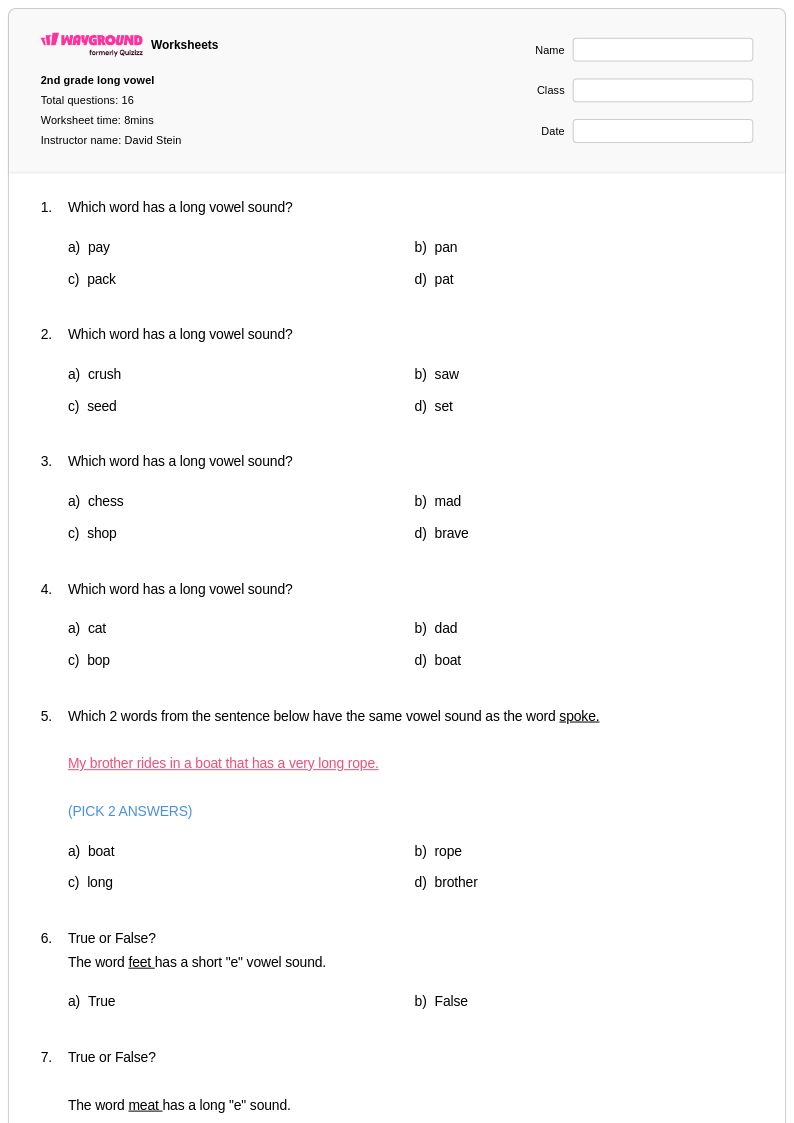
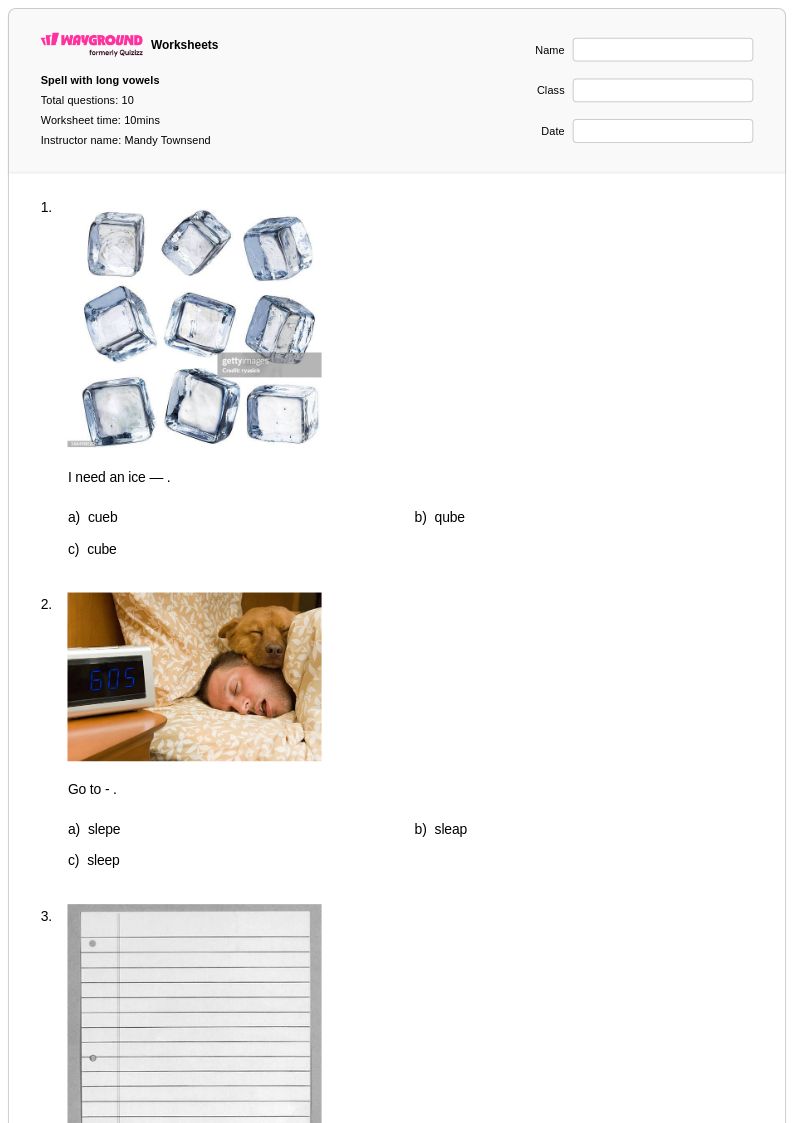
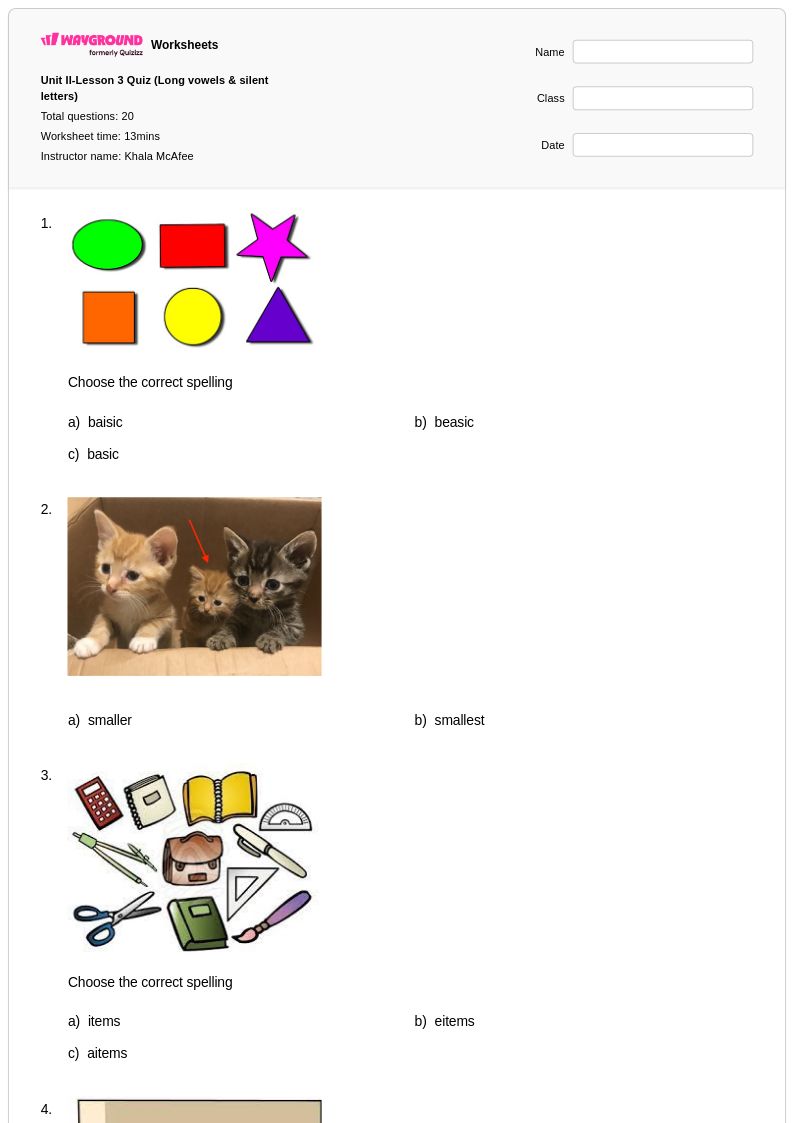
Long vowels represent a fundamental phonetic concept that Class 2 students must master to develop strong reading and spelling foundations. Wayground's comprehensive collection of long vowel worksheets provides systematic practice opportunities that help young learners distinguish between vowel sounds and apply proper spelling patterns. These educational resources focus on the five long vowel sounds (a, e, i, o, u) and their various representations, including silent e patterns, vowel teams, and open syllable structures. Each worksheet includes carefully crafted practice problems that progress from simple word recognition to more complex spelling applications, with accompanying answer keys that enable both independent learning and teacher-guided instruction. The free printable format ensures accessibility for classroom use, homework assignments, and targeted intervention sessions.
Wayground, formerly Quizizz, empowers educators with millions of teacher-created long vowel resources that streamline lesson planning and differentiated instruction for Class 2 classrooms. The platform's robust search and filtering capabilities allow teachers to locate worksheets aligned with specific curriculum standards and student ability levels, while customization tools enable modification of existing materials to meet diverse learning needs. These comprehensive worksheet collections are available in both printable pdf format and digital versions, supporting flexible implementation across various teaching environments. Teachers utilize these resources for initial skill introduction, targeted remediation for struggling readers, enrichment activities for advanced students, and ongoing practice to reinforce phonetic concepts, ensuring that all Class 2 students develop proficiency with long vowel recognition and application.
FAQs
How do I teach long vowel sounds to early readers?
Long vowel sounds are most effectively taught by introducing one vowel pattern at a time, starting with the silent e rule (CVCe words like 'cake' and 'bike') before moving to vowel teams. Use word sorting activities to help students visually distinguish long vowel patterns from short vowel patterns, and pair sorting with oral repetition so students connect the written pattern to the sound. Building in frequent review across multiple lessons reinforces recognition before students encounter these patterns in connected text.
What activities help students practice long vowel patterns?
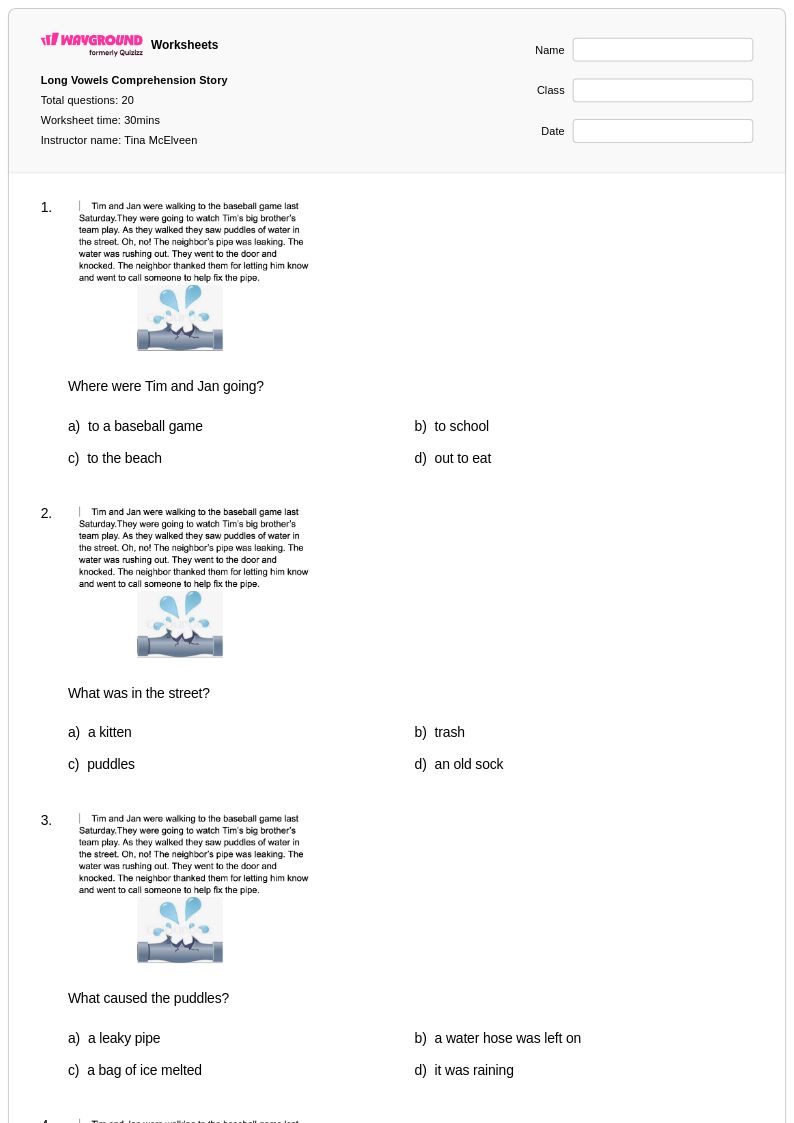
Word sorting, fill-in-the-blank spelling exercises, and reading passages with targeted long vowel words are among the most effective practice activities. Word sorts are especially useful because they require students to actively categorize vowel patterns rather than passively recognize them. Worksheets that combine reading comprehension with phonics practice reinforce long vowel decoding in context, which builds reading fluency alongside pattern recognition.
What mistakes do students commonly make when learning long vowel sounds?
One of the most frequent errors is confusing short and long vowel sounds, particularly in CVC versus CVCe word pairs such as 'cap' and 'cape' or 'bit' and 'bite.' Students also commonly misread vowel teams like 'ea' and 'oa,' applying only the sound of the first vowel instead of recognizing the team as a unit. Another persistent error is failing to account for the silent e, causing students to mispronounce or misspell words that follow the magic e pattern.
How do I differentiate long vowels instruction for students at different skill levels?
For students who are still building basic phonemic awareness, begin with auditory discrimination tasks before introducing written patterns. Students who have mastered the silent e rule can be challenged with multisyllabic words and less predictable vowel teams. On Wayground, teachers can apply individual accommodations such as read-aloud support for students who need questions read to them, and reduced answer choices for students who benefit from a narrower set of options, ensuring every learner is appropriately supported without disrupting the rest of the class.
How can I use long vowels worksheets from Wayground in my classroom?
Wayground's long vowels worksheets are available as printable PDFs for traditional classroom use and in digital formats for technology-integrated learning environments, giving teachers flexibility depending on their setup. Teachers can also host worksheets as a quiz directly on Wayground, allowing for easy digital distribution and immediate assessment. Complete answer keys are included with every worksheet, which reduces prep time and supports efficient feedback during independent practice or small group instruction.
How do long vowel skills connect to broader reading and spelling development?
Long vowel pattern recognition is a foundational decoding skill that directly supports reading fluency and spelling accuracy. When students reliably identify silent e words and vowel teams, they can decode unfamiliar multisyllabic words more independently, which reduces cognitive load during reading. Mastery of long vowel patterns also transfers to spelling, as students learn to apply consistent rules rather than memorizing each word individually.