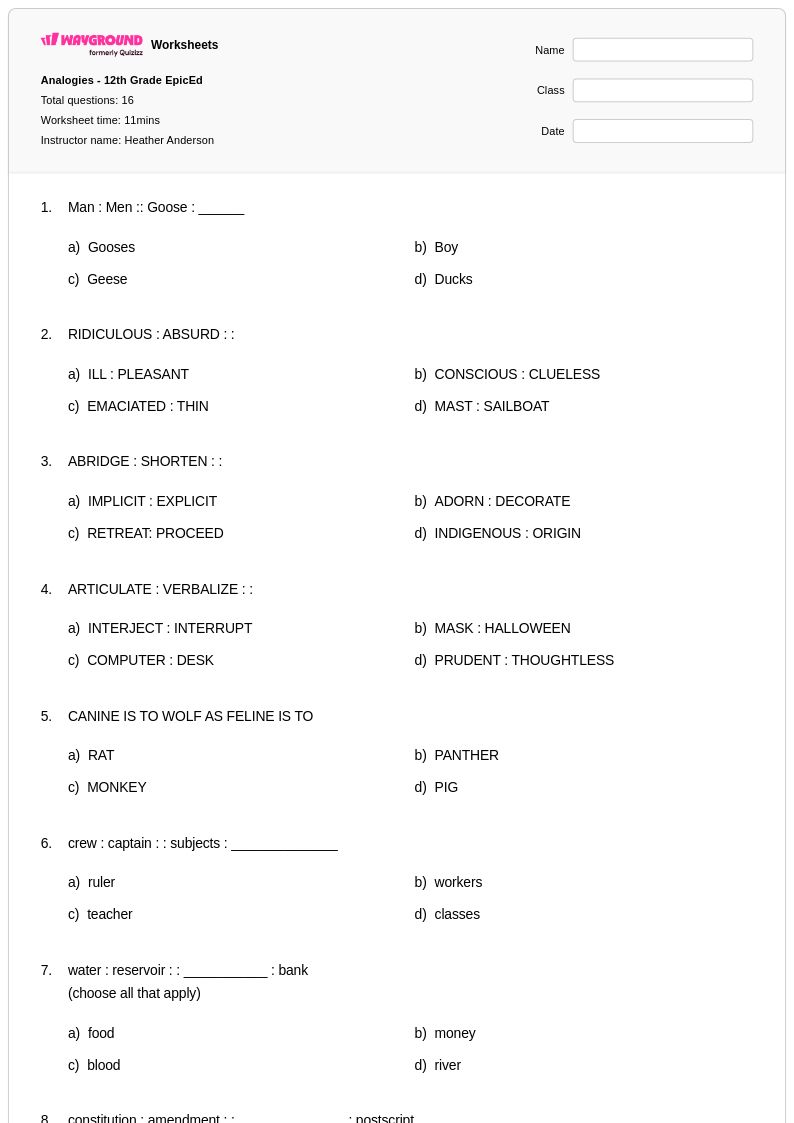
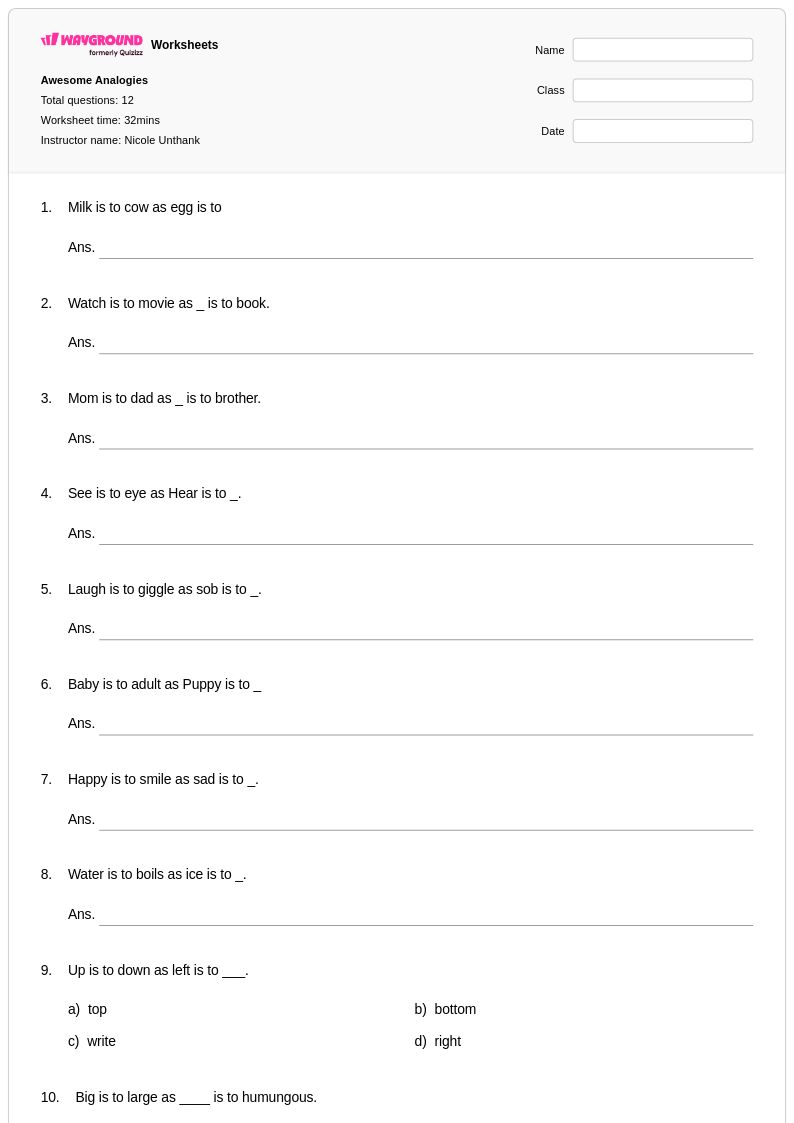
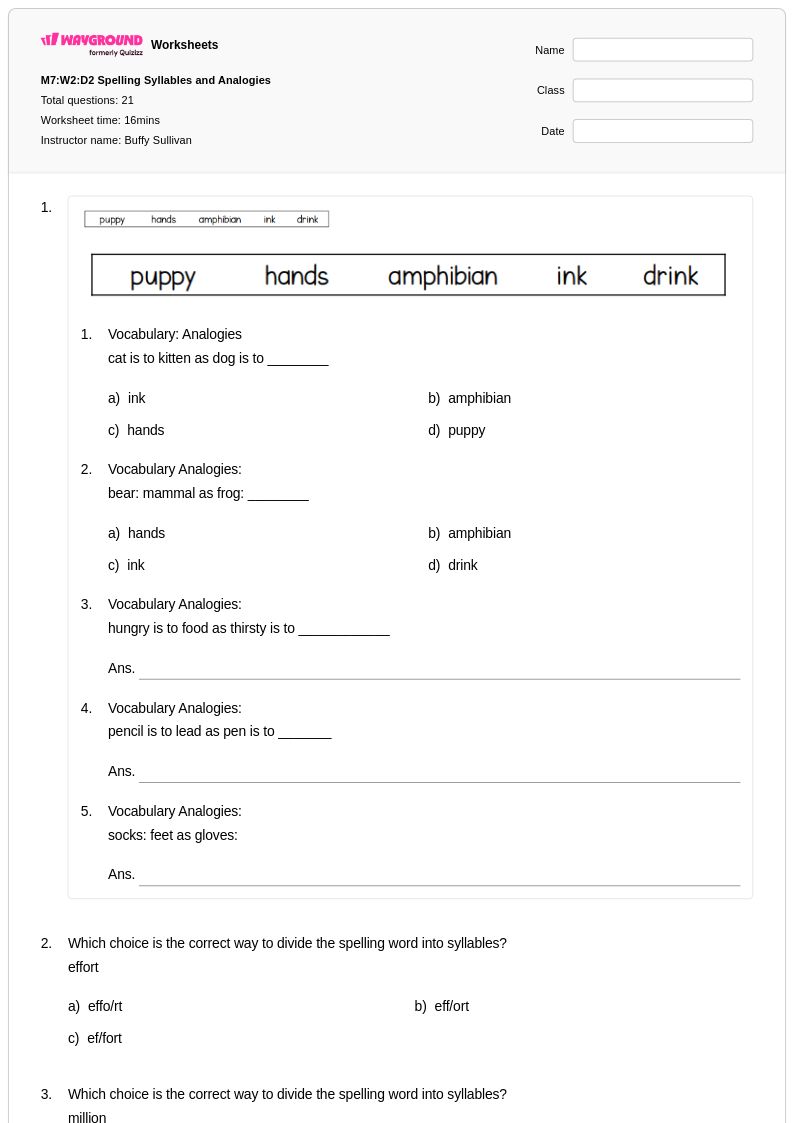
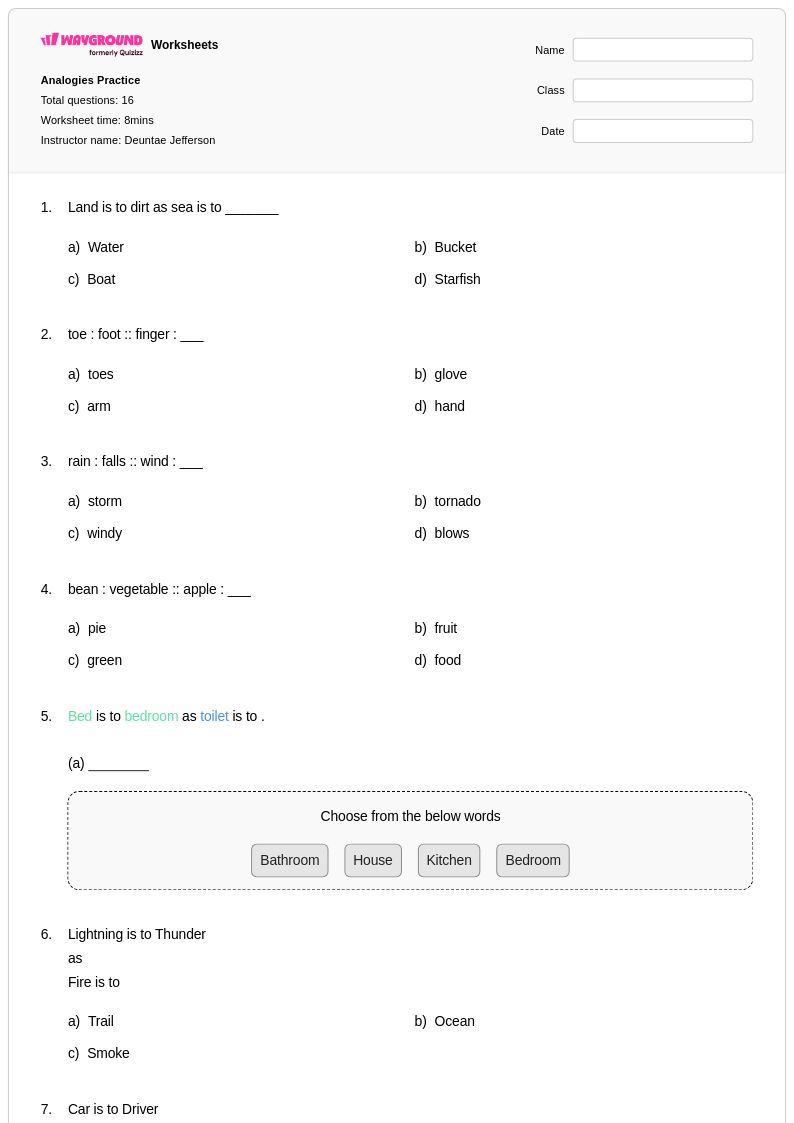
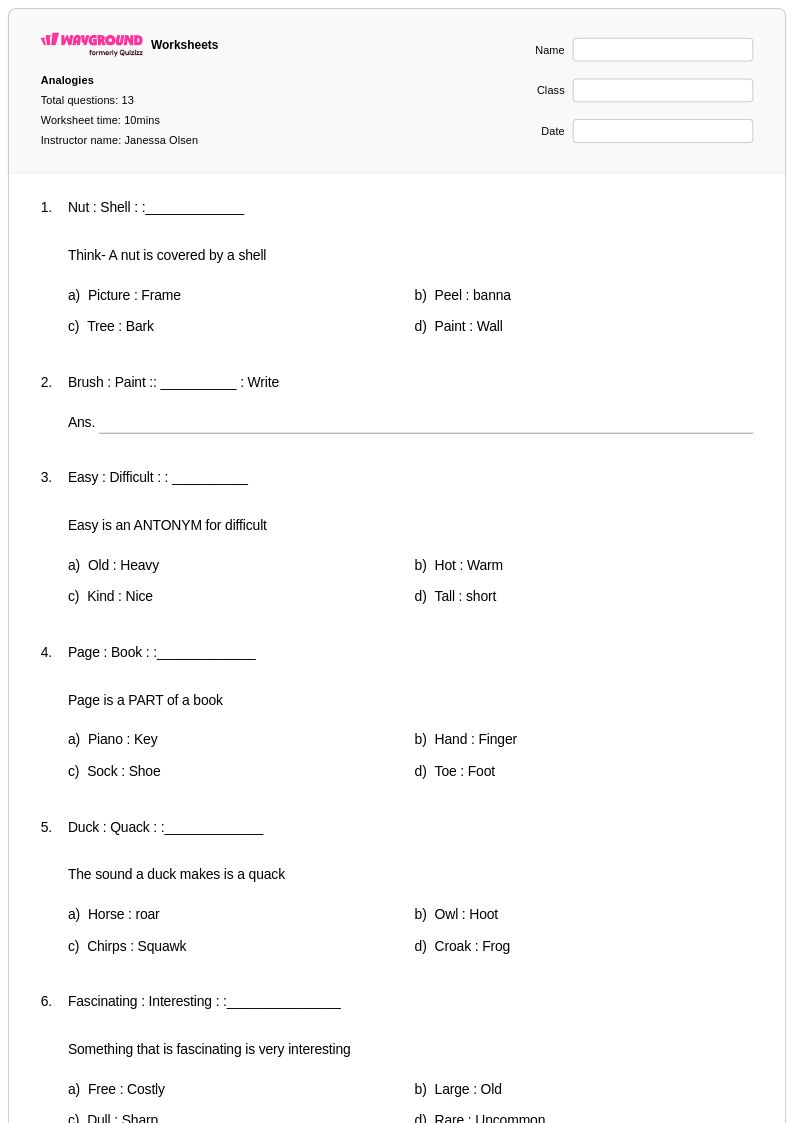
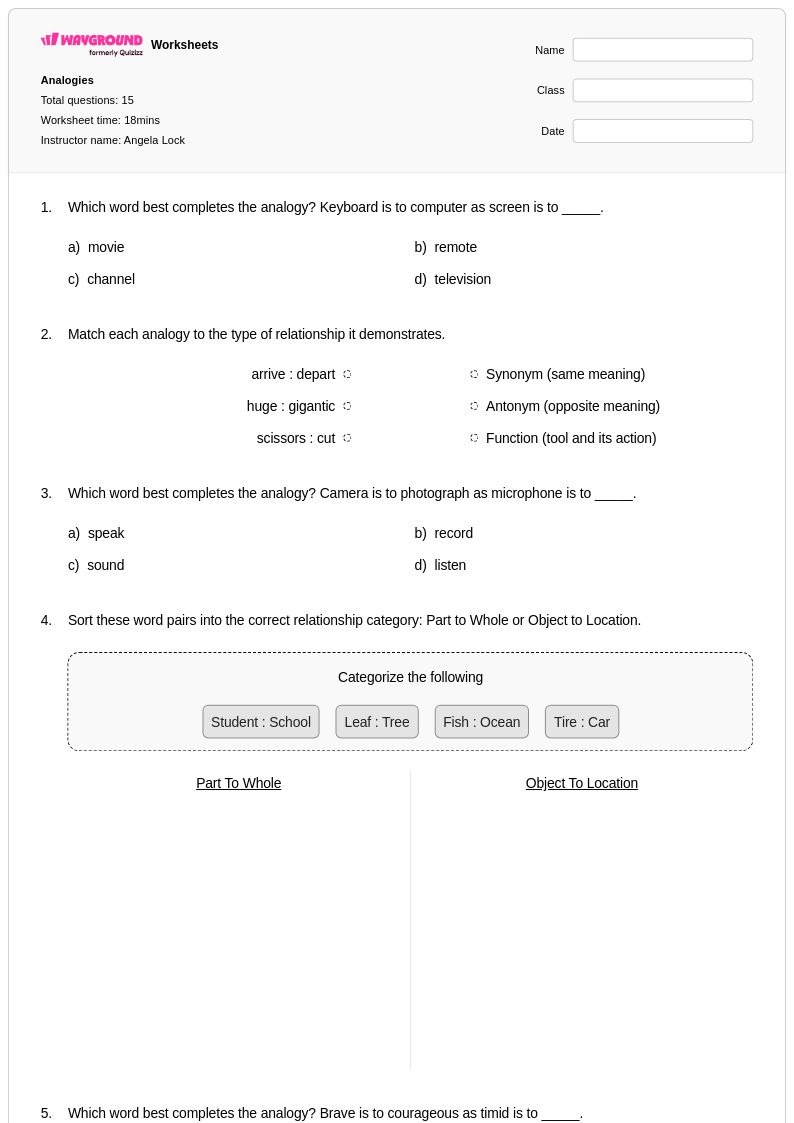
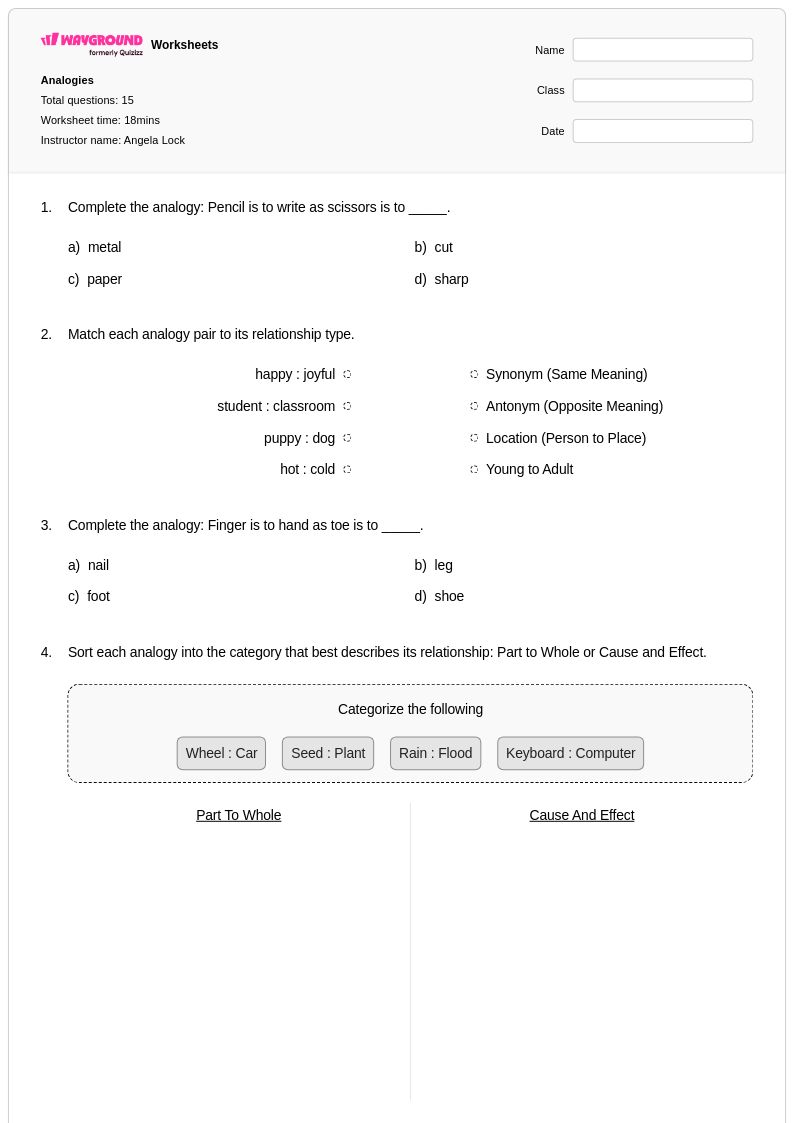
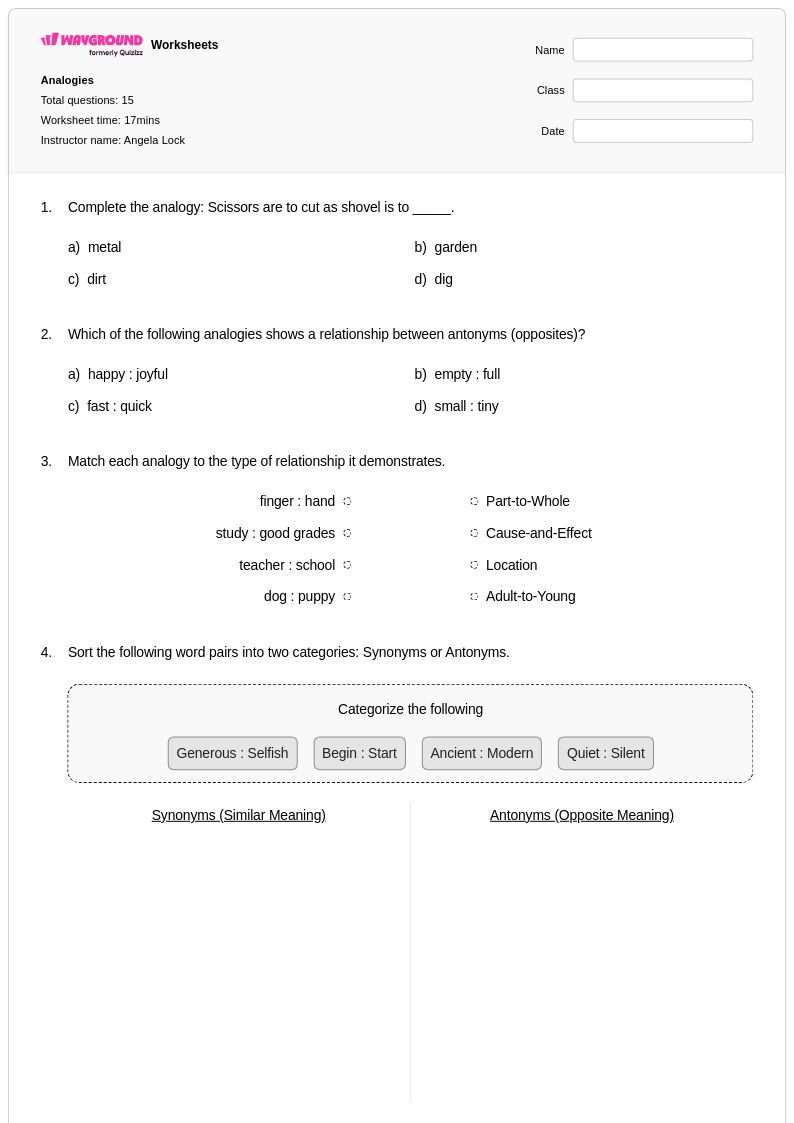
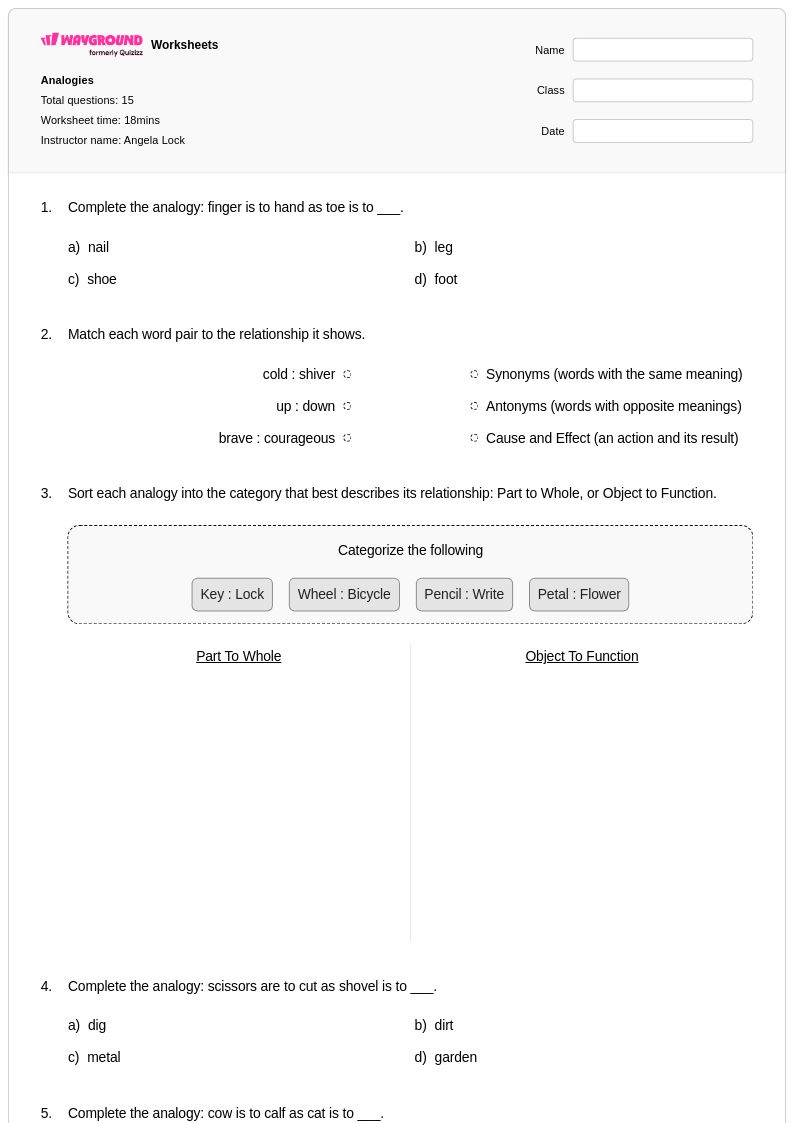
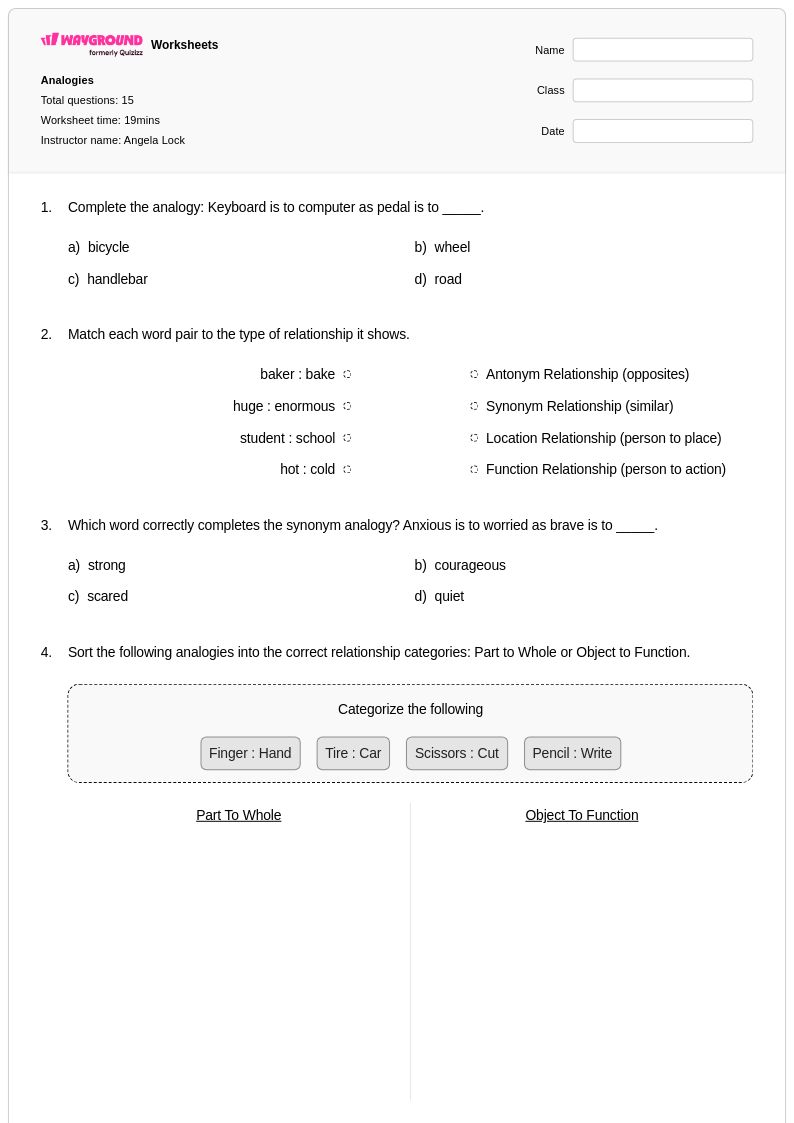
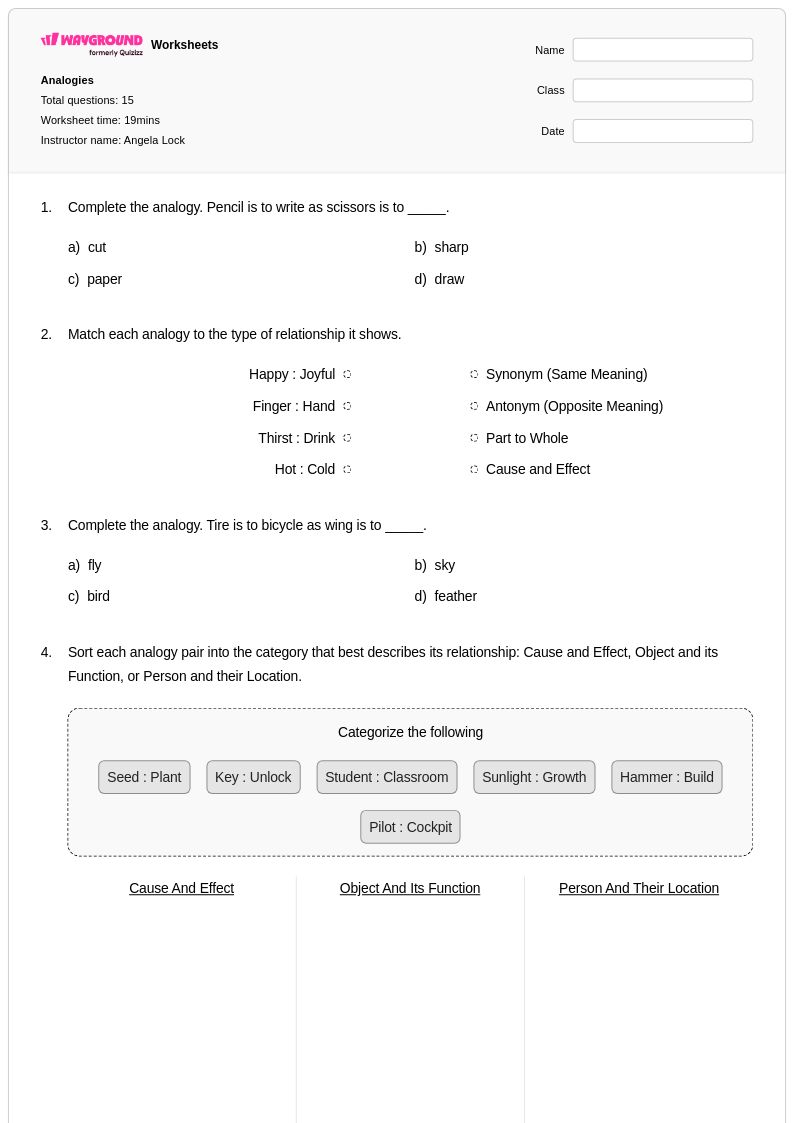
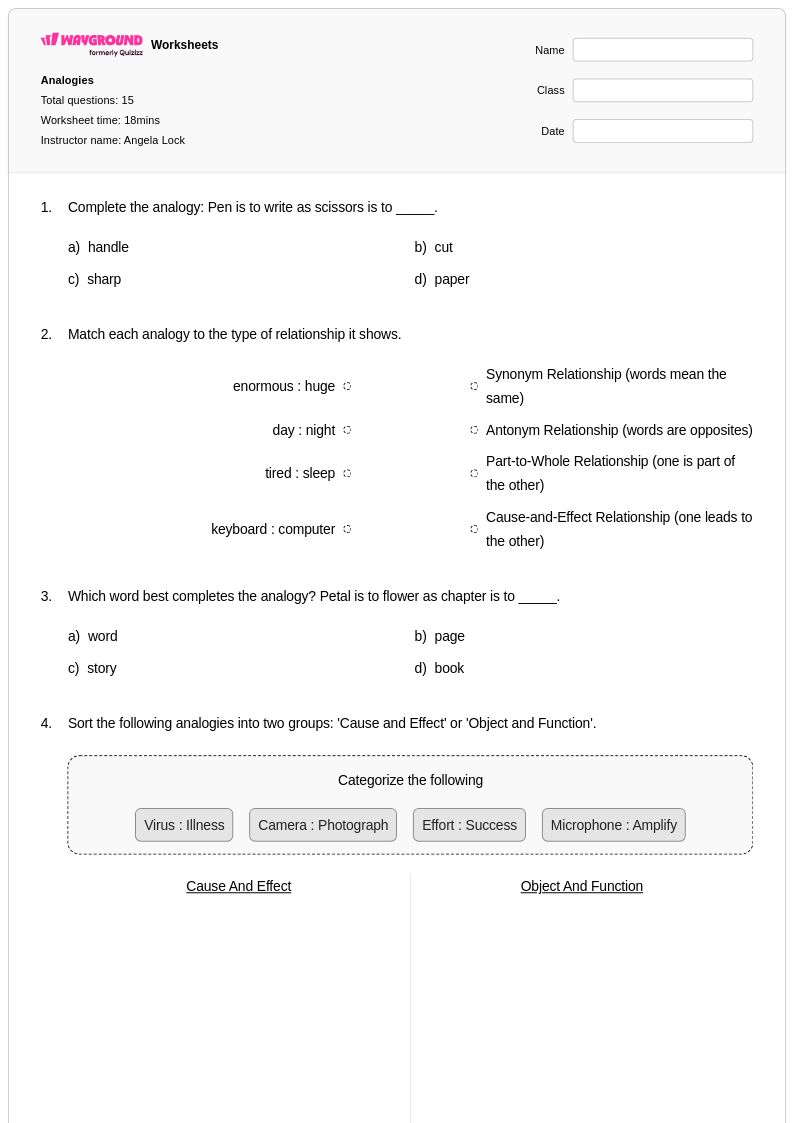
Master analogies with Wayground's comprehensive collection of free worksheets and printables that help students develop critical thinking skills through engaging practice problems, complete with detailed answer keys and downloadable PDFs.
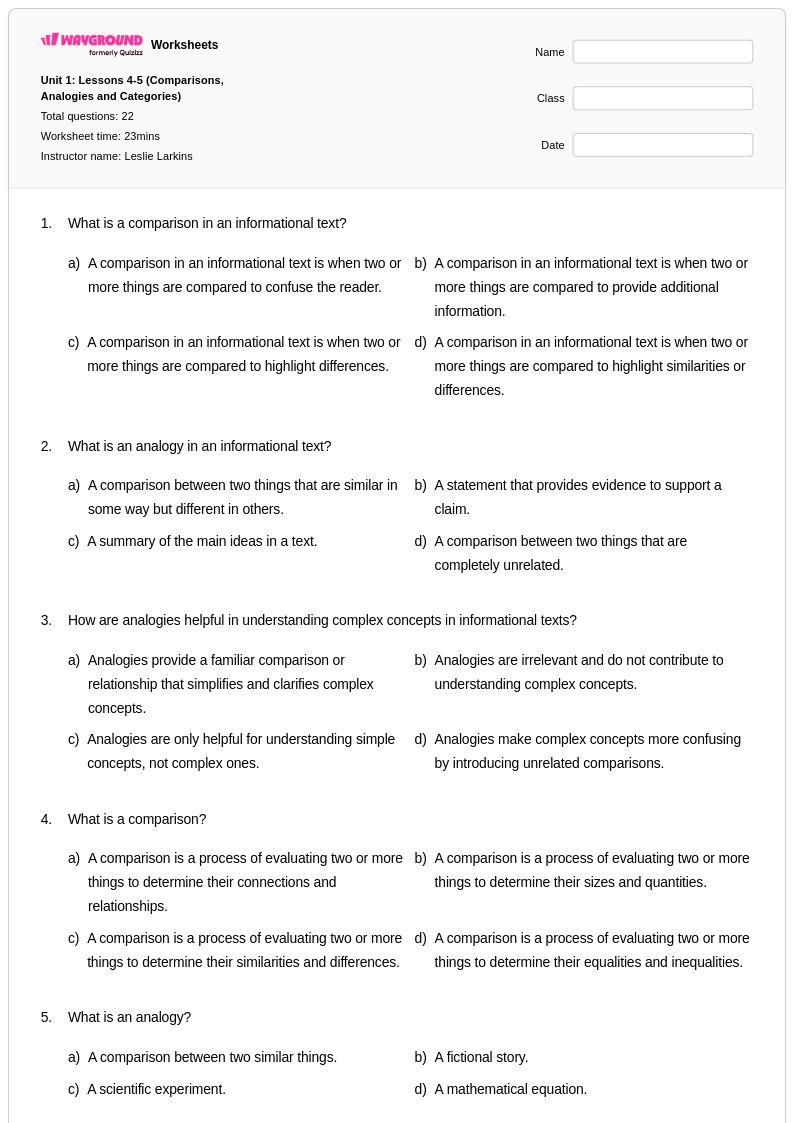
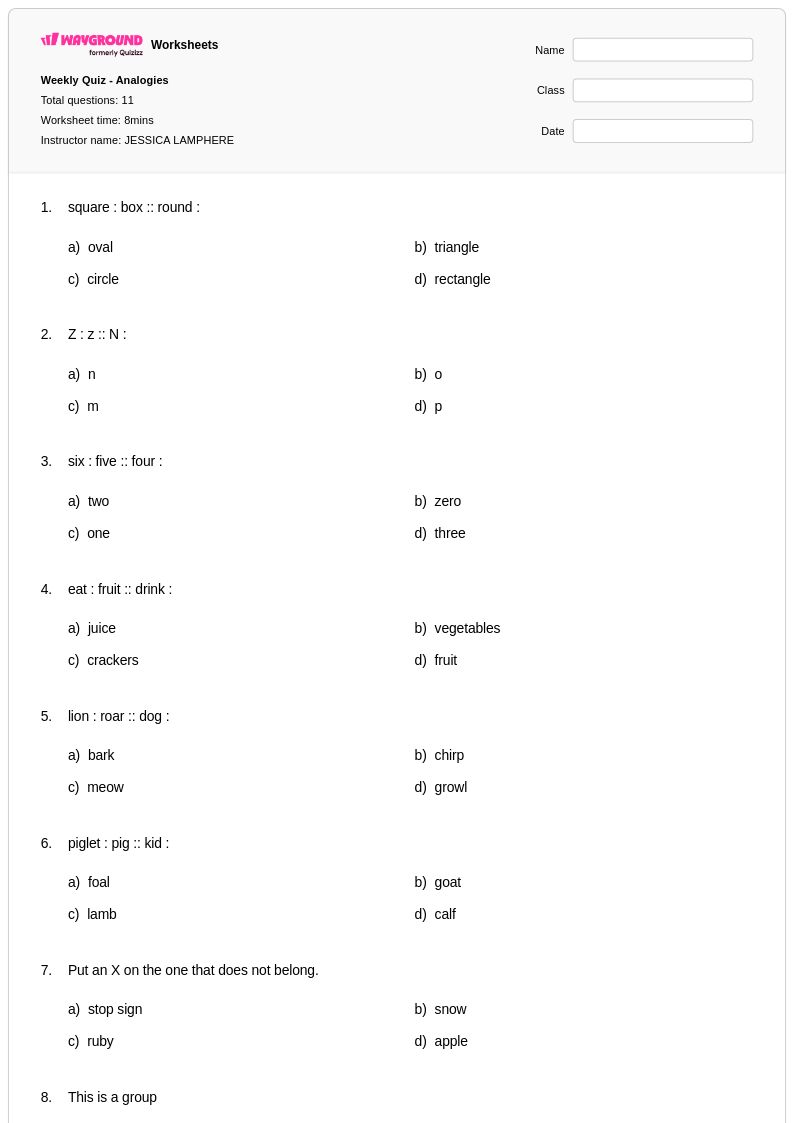
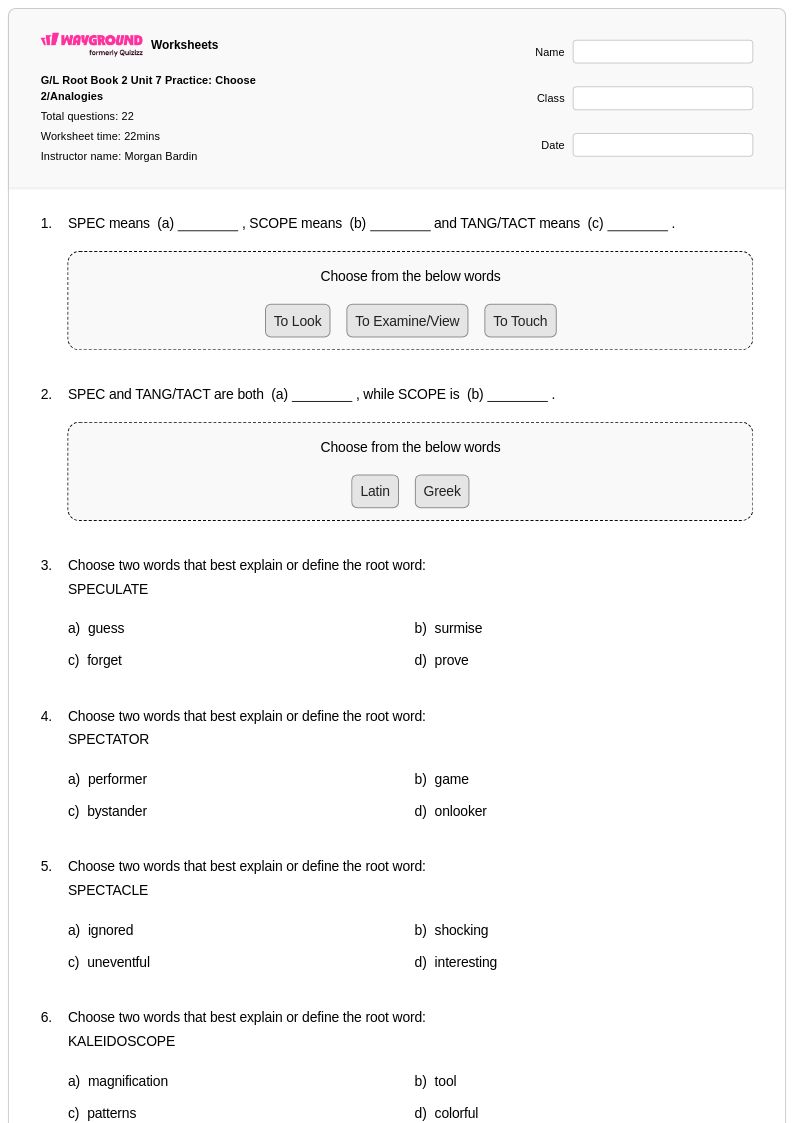
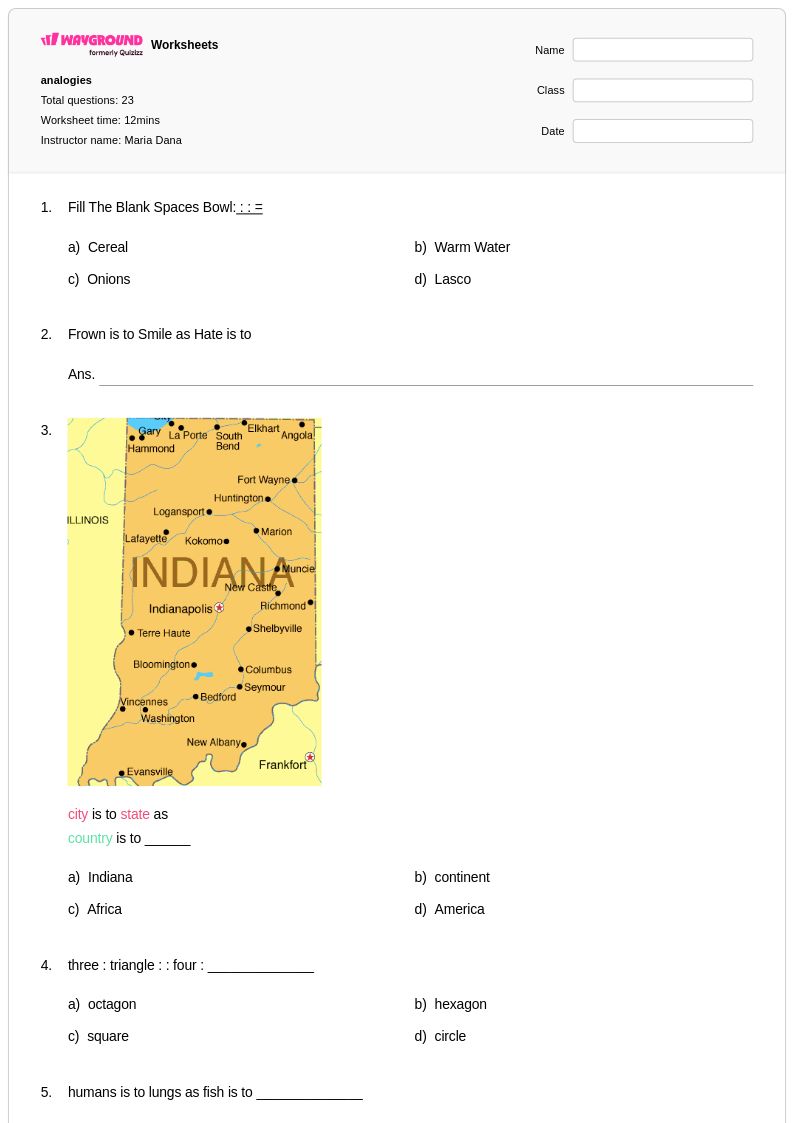
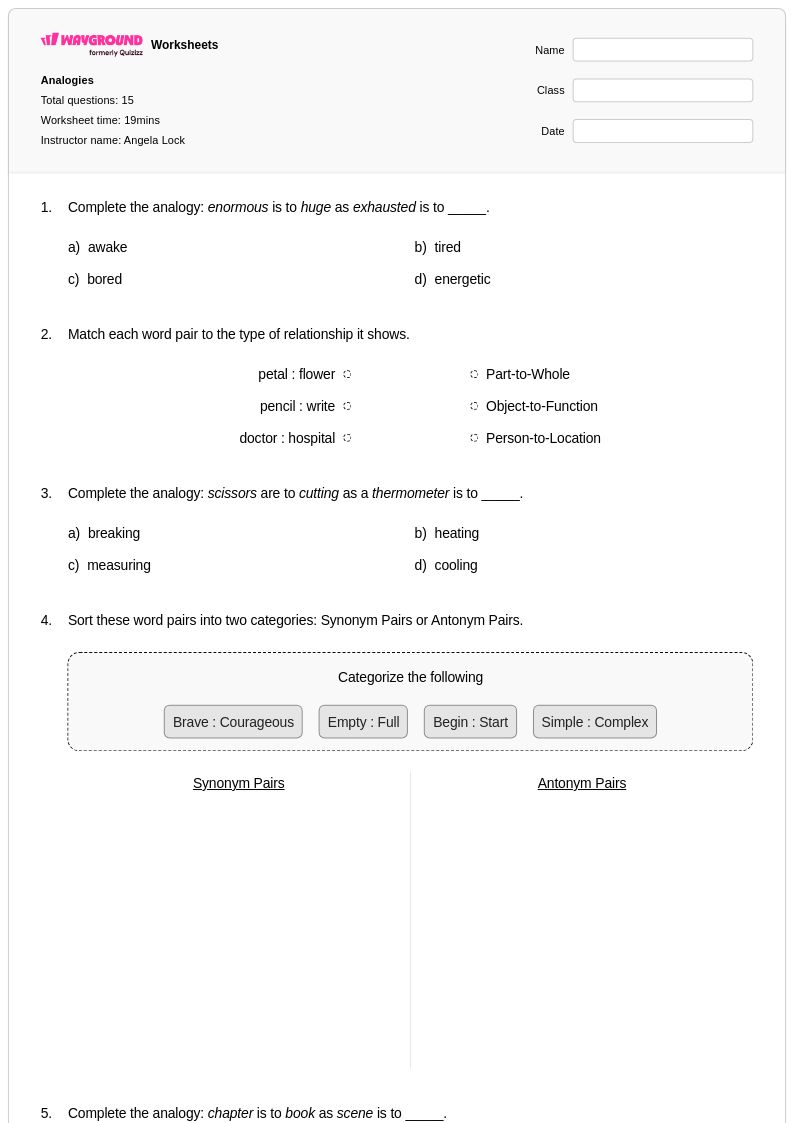
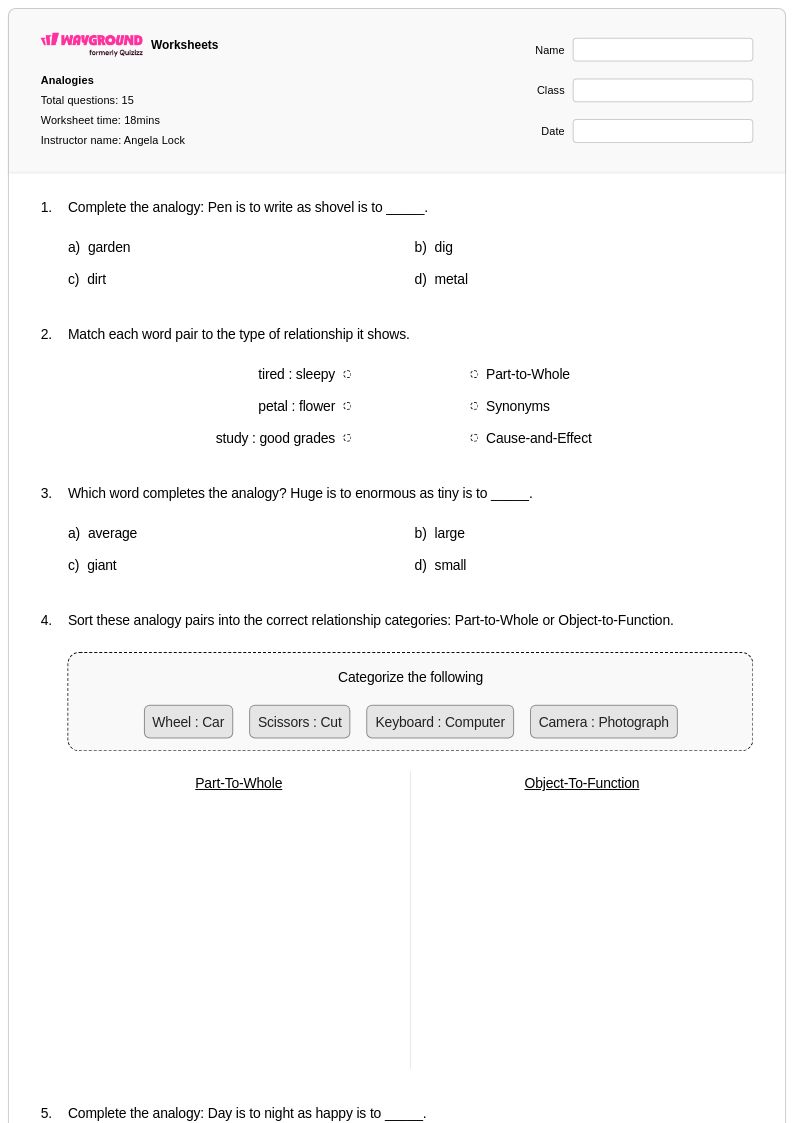
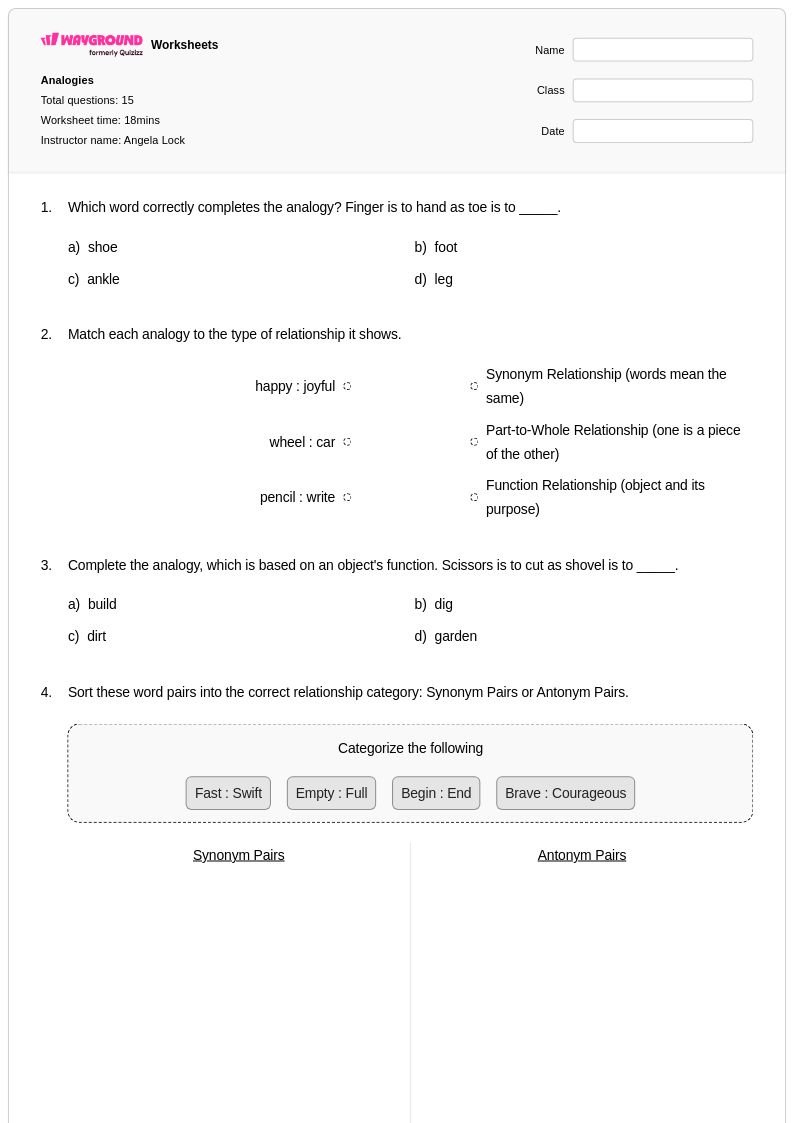
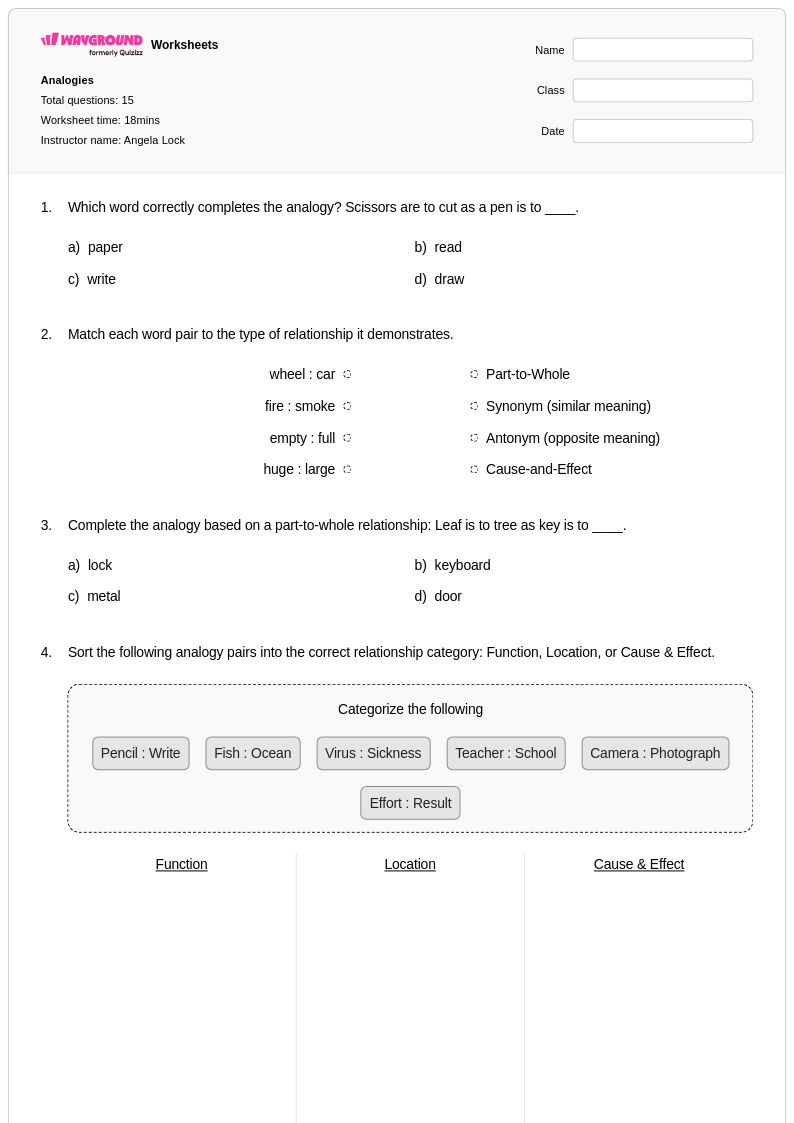
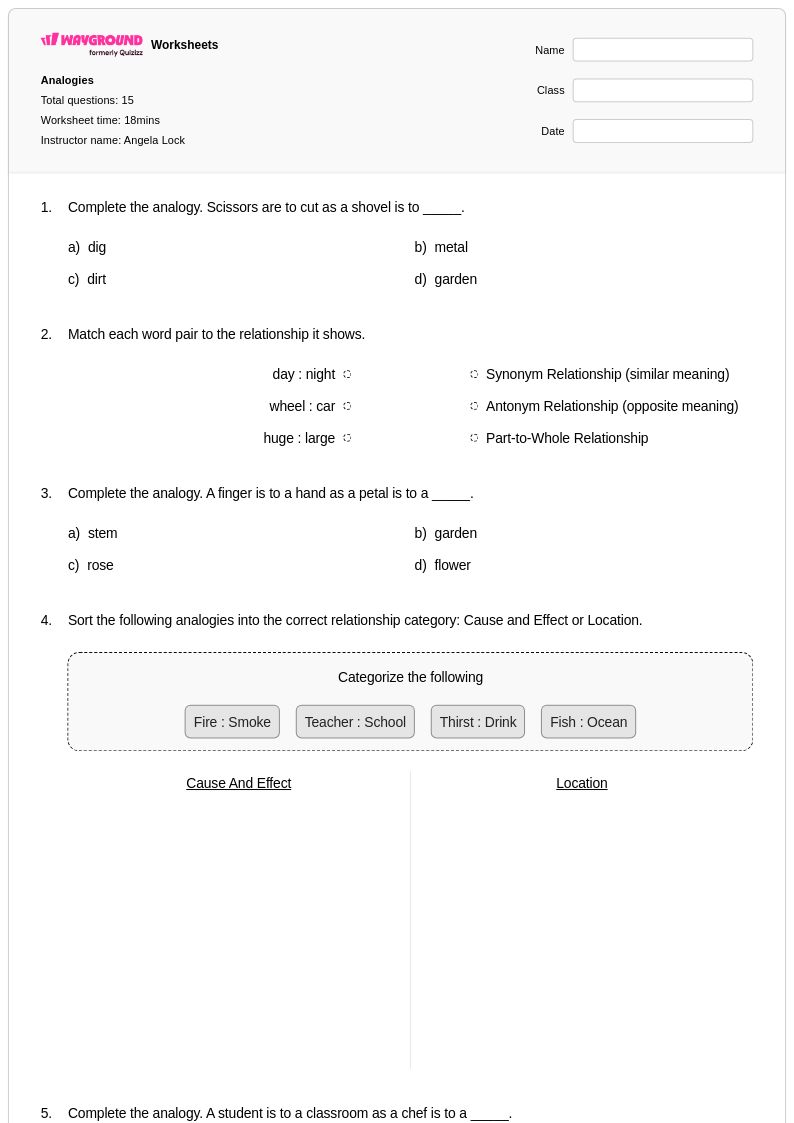
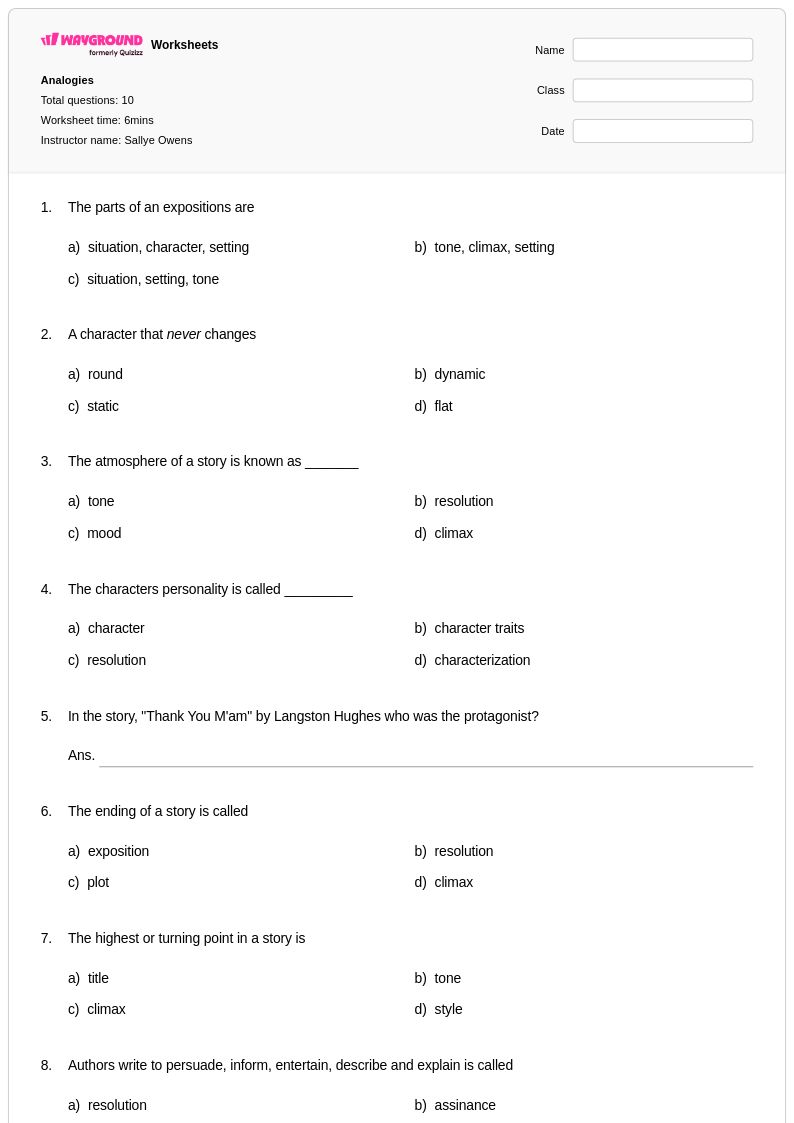
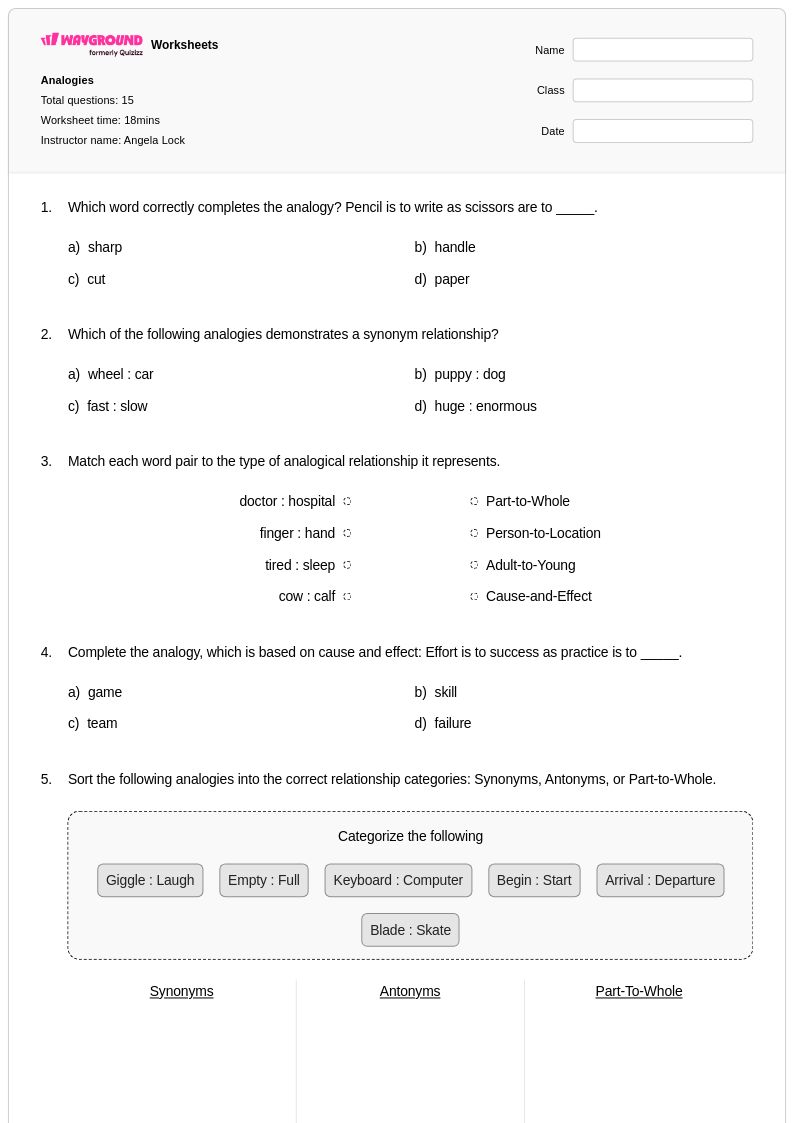
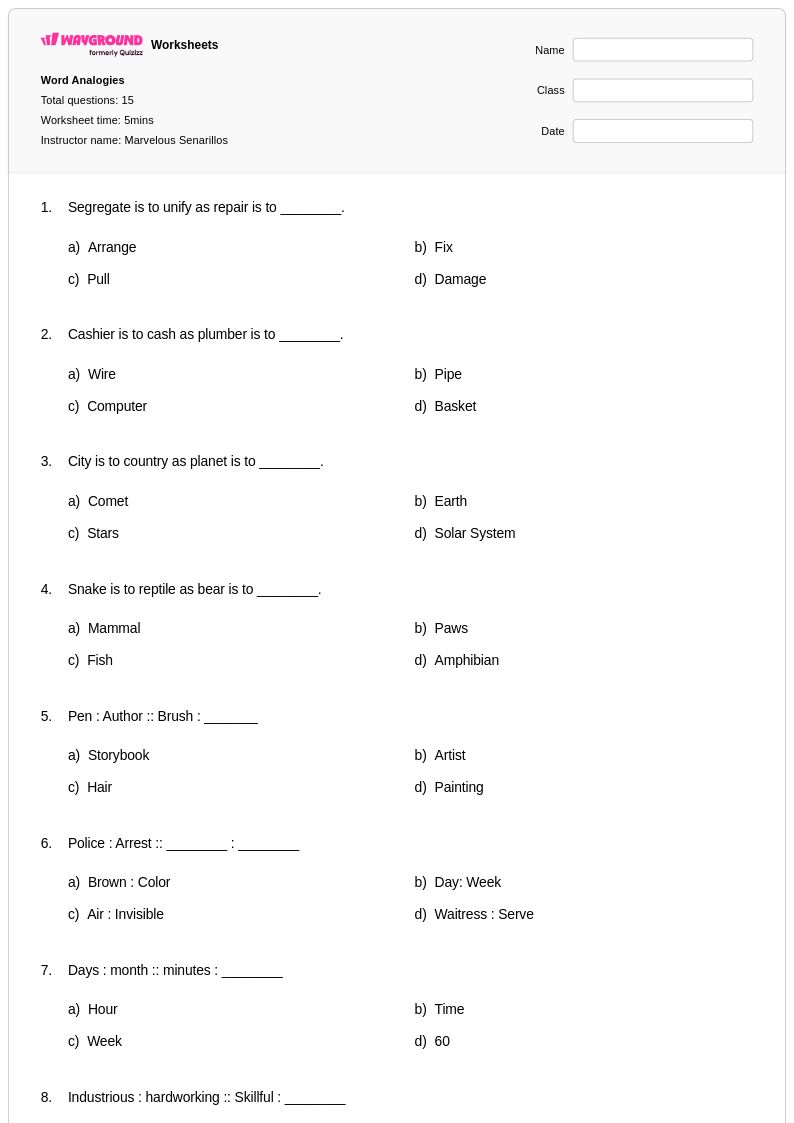
Analogies worksheets available through Wayground (formerly Quizizz) provide comprehensive practice opportunities for students to develop critical thinking and vocabulary skills through structured relationship comparisons. These educational resources focus on helping learners identify patterns, recognize word relationships, and strengthen logical reasoning abilities by working through various analogy formats including word-to-word, part-to-whole, cause-and-effect, and synonym-antonym relationships. The worksheets feature diverse practice problems that challenge students to analyze the connection between paired terms and apply that same relationship to complete additional word pairs. Teachers can access these materials as free printables in pdf format, complete with detailed answer keys that facilitate efficient grading and provide immediate feedback for student learning assessment.
Wayground (formerly Quizizz) supports educators with an extensive collection of teacher-created analogy worksheets drawn from millions of available resources, all enhanced with robust search and filtering capabilities that enable quick identification of materials suited to specific learning objectives. The platform's differentiation tools allow teachers to customize worksheet difficulty levels and content focus areas, ensuring appropriate challenge levels for diverse learners while maintaining standards alignment across educational frameworks. These analogy resources are available in both printable and digital formats, including downloadable pdf versions, giving educators flexibility in delivery methods whether for classroom instruction, homework assignments, or independent practice sessions. The comprehensive worksheet collection serves multiple instructional purposes, from initial concept introduction and skill-building practice to targeted remediation for struggling learners and enrichment activities for advanced students seeking deeper analytical challenges.
FAQs
How do I teach analogies to students?
Start by teaching students to identify the relationship in the first word pair before attempting to complete the analogy — common relationship types include part-to-whole, cause-and-effect, synonym-antonym, and function. Model your thinking aloud: 'Fin is to fish as wing is to bird — both describe a body part used for movement.' Once students can name the relationship type, move them toward completing unfamiliar pairs independently. Gradually increasing complexity, from simple synonym pairs to multi-step logical relationships, builds both vocabulary and reasoning stamina.
What types of analogy relationships should students know?
Students should be familiar with at least six core relationship types: synonym (happy : joyful), antonym (hot : cold), part-to-whole (wheel : car), cause-and-effect (drought : famine), function (pen : write), and category-to-member (mammal : dolphin). Teaching students to label the relationship type before solving helps them approach unfamiliar analogies systematically rather than by guessing. Exposure to all major formats is especially important for students preparing for standardized tests where analogies frequently appear.
What exercises help students practice analogies?
Structured worksheet practice is highly effective — specifically exercises where students must first identify the relationship type, then complete the second pair, rather than simply selecting from multiple-choice options. Varying formats across sessions, such as fill-in-the-blank, matching, and error-correction tasks, prevents rote pattern-matching and keeps reasoning active. Timed practice sets also help students build fluency with recognizing analogy structures quickly, which is a transferable skill for reading comprehension and vocabulary development.
What mistakes do students commonly make when solving analogies?
The most common error is focusing on word meaning alone rather than the relationship between the paired terms — students often choose an answer that simply 'sounds related' to one of the words rather than mirroring the structural logic of the original pair. Another frequent mistake is reversing the direction of the relationship, for example treating 'part-to-whole' as 'whole-to-part.' Explicit instruction on naming the relationship before solving, and checking that the named relationship holds true in both word pairs, directly addresses both error types.
How can I use Wayground's analogy worksheets in my classroom?
Wayground's analogy worksheets are available as printable PDFs for traditional classroom use and in digital formats for technology-integrated environments, giving teachers flexibility for in-class work, homework, or independent practice. Teachers can also host worksheets as a quiz directly on Wayground, enabling real-time progress tracking. For students who need additional support, Wayground's built-in accommodation tools allow teachers to enable Read Aloud for audio delivery of questions or reduce the number of answer choices to lower cognitive load — settings that can be applied individually without affecting the rest of the class.
How do analogies support vocabulary and reading comprehension development?
Analogy practice directly strengthens vocabulary by requiring students to process word meanings relationally rather than in isolation, which research consistently links to deeper retention. Because analogies demand that students identify logical connections between concepts, regular practice also builds the inferential reasoning skills that underpin reading comprehension, particularly in content-area texts where understanding cause-and-effect or part-to-whole relationships is essential. Teachers often find that students who practice analogies regularly show measurable gains in both standardized vocabulary assessments and independent reading fluency.