
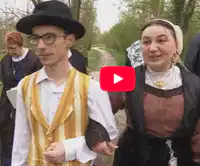
Traditional French Dance Characteristics

Interactive Video
•
Performing Arts
•
6th - 7th Grade
•
Practice Problem
•
Easy

Eve LeCheminant
Used 2+ times
FREE Resource
8 questions
Show all answers
1.
MULTIPLE CHOICE QUESTION
30 sec • 1 pt
In which region of France do dancers dress in 18th-century period costumes for regional dances?
Provence
Brittany
Poitou
Normandy
2.
MULTIPLE CHOICE QUESTION
30 sec • 1 pt
What is the correct order of garments worn by the female dancers, from innermost to outermost?
Petticoat, pants, top dress, wimple
Pants, petticoat, another petticoat, top dress, wimple
Wimple, pants, petticoat, top dress
Top dress, petticoat, pants, wimple
3.
MULTIPLE CHOICE QUESTION
30 sec • 1 pt
What is a characteristic feature of the "La Vrille du Poitou" dance?
It is reserved for women to show off their dresses.
It involves slow, graceful movements.
It is an athletic dance for men, including squats and kicks.
It is performed in a large circle holding hands.
4.
MULTIPLE CHOICE QUESTION
30 sec • 1 pt
What was the traditional purpose of the energetic and athletic moves performed by men in the regional dances?
To demonstrate their physical strength to other men.
To impress young girls.
To mimic animals found in the Marais Poitevin.
To prepare for agricultural work.
5.
MULTIPLE CHOICE QUESTION
30 sec • 1 pt
In which region of France do dancers sometimes struggle to breathe due to tight corsets?
Poitou
Provence
Normandy
Brittany
6.
MULTIPLE CHOICE QUESTION
30 sec • 1 pt
What is a key characteristic of the Farandole dance?
Dancers perform individually with complex footwork.
It is a slow, meditative dance performed in silence.
Dancers hold hands and move in a circle, often around a central point.
It is a competitive dance between two opposing lines of dancers.
7.
MULTIPLE CHOICE QUESTION
30 sec • 1 pt
From which historical period are the basic steps and military traditions of the Farandole dance said to have been passed down?
The Roman Empire
The Middle Ages
The reign of Louis XIV
The 20th century
Access all questions and much more by creating a free account
Create resources
Host any resource
Get auto-graded reports

Continue with Google

Continue with Email

Continue with Classlink

Continue with Clever
or continue with

Microsoft
%20(1).png)
Apple

Others
Already have an account?

