
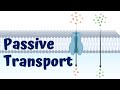
Understanding Passive Transport

Interactive Video
•
Biology
•
9th - 10th Grade
•
Hard

Evelyn Hayes
FREE Resource
5 questions
Show all answers
1.
MULTIPLE CHOICE QUESTION
30 sec • 1 pt
What is the primary difference between active and passive transport?
Both active and passive transport require energy.
Passive transport requires energy, while active transport does not.
Active transport requires energy, while passive transport does not.
Neither active nor passive transport require energy.
2.
MULTIPLE CHOICE QUESTION
30 sec • 1 pt
Which component of the cell membrane is responsible for creating a barrier between the inside and outside of the cell?
Proteins
Cholesterol
Phospholipid bilayer
Carbohydrates
3.
MULTIPLE CHOICE QUESTION
30 sec • 1 pt
In facilitated diffusion, what assists larger or charged molecules in moving through the cell membrane?
Water molecules
Carbohydrates
Proteins
Lipids
4.
MULTIPLE CHOICE QUESTION
30 sec • 1 pt
Which process involves water molecules moving through the membrane to balance solute concentration?
Osmosis
Facilitated diffusion
Active transport
Simple diffusion
5.
MULTIPLE CHOICE QUESTION
30 sec • 1 pt
Which of the following is an example of passive transport in the human body?
Pumping of sodium ions out of cells
Synthesis of proteins
Absorption of nutrients in the digestive system
Movement of glucose into cells
Access all questions and much more by creating a free account
Create resources
Host any resource
Get auto-graded reports

Continue with Google

Continue with Email

Continue with Classlink

Continue with Clever
or continue with

Microsoft
%20(1).png)
Apple

Others
Already have an account?

