
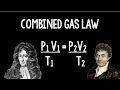
Understanding the Combined Gas Law

Interactive Video
•
Chemistry
•
9th - 10th Grade
•
Practice Problem
•
Hard

Nancy Jackson
FREE Resource
10 questions
Show all answers
1.
MULTIPLE CHOICE QUESTION
30 sec • 1 pt
What is the equation for the Combined Gas Law?
P1 * V1 = P2 * V2
P1 * V1 / T1 = P2 * V2 / T2
V1 / T1 = V2 / T2
P1 / T1 = P2 / T2
2.
MULTIPLE CHOICE QUESTION
30 sec • 1 pt
Why is it important to use Kelvin in gas law calculations?
Kelvin is a larger unit than Celsius.
Kelvin is the standard unit for pressure.
Kelvin is easier to calculate with.
Using Kelvin prevents division by zero.
3.
MULTIPLE CHOICE QUESTION
30 sec • 1 pt
What happens to the Combined Gas Law equation if temperature is constant?
It remains unchanged.
It becomes Gay-Lussac's Law.
It becomes Charles' Law.
It becomes Boyle's Law.
4.
MULTIPLE CHOICE QUESTION
30 sec • 1 pt
What does STP stand for in gas law problems?
Standard Temperature and Power
Standard Time and Pressure
Standard Time and Power
Standard Temperature and Pressure
5.
MULTIPLE CHOICE QUESTION
30 sec • 1 pt
When should you use the Combined Gas Law?
When only pressure changes.
When only volume changes.
When pressure, volume, or temperature changes.
When no variables change.
6.
MULTIPLE CHOICE QUESTION
30 sec • 1 pt
In the example with methane, what was the initial volume?
3.8 L
4.9 L
5.0 L
3.5 L
7.
MULTIPLE CHOICE QUESTION
30 sec • 1 pt
In the methane example, what was the final temperature in Kelvin?
278 K
359 K
273 K
300 K
Access all questions and much more by creating a free account
Create resources
Host any resource
Get auto-graded reports

Continue with Google

Continue with Email

Continue with Classlink

Continue with Clever
or continue with

Microsoft
%20(1).png)
Apple

Others
Already have an account?

