
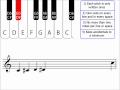
Understanding Chromatic Scales

Interactive Video
•
Performing Arts
•
9th - 10th Grade
•
Practice Problem
•
Hard

Jennifer Brown
FREE Resource
10 questions
Show all answers
1.
MULTIPLE CHOICE QUESTION
30 sec • 1 pt
What does the term 'chromatic' refer to in music theory?
A scale with no accidentals
A scale with notes a whole tone apart
A scale with only whole steps
A scale with notes a semitone apart
2.
MULTIPLE CHOICE QUESTION
30 sec • 1 pt
Which of the following is a semitone?
A to B
G to A
E to F
C to D
3.
MULTIPLE CHOICE QUESTION
30 sec • 1 pt
When constructing a chromatic scale, what is the rule regarding the use of accidentals?
Use only flats
Keep accidentals to a minimum
Avoid using accidentals
Use as many accidentals as possible
4.
MULTIPLE CHOICE QUESTION
30 sec • 1 pt
In a chromatic scale starting from C, which note comes after F?
G flat
F sharp
E sharp
G
5.
MULTIPLE CHOICE QUESTION
30 sec • 1 pt
What is the first step in drawing an ascending chromatic scale starting on B flat?
Use only sharps
Add a sharp to B
Add the key signature of B flat major
Start with a natural B
6.
MULTIPLE CHOICE QUESTION
30 sec • 1 pt
Why is it important to avoid using sharps in a chromatic scale based on B flat major?
Sharps are not allowed in B flat major
It makes the scale easier to read
Flats are more visually appealing
Sharps are harder to play
7.
MULTIPLE CHOICE QUESTION
30 sec • 1 pt
In a descending chromatic scale starting on C double sharp, what is the equivalent note for C double sharp?
C
E
B
D
Access all questions and much more by creating a free account
Create resources
Host any resource
Get auto-graded reports

Continue with Google

Continue with Email

Continue with Classlink

Continue with Clever
or continue with

Microsoft
%20(1).png)
Apple

Others
Already have an account?

