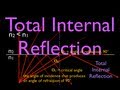
Understanding Total Internal Reflection

Interactive Video
•
Physics
•
9th - 10th Grade
•
Practice Problem
•
Hard

Jennifer Brown
FREE Resource
10 questions
Show all answers
1.
MULTIPLE CHOICE QUESTION
30 sec • 1 pt
What are the two conditions necessary for total internal reflection to occur?
Light must travel from a higher to a lower index of refraction and the angle of incidence must be less than the critical angle.
Light must travel from a lower to a higher index of refraction and the angle of incidence must be greater than the critical angle.
Light must travel from a higher to a lower index of refraction and the angle of incidence must be greater than the critical angle.
Light must travel from a lower to a higher index of refraction and the angle of incidence must be less than the critical angle.
2.
MULTIPLE CHOICE QUESTION
30 sec • 1 pt
According to Snell's Law, what happens to light when it passes into a material with a lower index of refraction?
It bends towards the normal line.
It continues in a straight line.
It bends away from the normal line.
It reflects back into the original material.
3.
MULTIPLE CHOICE QUESTION
30 sec • 1 pt
What is the critical angle?
The angle of refraction that results in an angle of incidence of 90 degrees.
The angle of refraction that results in total reflection.
The angle of incidence that results in total reflection.
The angle of incidence that results in an angle of refraction of 90 degrees.
4.
MULTIPLE CHOICE QUESTION
30 sec • 1 pt
What occurs when the angle of incidence exceeds the critical angle?
All light is absorbed by the boundary.
All light is refracted into the second material.
All light is reflected back into the original material.
Light is partially refracted and partially reflected.
5.
MULTIPLE CHOICE QUESTION
30 sec • 1 pt
Which formula is used to calculate the critical angle?
cos(critical angle) = N2 / N1
sin(critical angle) = N2 / N1
sin(critical angle) = N1 / N2
cos(critical angle) = N1 / N2
6.
MULTIPLE CHOICE QUESTION
30 sec • 1 pt
In the critical angle formula, what does N1 represent?
The index of refraction of the material the light is entering.
The index of refraction of the material the light is leaving.
The angle of incidence.
The angle of refraction.
7.
MULTIPLE CHOICE QUESTION
30 sec • 1 pt
What is the sine of 90 degrees used for in the critical angle calculation?
To determine the angle of incidence.
To simplify the equation as it equals one.
To determine the angle of refraction.
To simplify the equation as it equals zero.
Access all questions and much more by creating a free account
Create resources
Host any resource
Get auto-graded reports

Continue with Google

Continue with Email

Continue with Classlink

Continue with Clever
or continue with

Microsoft
%20(1).png)
Apple

Others
Already have an account?
Similar Resources on Wayground
Popular Resources on Wayground

15 questions
Fractions on a Number Line

Quiz
•
3rd Grade
20 questions
Equivalent Fractions
Quiz
•
3rd Grade
25 questions
Multiplication Facts
Quiz
•
5th Grade
54 questions
Analyzing Line Graphs & Tables
Quiz
•
4th Grade
22 questions
fractions
Quiz
•
3rd Grade
20 questions
Main Idea and Details
Quiz
•
5th Grade
20 questions
Context Clues
Quiz
•
6th Grade
15 questions
Equivalent Fractions
Quiz
•
4th Grade
Discover more resources for Physics
27 questions
Simple Machines and Mechanical Advantage Quiz
Quiz
•
9th Grade
10 questions
Understanding Heat, Thermal Energy, and Temperature
Interactive video
•
9th - 10th Grade
10 questions
Newton's Laws of Motion
Quiz
•
10th Grade
10 questions
unit 10 -- electric forces and fields

Lesson
•
9th - 12th Grade
21 questions
Diffraction, Reflection, Refraction
Quiz
•
9th - 12th Grade
15 questions
Position vs. Time and Velocity vs. Time Graphs
Quiz
•
10th - 12th Grade
10 questions
Types of Chemical Reactions
Quiz
•
10th Grade
11 questions
Conservation of Momentum: Physics in Motion Video
Interactive video
•
10th Grade