
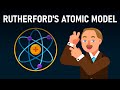
Understanding Rutherford's Atomic Model

Interactive Video
•
Chemistry
•
9th - 10th Grade
•
Practice Problem
•
Hard

Jennifer Brown
FREE Resource
5 questions
Show all answers
1.
MULTIPLE CHOICE QUESTION
30 sec • 1 pt
What was the main idea behind J. J. Thomson's 'Plum Pudding' model?
Electrons are embedded in a positively charged cloud.
Electrons orbit the nucleus in fixed paths.
Atoms consist of a central nucleus surrounded by electrons.
Atoms are mostly empty space with a dense nucleus.
2.
MULTIPLE CHOICE QUESTION
30 sec • 1 pt
What unexpected result did Rutherford observe in his gold foil experiment?
Some alpha particles were deflected at large angles.
Alpha particles emitted light when hitting the foil.
Alpha particles were absorbed by the gold foil.
All alpha particles passed through the foil without deflection.
3.
MULTIPLE CHOICE QUESTION
30 sec • 1 pt
What did Rutherford conclude about the structure of the atom from his experiment?
Atoms have no internal structure.
Atoms are made entirely of electrons.
Atoms have a dense, positively charged nucleus.
Atoms are solid spheres.
4.
MULTIPLE CHOICE QUESTION
30 sec • 1 pt
What is a major limitation of Rutherford's Nuclear Model according to classical electrodynamics?
It claims that protons and electrons are the same.
It suggests that atoms are indivisible.
It states that atoms cannot emit light.
It predicts that electrons should spiral into the nucleus.
5.
MULTIPLE CHOICE QUESTION
30 sec • 1 pt
Despite its limitations, what was a significant contribution of Rutherford's model?
It provided a fundamental understanding of atomic structure.
It described the quantum nature of electrons.
It introduced the concept of atomic isotopes.
It explained the chemical behavior of elements.
Access all questions and much more by creating a free account
Create resources
Host any resource
Get auto-graded reports

Continue with Google

Continue with Email

Continue with Classlink

Continue with Clever
or continue with

Microsoft
%20(1).png)
Apple

Others
Already have an account?
Similar Resources on Wayground

8 questions
1st hour - The Chemistry of Life
Interactive video
•
10th Grade
11 questions
Understanding Boiling Points and Intermolecular Forces
Interactive video
•
9th - 10th Grade
11 questions
Atomic Mass and Atomic Number Quiz
Interactive video
•
9th - 10th Grade
11 questions
Understanding Atomic Bonds
Interactive video
•
9th - 10th Grade
6 questions
Understanding Atomic Models
Interactive video
•
9th - 10th Grade
6 questions
Understanding Electron Guns and Cathode Rays
Interactive video
•
9th - 10th Grade
6 questions
Photosynthesis: Light-Dependent Reactions
Interactive video
•
9th - 10th Grade
Popular Resources on Wayground
8 questions
Spartan Way - Classroom Responsible

Quiz
•
9th - 12th Grade
15 questions
Fractions on a Number Line
Quiz
•
3rd Grade
14 questions
Boundaries & Healthy Relationships

Lesson
•
6th - 8th Grade
20 questions
Equivalent Fractions
Quiz
•
3rd Grade
3 questions
Integrity and Your Health
Lesson
•
6th - 8th Grade
25 questions
Multiplication Facts
Quiz
•
5th Grade
9 questions
FOREST Perception
Lesson
•
KG
20 questions
Main Idea and Details
Quiz
•
5th Grade
Discover more resources for Chemistry
22 questions
Unit 9 Gas Law Quiz
Quiz
•
10th Grade
20 questions
Types of Chemical Reactions
Quiz
•
9th - 12th Grade
13 questions
Solubility Curves
Quiz
•
10th Grade
20 questions
momentum and impulse
Quiz
•
9th - 12th Grade
22 questions
Solubility Curve Practice
Quiz
•
10th Grade
40 questions
Unit 3 (Part 1) Chemical Equations & Reactions Review Game
Quiz
•
8th - 12th Grade
35 questions
Types of Chemical Reactions
Quiz
•
9th - 12th Grade
15 questions
Ionic Bonding
Quiz
•
10th - 11th Grade