
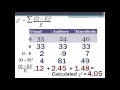
Chi-Square Quiz

Interactive Video
•
Mathematics
•
9th - 10th Grade
•
Practice Problem
•
Hard

Jennifer Brown
FREE Resource
10 questions
Show all answers
1.
MULTIPLE CHOICE QUESTION
30 sec • 1 pt
What type of data is chi-square used for?
Ordinal data
Continuous data
Interval data
Nominal or categorical data
2.
MULTIPLE CHOICE QUESTION
30 sec • 1 pt
What does the null hypothesis in a chi-square test state?
Observed frequencies are less than expected frequencies
Observed frequencies are not related to expected frequencies
Observed frequencies are greater than expected frequencies
Observed frequencies are equal to expected frequencies
3.
MULTIPLE CHOICE QUESTION
30 sec • 1 pt
How do you calculate the expected frequency in a chi-square test?
Total sample size multiplied by the number of categories
Total sample size divided by the number of categories
Total sample size minus the number of categories
Total sample size plus the number of categories
4.
MULTIPLE CHOICE QUESTION
30 sec • 1 pt
What is the formula for calculating the chi-square statistic?
Sum of (observed - expected) squared divided by expected
Sum of (expected - observed) squared divided by observed
Sum of (expected - observed) divided by observed
Sum of (observed - expected) divided by expected
5.
MULTIPLE CHOICE QUESTION
30 sec • 1 pt
What does a higher calculated chi-square value than the critical value indicate?
Accept the alternative hypothesis
Reject the null hypothesis
Accept the null hypothesis
Reject the alternative hypothesis
6.
MULTIPLE CHOICE QUESTION
30 sec • 1 pt
What is the significance of degrees of freedom in a chi-square test?
It indicates the number of categories minus one
It measures the difference between observed and expected frequencies
It shows the level of confidence
It determines the sample size
7.
MULTIPLE CHOICE QUESTION
30 sec • 1 pt
If the calculated chi-square is zero, what does it imply?
There is a significant difference between observed and expected frequencies
Expected frequencies are greater than observed
Observed frequencies are greater than expected
Observed and expected frequencies are identical
Access all questions and much more by creating a free account
Create resources
Host any resource
Get auto-graded reports

Continue with Google

Continue with Email

Continue with Classlink

Continue with Clever
or continue with

Microsoft
%20(1).png)
Apple

Others
Already have an account?
Popular Resources on Wayground

8 questions
Spartan Way - Classroom Responsible

Quiz
•
9th - 12th Grade
15 questions
Fractions on a Number Line
Quiz
•
3rd Grade
14 questions
Boundaries & Healthy Relationships

Lesson
•
6th - 8th Grade
20 questions
Equivalent Fractions
Quiz
•
3rd Grade
3 questions
Integrity and Your Health
Lesson
•
6th - 8th Grade
25 questions
Multiplication Facts
Quiz
•
5th Grade
9 questions
FOREST Perception
Lesson
•
KG
20 questions
Main Idea and Details
Quiz
•
5th Grade
Discover more resources for Mathematics
20 questions
Graphing Inequalities on a Number Line
Quiz
•
6th - 9th Grade
11 questions
Adding and Subtracting Polynomials
Quiz
•
9th Grade
20 questions
Box and Whisker Plots
Quiz
•
9th Grade
18 questions
Exponential Growth and Decay
Quiz
•
9th Grade
12 questions
Equation of a Circle
Lesson
•
10th Grade
12 questions
Exponential Growth and Decay
Quiz
•
9th Grade
14 questions
Making Inferences From Samples
Quiz
•
7th - 12th Grade
24 questions
Solving Linear Equations with Variables on Both Sides
Quiz
•
9th Grade