
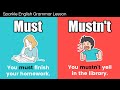
Understanding the Modal Verb 'Must' and 'Mustn't'

Interactive Video
•
English
•
6th - 7th Grade
•
Practice Problem
•
Hard

Jennifer Brown
FREE Resource
10 questions
Show all answers
1.
MULTIPLE CHOICE QUESTION
30 sec • 1 pt
What is the primary function of the modal verb 'must'?
To express a rule or obligation
To express a suggestion
To express a possibility
To express a wish
2.
MULTIPLE CHOICE QUESTION
30 sec • 1 pt
In the affirmative form, how does 'must' compare to 'have to'?
'Must' is weaker than 'have to'
'Must' is stronger than 'have to'
'Must' and 'have to' are identical
'Must' is only used in informal contexts
3.
MULTIPLE CHOICE QUESTION
30 sec • 1 pt
Which of the following is an example of using 'must' to make a deduction?
You must finish your homework.
He must be tired after the long flight.
You must not enter the restricted area.
We must pay the rent on time.
4.
MULTIPLE CHOICE QUESTION
30 sec • 1 pt
In which situation would you use 'must' to give a strong recommendation?
You must not enter the building.
You must see this movie, it's amazing.
You must be 18 to vote.
You must finish your assignment.
5.
MULTIPLE CHOICE QUESTION
30 sec • 1 pt
What does 'mustn't' express?
A possibility
A necessity
A prohibition
A suggestion
6.
MULTIPLE CHOICE QUESTION
30 sec • 1 pt
How does 'mustn't' differ from 'don't have to'?
'Mustn't' means not allowed, 'don't have to' means optional
'Mustn't' means optional, 'don't have to' means not allowed
Both mean the same thing
Both express a strong recommendation
7.
MULTIPLE CHOICE QUESTION
30 sec • 1 pt
Which sentence correctly uses the affirmative form of 'must'?
We mustn't forget the keys.
They must leave early.
She must to go now.
He musts finish his work.
Access all questions and much more by creating a free account
Create resources
Host any resource
Get auto-graded reports

Continue with Google

Continue with Email

Continue with Classlink

Continue with Clever
or continue with

Microsoft
%20(1).png)
Apple

Others
Already have an account?


