
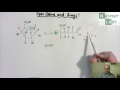
Understanding Carbohydrates: Open Chains and Rings

Interactive Video
•
Chemistry
•
11th Grade - University
•
Practice Problem
•
Hard

Nancy Jackson
FREE Resource
10 questions
Show all answers
1.
MULTIPLE CHOICE QUESTION
30 sec • 1 pt
Which of the following is NOT a type of carbohydrate discussed in the video?
Polysaccharide
Trisaccharide
Disaccharide
Monosaccharide
2.
MULTIPLE CHOICE QUESTION
30 sec • 1 pt
What unique ability does glucose have compared to other ring structures in inorganic chemistry?
It can form a double bond with oxygen.
It can open and close its ring structure.
It can form a crystalline structure.
It can dissolve in water without energy input.
3.
MULTIPLE CHOICE QUESTION
30 sec • 1 pt
What causes the glucose ring to open and close?
The presence of a strong acid
The interaction between electronegative oxygen and positive carbon
The addition of heat
The presence of a catalyst
4.
MULTIPLE CHOICE QUESTION
30 sec • 1 pt
In the context of the video, what does the term 'equilibrium' refer to?
The stability of glucose in crystalline form
The constant interconversion between the ring and open chain forms of glucose
The balance between different types of carbohydrates
The reaction between glucose and fructose
5.
MULTIPLE CHOICE QUESTION
30 sec • 1 pt
What is the role of the electronegative oxygen in glucose?
It stabilizes the glucose molecule.
It attracts the positive carbon, facilitating ring opening and closing.
It prevents glucose from dissolving in water.
It forms a double bond with carbon.
6.
MULTIPLE CHOICE QUESTION
30 sec • 1 pt
Why is the open chain form of glucose important?
It allows glucose to dissolve in water.
It is responsible for the behavior of reducing sugars.
It helps glucose form a crystalline structure.
It makes glucose more stable.
7.
MULTIPLE CHOICE QUESTION
30 sec • 1 pt
Which group is responsible for the reducing properties of sugars?
Hydroxyl group
Aldehyde group
Carboxyl group
Amine group
Access all questions and much more by creating a free account
Create resources
Host any resource
Get auto-graded reports

Continue with Google

Continue with Email

Continue with Classlink

Continue with Clever
or continue with

Microsoft
%20(1).png)
Apple

Others
Already have an account?

