
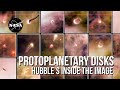
Hubble and Planet Formation

Interactive Video
•
Physics
•
9th - 10th Grade
•
Practice Problem
•
Hard

Jennifer Brown
FREE Resource
5 questions
Show all answers
1.
MULTIPLE CHOICE QUESTION
30 sec • 1 pt
What did the initial images from Hubble reveal about young stars in the Orion region?
They are moving away from the Orion region.
They are older than previously thought.
They are surrounded by material forming planetary systems.
They have no material around them.
2.
MULTIPLE CHOICE QUESTION
30 sec • 1 pt
What was the primary basis for early planet formation models?
Theories from ancient astronomers.
The structure of our own solar system.
Observations from other galaxies.
Data from the Voyager spacecraft.
3.
MULTIPLE CHOICE QUESTION
30 sec • 1 pt
Which planets are considered the gas giants in our solar system?
Mercury, Venus, Earth, Mars
Jupiter, Saturn, Uranus, Neptune
Pluto, Eris, Haumea, Makemake
Ceres, Vesta, Pallas, Hygiea
4.
MULTIPLE CHOICE QUESTION
30 sec • 1 pt
What new capability did Hubble provide in the study of exoplanets?
Analyzing the atmospheres of planets outside our solar system.
Detecting black holes.
Mapping the surface of Mars.
Measuring the distance to stars.
5.
MULTIPLE CHOICE QUESTION
30 sec • 1 pt
What is the significance of studying exoplanet atmospheres?
It allows for the discovery of new elements.
It confirms the existence of life on other planets.
It provides insights into planet formation around other stars.
It helps in predicting weather patterns on Earth.
Access all questions and much more by creating a free account
Create resources
Host any resource
Get auto-graded reports

Continue with Google

Continue with Email

Continue with Classlink

Continue with Clever
or continue with

Microsoft
%20(1).png)
Apple

Others
Already have an account?

