
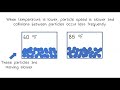
States of Matter and Particle Motion

Interactive Video
•
Physics
•
9th - 10th Grade
•
Practice Problem
•
Medium

Nancy Jackson
Used 6+ times
FREE Resource
5 questions
Show all answers
1.
MULTIPLE CHOICE QUESTION
30 sec • 1 pt
How do molecules in a solid differ from those in a liquid?
Molecules in a solid are spread out and take the shape of their container, while those in a liquid are tightly packed.
Molecules in a solid move freely and collide randomly, while those in a liquid are tightly packed.
Molecules in a solid move very quickly, while those in a liquid are stationary.
Molecules in a solid are tightly packed and vibrate in place, while those in a liquid are spread out and move freely.
2.
MULTIPLE CHOICE QUESTION
30 sec • 1 pt
What happens to particle speed and collision frequency as temperature increases?
Particle speed decreases and collision frequency remains constant.
Particle speed remains constant and collision frequency decreases.
Particle speed increases and collision frequency increases.
Particle speed decreases and collision frequency decreases.
3.
MULTIPLE CHOICE QUESTION
30 sec • 1 pt
What is the result of increasing the temperature of a liquid?
The liquid turns into a plasma.
The liquid turns into a solid.
The liquid turns into a gas.
The liquid remains unchanged.
4.
MULTIPLE CHOICE QUESTION
30 sec • 1 pt
In which states of matter do particle collisions occur?
In solids, liquids, and gases
In both gases and liquids
Only in gases
Only in solids
5.
MULTIPLE CHOICE QUESTION
30 sec • 1 pt
What happens to scent molecules when you spray perfume in a room?
They remain concentrated in one area.
They spread out evenly due to collisions.
They sink to the floor.
They disappear immediately.
Access all questions and much more by creating a free account
Create resources
Host any resource
Get auto-graded reports

Continue with Google

Continue with Email

Continue with Microsoft
or continue with

%20(1).png)
Apple

Others
Already have an account?


