
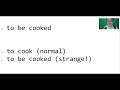
Active and Passive Infinitives

Interactive Video
•
English
•
6th - 7th Grade
•
Practice Problem
•
Hard

Richard Gonzalez
FREE Resource
Read more
8 questions
Show all answers
1.
MULTIPLE CHOICE QUESTION
30 sec • 1 pt
What is the main focus of the lesson introduced at the beginning?
Active infinitives
Past participles
Passive infinitives
Gerunds
2.
MULTIPLE CHOICE QUESTION
30 sec • 1 pt
Which of the following is an example of a normal infinitive?
To have been running
To run
To have cooked
To be cooked
3.
MULTIPLE CHOICE QUESTION
30 sec • 1 pt
How does a passive infinitive differ from a normal infinitive?
It uses 'to' and a verb
It uses 'to have been' and a verb
It uses 'to be' and a past participle
It uses 'to have' and a verb
4.
MULTIPLE CHOICE QUESTION
30 sec • 1 pt
What is the implication of the sentence 'She likes to be cooked food'?
She likes to eat cooked food
She wants to be cooked as food
She prefers raw food
She enjoys cooking food
5.
MULTIPLE CHOICE QUESTION
30 sec • 1 pt
In the context of waking up, what does 'active' mean?
You stay asleep
Someone else wakes you up
You wake up by yourself
You wake someone else up
6.
MULTIPLE CHOICE QUESTION
30 sec • 1 pt
What does it mean if someone likes to be woken up in the morning?
They want someone else to wake them up
They dislike mornings
They enjoy waking others up
They prefer to wake up on their own
7.
MULTIPLE CHOICE QUESTION
30 sec • 1 pt
How do people meet new friends actively?
By staying in one place
By going out to meet them
By avoiding social interactions
By waiting for friends to come
Access all questions and much more by creating a free account
Create resources
Host any resource
Get auto-graded reports

Continue with Google

Continue with Email

Continue with Classlink

Continue with Clever
or continue with

Microsoft
%20(1).png)
Apple

Others
Already have an account?


