
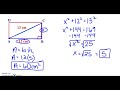
Area and Properties of Shapes

Interactive Video
•
Mathematics
•
6th - 7th Grade
•
Hard
Thomas White
FREE Resource
Read more
11 questions
Show all answers
1.
MULTIPLE CHOICE QUESTION
30 sec • 1 pt
What is the main focus of today's lesson?
Reviewing the areas of rectangles and parallelograms
Calculating the volume of 3D shapes
Exploring the properties of circles
Learning about the history of geometry
2.
MULTIPLE CHOICE QUESTION
30 sec • 1 pt
Which of the following best describes 'area' in geometry?
The angle between two lines
The distance between two points
The length of the perimeter of a shape
The measure of the size of the interior of a figure
3.
MULTIPLE CHOICE QUESTION
30 sec • 1 pt
What is the role of the 'base' in calculating the area of a polygon?
It is always the longest side of the polygon
It is the diagonal of the polygon
It is the side used to calculate the perimeter
It is a side of the polygon used in area calculations
4.
MULTIPLE CHOICE QUESTION
30 sec • 1 pt
How is 'altitude' defined in the context of geometry?
The sum of all sides of a polygon
A segment from the vertex perpendicular to the base
The angle between two sides
The longest side of a triangle
5.
MULTIPLE CHOICE QUESTION
30 sec • 1 pt
What is the formula for the area of a rectangle?
A = base + height
A = base x height
A = base / height
A = 2 x (base + height)
6.
MULTIPLE CHOICE QUESTION
30 sec • 1 pt
How does the area formula for a parallelogram compare to that of a rectangle?
It uses the diagonal instead of the height
It involves the perimeter instead of the base
It is the same: A = base x height
It is different because parallelograms are slanted
7.
MULTIPLE CHOICE QUESTION
30 sec • 1 pt
In the example of finding the area of a rectangle, what is the result when the base is 8 and the height is 5?
40 square units
13 square units
20 square units
60 square units
Access all questions and much more by creating a free account
Create resources
Host any resource
Get auto-graded reports

Continue with Google

Continue with Email

Continue with Classlink

Continue with Clever
or continue with

Microsoft
%20(1).png)
Apple

Others
Already have an account?

