
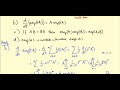
Matrix Exponentials and Convergence Concepts

Interactive Video
•
Mathematics
•
11th - 12th Grade
•
Hard

Thomas White
FREE Resource
Read more
8 questions
Show all answers
1.
MULTIPLE CHOICE QUESTION
30 sec • 1 pt
What is the matrix exponential defined as?
A product of matrices
A differential equation
A sum of matrices
A power series
2.
MULTIPLE CHOICE QUESTION
30 sec • 1 pt
What does absolute convergence of a series imply?
The series diverges
The series can be reordered without changing its sum
The series converges only for specific values
The series is finite
3.
MULTIPLE CHOICE QUESTION
30 sec • 1 pt
What is the significance of uniform convergence in the context of matrix exponentials?
It limits the series to bounded matrices
It ensures the series is always positive
It restricts the series to finite terms
It allows differentiation inside the summation
4.
MULTIPLE CHOICE QUESTION
30 sec • 1 pt
What happens when you differentiate the matrix exponential with respect to a variable t?
You get a zero matrix
You get a scalar value
You get the original matrix
You get a new matrix multiplied by the original matrix
5.
MULTIPLE CHOICE QUESTION
30 sec • 1 pt
In the example provided, what matrix is used to demonstrate the differentiation property?
An identity matrix
A rotation matrix
A zero matrix
A diagonal matrix
6.
MULTIPLE CHOICE QUESTION
30 sec • 1 pt
What condition must matrices A and B satisfy for the commutativity property to hold?
A and B must be zero matrices
A and B must be identity matrices
A and B must commute
A and B must be diagonal
7.
MULTIPLE CHOICE QUESTION
30 sec • 1 pt
What mathematical concept is used to prove the commutativity property?
Eigenvalue decomposition
Binomial expansion
Differential equations
Matrix inversion
Access all questions and much more by creating a free account
Create resources
Host any resource
Get auto-graded reports

Continue with Google

Continue with Email

Continue with Classlink

Continue with Clever
or continue with

Microsoft
%20(1).png)
Apple

Others
Already have an account?
Similar Resources on Wayground
Popular Resources on Wayground

7 questions
History of Valentine's Day
Interactive video
•
4th Grade
15 questions
Fractions on a Number Line

Quiz
•
3rd Grade
20 questions
Equivalent Fractions
Quiz
•
3rd Grade
25 questions
Multiplication Facts
Quiz
•
5th Grade
22 questions
fractions
Quiz
•
3rd Grade
15 questions
Valentine's Day Trivia
Quiz
•
3rd Grade
20 questions
Main Idea and Details
Quiz
•
5th Grade
20 questions
Context Clues
Quiz
•
6th Grade
Discover more resources for Mathematics
10 questions
Factor Quadratic Expressions with Various Coefficients
Quiz
•
9th - 12th Grade
10 questions
Evaluating Piecewise Functions Practice
Quiz
•
11th Grade
5 questions
Triangle Congruence Theorems
Interactive video
•
9th - 12th Grade
15 questions
Exponential Growth and Decay Word Problems Practice
Quiz
•
9th - 12th Grade
21 questions
Converting between Logs and Exponents
Quiz
•
11th Grade
20 questions
Classifying polynomials
Quiz
•
11th Grade
20 questions
special right triangles
Quiz
•
9th - 12th Grade
20 questions
Interpreting Scatter Plots
Quiz
•
8th - 12th Grade