
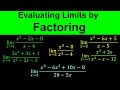
Factoring and Limits in Algebra

Interactive Video
•
Mathematics
•
9th - 10th Grade
•
Practice Problem
•
Hard

Thomas White
FREE Resource
Read more
8 questions
Show all answers
1.
MULTIPLE CHOICE QUESTION
30 sec • 1 pt
What is the main goal of the video tutorial?
To study the properties of exponential functions
To explore integration techniques
To understand the concept of derivatives
To learn how to find limits using the factoring method
2.
MULTIPLE CHOICE QUESTION
30 sec • 1 pt
Why can't we find the limit by direct substitution in the given example?
Because it results in a negative value
Because it results in a complex number
Because it results in an indeterminate form
Because it results in an undefined expression
3.
MULTIPLE CHOICE QUESTION
30 sec • 1 pt
What is the first step in factoring a quadratic expression?
Finding the derivative
Setting the expression equal to zero
Putting two brackets and placing x in each
Using the quadratic formula
4.
MULTIPLE CHOICE QUESTION
30 sec • 1 pt
In the second example, what is the common factor in the numerator?
x + 1
x - 4
x + 3
x - 5
5.
MULTIPLE CHOICE QUESTION
30 sec • 1 pt
What is the general rule for finding the common factor in limits?
The common factor is x - a where x approaches a
The common factor is always x + a
The common factor is always x - 1
The common factor is x squared
6.
MULTIPLE CHOICE QUESTION
30 sec • 1 pt
In the complex example, what identity is used to factor the numerator?
Difference of squares
Difference of cubes
Quadratic formula
Sum of cubes
7.
MULTIPLE CHOICE QUESTION
30 sec • 1 pt
What is the advantage of using synthetic division over long division?
It can be used for any polynomial
It requires less knowledge of algebra
It is faster and simpler
It is more accurate
Access all questions and much more by creating a free account
Create resources
Host any resource
Get auto-graded reports

Continue with Google

Continue with Email

Continue with Classlink

Continue with Clever
or continue with

Microsoft
%20(1).png)
Apple

Others
Already have an account?

