
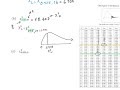
Chi-Square Distribution Concepts

Interactive Video
•
Mathematics
•
10th - 12th Grade
•
Practice Problem
•
Hard

Thomas White
FREE Resource
Read more
9 questions
Show all answers
1.
MULTIPLE CHOICE QUESTION
30 sec • 1 pt
What is the main focus of Section 7.4?
Confidence intervals for proportions
Confidence intervals for Z
Confidence intervals for mu
Confidence intervals for Sigma square
2.
MULTIPLE CHOICE QUESTION
30 sec • 1 pt
Which distribution is introduced in Section 7.4?
Normal distribution
Binomial distribution
T distribution
Chi-square distribution
3.
MULTIPLE CHOICE QUESTION
30 sec • 1 pt
What is the purpose of the chi-square table?
To find chi-square values
To find T values
To find Z values
To find proportions
4.
MULTIPLE CHOICE QUESTION
30 sec • 1 pt
How do you determine the degrees of freedom for chi-square?
2n
n
n - 1
n + 1
5.
MULTIPLE CHOICE QUESTION
30 sec • 1 pt
Why is the chi-square distribution not symmetrical?
It is based on a normal distribution
It includes negative values
It is based on a binomial distribution
It only includes positive values
6.
MULTIPLE CHOICE QUESTION
30 sec • 1 pt
What is the first step in finding chi-square values?
Find the right side
Calculate the mean
Determine the sample size
Find the left side
7.
MULTIPLE CHOICE QUESTION
30 sec • 1 pt
What is the key difference when using chi-square for confidence intervals?
It uses negative values
It is symmetrical
It does not use plus or minus
It is based on proportions
Access all questions and much more by creating a free account
Create resources
Host any resource
Get auto-graded reports

Continue with Google

Continue with Email

Continue with Classlink

Continue with Clever
or continue with

Microsoft
%20(1).png)
Apple

Others
Already have an account?
Similar Resources on Wayground

11 questions
Complex Numbers and Operations
Interactive video
•
9th - 12th Grade
11 questions
Trigonometry and Complex Numbers Concepts
Interactive video
•
9th - 12th Grade
11 questions
Exponential Functions and Bacterial Growth
Interactive video
•
9th - 12th Grade
11 questions
Maximizing Area of Rectangles
Interactive video
•
9th - 12th Grade
11 questions
Understanding Geometric Random Variables
Interactive video
•
9th - 12th Grade
11 questions
Understanding Area Approximation with Right-Sided Rectangles
Interactive video
•
9th - 12th Grade
11 questions
Measures of Central Tendency
Interactive video
•
9th - 12th Grade
Popular Resources on Wayground
15 questions
Fractions on a Number Line

Quiz
•
3rd Grade
20 questions
Equivalent Fractions
Quiz
•
3rd Grade
25 questions
Multiplication Facts
Quiz
•
5th Grade
29 questions
Alg. 1 Section 5.1 Coordinate Plane
Quiz
•
9th Grade
22 questions
fractions
Quiz
•
3rd Grade
11 questions
FOREST Effective communication

Lesson
•
KG
20 questions
Main Idea and Details
Quiz
•
5th Grade
20 questions
Context Clues
Quiz
•
6th Grade
Discover more resources for Mathematics
20 questions
SSS/SAS
Quiz
•
9th - 12th Grade
14 questions
Making Inferences From Samples
Quiz
•
7th - 12th Grade
23 questions
CCG - CH8 Polygon angles and area Review
Quiz
•
9th - 12th Grade
15 questions
Module 3 Topic 1 Vocabulary Quiz
Quiz
•
10th Grade
16 questions
Properties of Quadrilaterals
Quiz
•
11th Grade
20 questions
Domain and Range Spiral Review
Quiz
•
9th - 12th Grade
15 questions
Characteristics of Quadratics
Quiz
•
9th - 10th Grade
20 questions
Triangle Proportionality Theorem
Quiz
•
9th - 10th Grade