
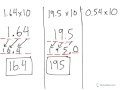
Multiplying Decimals by 10

Interactive Video
•
Mathematics
•
4th - 5th Grade
•
Practice Problem
•
Hard

Emma Peterson
FREE Resource
Read more
10 questions
Show all answers
1.
MULTIPLE CHOICE QUESTION
30 sec • 1 pt
What happens to the decimal point when you multiply a decimal by 10?
It moves one place to the right.
It stays in the same position.
It disappears.
It moves two places to the left.
2.
MULTIPLE CHOICE QUESTION
30 sec • 1 pt
How does multiplying a decimal by 10 affect the digits of the number?
All digits move one place to the right.
All digits move one place to the left.
Digits remain in the same position.
Digits disappear.
3.
MULTIPLE CHOICE QUESTION
30 sec • 1 pt
When multiplying 1.64 by 10, what is the resulting number?
164
0.164
1.64
16.4
4.
MULTIPLE CHOICE QUESTION
30 sec • 1 pt
What is the result of multiplying 1.64 by 10?
164
16.4
1.64
0.164
5.
MULTIPLE CHOICE QUESTION
30 sec • 1 pt
In the example of multiplying 19.5 by 10, what is the final result?
1950
195
1.95
19.5
6.
MULTIPLE CHOICE QUESTION
30 sec • 1 pt
Why is it unnecessary to write zeros after the decimal point in 195.000?
Because they add value to the number.
Because they do not change the value of the number.
Because they make the number larger.
Because they are placeholders.
7.
MULTIPLE CHOICE QUESTION
30 sec • 1 pt
What is the importance of keeping a zero before the decimal point?
It indicates a whole number.
It shows there is no whole number value.
It makes the number larger.
It is required for all decimal numbers.
Access all questions and much more by creating a free account
Create resources
Host any resource
Get auto-graded reports

Continue with Google

Continue with Email

Continue with Classlink

Continue with Clever
or continue with

Microsoft
%20(1).png)
Apple

Others
Already have an account?


