
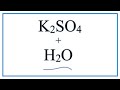
Chemical Reactions and Ionic Compounds

Interactive Video
•
Chemistry
•
9th - 10th Grade
•
Practice Problem
•
Hard

Aiden Montgomery
FREE Resource
Read more
8 questions
Show all answers
1.
MULTIPLE CHOICE QUESTION
30 sec • 1 pt
What type of compound is formed when a metal combines with nonmetals?
Organic compound
Ionic compound
Metallic compound
Covalent compound
2.
MULTIPLE CHOICE QUESTION
30 sec • 1 pt
What is the charge of a potassium ion (K) in the periodic table?
0
+2
+1
-1
3.
MULTIPLE CHOICE QUESTION
30 sec • 1 pt
How do you determine the charge of the sulfate ion (SO4)?
By looking at the periodic table
By observing its color
By using a table of polyatomic ions
By measuring its pH
4.
MULTIPLE CHOICE QUESTION
30 sec • 1 pt
What happens to K2SO4 when it is placed in water?
It evaporates
It forms a precipitate
It remains unchanged
It dissolves into ions
5.
MULTIPLE CHOICE QUESTION
30 sec • 1 pt
Why is a coefficient of 2 placed in front of K+ in the balanced equation?
To balance the charge
To balance the number of potassium ions
To indicate a solid state
To show a reaction with water
6.
MULTIPLE CHOICE QUESTION
30 sec • 1 pt
What does 'aq' signify when written after an ion in a chemical equation?
The ion is in a liquid state
The ion is dissolved in water
The ion is in a solid state
The ion is in a gaseous state
7.
MULTIPLE CHOICE QUESTION
30 sec • 1 pt
Why is liquid water (H2O) not written on the product side of the equation?
Because it forms a new compound
Because 'aq' already indicates the presence of water
Because it evaporates
Because it is not involved in the reaction
Access all questions and much more by creating a free account
Create resources
Host any resource
Get auto-graded reports

Continue with Google

Continue with Email

Continue with Classlink

Continue with Clever
or continue with

Microsoft
%20(1).png)
Apple

Others
Already have an account?

