
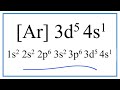
Chromium's Electron Configuration Concepts

Interactive Video
•
Chemistry
•
9th - 10th Grade
•
Practice Problem
•
Hard

Olivia Brooks
FREE Resource
Read more
10 questions
Show all answers
1.
MULTIPLE CHOICE QUESTION
30 sec • 1 pt
What is the electron configuration that ends in 3d5 4s1 used to identify?
The element with atomic number 24
The element with atomic number 26
The element with atomic number 30
The element with atomic number 28
2.
MULTIPLE CHOICE QUESTION
30 sec • 1 pt
How many electrons are present in the electron configuration discussed in the video?
23
25
22
24
3.
MULTIPLE CHOICE QUESTION
30 sec • 1 pt
What does the atomic number of an element represent?
The number of isotopes
The number of protons
The number of electrons
The number of neutrons
4.
MULTIPLE CHOICE QUESTION
30 sec • 1 pt
What does the neutrality of an element imply about its electrons and protons?
Electrons are more than protons
Neutrons equal protons
Protons are more than electrons
Electrons equal protons
5.
MULTIPLE CHOICE QUESTION
30 sec • 1 pt
Why is chromium's electron configuration considered exceptional?
It has more electrons than expected
It has fewer protons than expected
It has a different arrangement of electrons than expected
It has a different number of neutrons than expected
6.
MULTIPLE CHOICE QUESTION
30 sec • 1 pt
What is the expected electron configuration for chromium?
4s1 3d5
4s1 3d4
4s2 3d4
4s2 3d5
7.
MULTIPLE CHOICE QUESTION
30 sec • 1 pt
What is the significance of the 4s and 3d orbitals in chromium's configuration?
The 3d orbital is always filled before the 4s orbital
The 4s orbital is filled after the 3d orbital in chromium
The 4s orbital is always filled before the 3d orbital
The 3d orbital is filled after the 4s orbital in chromium
Access all questions and much more by creating a free account
Create resources
Host any resource
Get auto-graded reports

Continue with Google

Continue with Email

Continue with Classlink

Continue with Clever
or continue with

Microsoft
%20(1).png)
Apple

Others
Already have an account?


