
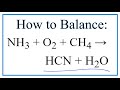
Balancing Chemical Equations Concepts

Interactive Video
•
Chemistry
•
9th - 10th Grade
•
Practice Problem
•
Hard

Sophia Harris
FREE Resource
Read more
10 questions
Show all answers
1.
MULTIPLE CHOICE QUESTION
30 sec • 1 pt
What is the initial number of hydrogen atoms on the reactant side before balancing?
3
10
4
7
2.
MULTIPLE CHOICE QUESTION
30 sec • 1 pt
Why is it suggested to balance oxygen atoms last in this equation?
Oxygen is not reactive.
Oxygen is a noble gas.
Oxygen is present in multiple compounds.
Oxygen is the most abundant element.
3.
MULTIPLE CHOICE QUESTION
30 sec • 1 pt
What is the result of placing a coefficient of 2 in front of NH3?
It balances the carbon atoms.
It results in 2 nitrogen atoms.
It results in 4 hydrogen atoms.
It balances the oxygen atoms.
4.
MULTIPLE CHOICE QUESTION
30 sec • 1 pt
What is the challenge faced after balancing nitrogen and carbon atoms?
Oxygen atoms are unbalanced.
Hydrogen atoms are unbalanced.
Carbon atoms are unbalanced.
Nitrogen atoms are unbalanced.
5.
MULTIPLE CHOICE QUESTION
30 sec • 1 pt
What is the total number of hydrogen atoms on the product side after balancing?
8
12
10
14
6.
MULTIPLE CHOICE QUESTION
30 sec • 1 pt
What is the final step to balance the oxygen atoms in the equation?
Add a coefficient of 6 in front of NH3.
Add a coefficient of 4 in front of CH4.
Add a coefficient of 2 in front of H2O.
Add a coefficient of 3 in front of O2.
7.
MULTIPLE CHOICE QUESTION
30 sec • 1 pt
What strategy is highlighted as useful in balancing this equation?
Balancing the heaviest element first.
Using trial and error to find the right coefficients.
Balancing the lightest element first.
Ignoring the oxygen atoms completely.
Access all questions and much more by creating a free account
Create resources
Host any resource
Get auto-graded reports

Continue with Google

Continue with Email

Continue with Classlink

Continue with Clever
or continue with

Microsoft
%20(1).png)
Apple

Others
Already have an account?

