
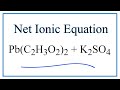
Net Ionic Equations and Spectator Ions

Interactive Video
•
Chemistry
•
9th - 10th Grade
•
Practice Problem
•
Hard

Jackson Turner
FREE Resource
Read more
10 questions
Show all answers
1.
MULTIPLE CHOICE QUESTION
30 sec • 1 pt
What is the first step in writing a balanced net ionic equation?
Write the complete ionic equation
Identify the spectator ions
Balance the molecular equation
Determine the solubility of compounds
2.
MULTIPLE CHOICE QUESTION
30 sec • 1 pt
How do you balance the number of acetate ions in the molecular equation?
Add a coefficient of 2 in front of potassium acetate
Add a coefficient of 2 in front of lead(II) sulfate
Add a coefficient of 2 in front of potassium sulfate
Add a coefficient of 2 in front of lead(II) acetate
3.
MULTIPLE CHOICE QUESTION
30 sec • 1 pt
Which compound is an exception to the general solubility of sulfate ions?
Potassium acetate
Acetate ion
Lead(II) sulfate
Potassium sulfate
4.
MULTIPLE CHOICE QUESTION
30 sec • 1 pt
What happens to the precipitate formed in the reaction?
It dissolves in water
It remains as ions in solution
It falls to the bottom of the test tube
It reacts with other ions
5.
MULTIPLE CHOICE QUESTION
30 sec • 1 pt
What is the purpose of writing the complete ionic equation?
To determine the solubility of compounds
To balance the charges
To split strong electrolytes into ions
To identify the precipitate
6.
MULTIPLE CHOICE QUESTION
30 sec • 1 pt
Which ions are not split in the complete ionic equation?
Ions forming a solid precipitate
Ions in aqueous solution
Spectator ions
All ions are split
7.
MULTIPLE CHOICE QUESTION
30 sec • 1 pt
What are spectator ions?
Ions that do not participate in the reaction
Ions that form a precipitate
Ions that balance the charges
Ions that are insoluble
Access all questions and much more by creating a free account
Create resources
Host any resource
Get auto-graded reports

Continue with Google

Continue with Email

Continue with Classlink

Continue with Clever
or continue with

Microsoft
%20(1).png)
Apple

Others
Already have an account?
Similar Resources on Wayground

6 questions
Understanding Binary Ionic Compounds
Interactive video
•
9th - 10th Grade
6 questions
Counting Valence Electrons Quiz
Interactive video
•
9th - 10th Grade
6 questions
Understanding Ionic Compounds
Interactive video
•
9th - 10th Grade
6 questions
Understanding Covalent and Ionic Bonds
Interactive video
•
9th - 10th Grade
11 questions
Net Ionic Equations Quiz
Interactive video
•
9th - 10th Grade
11 questions
Qualitative Tests for Anions Quiz
Interactive video
•
9th - 10th Grade
11 questions
Ionic Compounds Naming Quiz
Interactive video
•
9th - 10th Grade
11 questions
Periodic Trends Quiz
Interactive video
•
9th - 10th Grade
Popular Resources on Wayground
15 questions
Fractions on a Number Line

Quiz
•
3rd Grade
20 questions
Equivalent Fractions
Quiz
•
3rd Grade
25 questions
Multiplication Facts
Quiz
•
5th Grade
29 questions
Alg. 1 Section 5.1 Coordinate Plane
Quiz
•
9th Grade
22 questions
fractions
Quiz
•
3rd Grade
11 questions
FOREST Effective communication

Lesson
•
KG
20 questions
Main Idea and Details
Quiz
•
5th Grade
20 questions
Context Clues
Quiz
•
6th Grade
Discover more resources for Chemistry
22 questions
Unit 9 Gas Law Quiz
Quiz
•
10th Grade
10 questions
Exploring Types of Chemical Reactions
Interactive video
•
6th - 10th Grade
20 questions
Types of Chemical Reactions
Quiz
•
9th - 12th Grade
20 questions
Acids and Bases
Quiz
•
10th Grade
30 questions
Energy Review
Quiz
•
9th Grade
7 questions
GCSE Chemistry - Balancing Chemical Equations #4
Interactive video
•
9th - 10th Grade
20 questions
Chemistry: Classification of Matter
Quiz
•
10th Grade
40 questions
Unit 3 (Part 1) Chemical Equations & Reactions Review Game
Quiz
•
8th - 12th Grade