
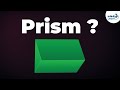
Understanding Prisms and Their Properties

Interactive Video
•
Mathematics
•
6th - 7th Grade
•
Practice Problem
•
Hard
Thomas White
FREE Resource
Read more
10 questions
Show all answers
1.
MULTIPLE CHOICE QUESTION
30 sec • 1 pt
What is the main reason people find the definition of a prism confusing?
It is too short and lacks detail.
It involves too many technical terms.
It is not commonly used in everyday language.
It uses terms like identical, parallel, and flat.
2.
MULTIPLE CHOICE QUESTION
30 sec • 1 pt
Which of the following is a key feature of a triangular prism?
It has circular ends.
It has two triangular ends and three rectangular faces.
It has four triangular faces.
It has a curved surface.
3.
MULTIPLE CHOICE QUESTION
30 sec • 1 pt
What defines a rectangular prism?
It has triangular ends.
It has two rectangular ends and four rectangular faces.
It has a curved surface.
It has circular ends.
4.
MULTIPLE CHOICE QUESTION
30 sec • 1 pt
How can you differentiate a prism from a non-prism?
By verifying it has more than four faces.
By ensuring it has identical and parallel ends with flat faces.
By confirming it has at least one triangular face.
By checking if it has curved surfaces.
5.
MULTIPLE CHOICE QUESTION
30 sec • 1 pt
What is a common misconception about rectangular prisms?
They are the same as cylinders.
They are not prisms.
They are also known as cuboids.
They have curved surfaces.
6.
MULTIPLE CHOICE QUESTION
30 sec • 1 pt
Why is a pipe with circular ends not considered a prism?
Because it has identical ends.
Because it has a curved surface.
Because it is too long.
Because it is hollow.
7.
MULTIPLE CHOICE QUESTION
30 sec • 1 pt
What happens if the ends of a shape are not parallel?
It remains a prism.
It becomes a prism.
It is not considered a prism.
It becomes a cylinder.
Access all questions and much more by creating a free account
Create resources
Host any resource
Get auto-graded reports

Continue with Google

Continue with Email

Continue with Classlink

Continue with Clever
or continue with

Microsoft
%20(1).png)
Apple

Others
Already have an account?

