
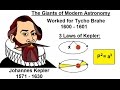
Kepler's Laws of Planetary Motion

Interactive Video
•
Physics
•
9th - 10th Grade
•
Practice Problem
•
Hard

Patricia Brown
FREE Resource
Read more
10 questions
Show all answers
1.
MULTIPLE CHOICE QUESTION
30 sec • 1 pt
What was the primary reason Kepler initially left Tycho Brahe's employment?
He wanted to work independently.
He was not paid enough to support his family.
He disagreed with Tycho's theories.
He was offered a better position elsewhere.
2.
MULTIPLE CHOICE QUESTION
30 sec • 1 pt
What did Kepler discover about the shape of planetary orbits?
They are elliptical with the sun at one focus.
They are perfectly circular.
They are random in shape.
They are spiral-shaped.
3.
MULTIPLE CHOICE QUESTION
30 sec • 1 pt
According to Kepler's second law, what happens to a planet's speed as it moves closer to the sun?
It remains constant.
It decreases.
It stops moving.
It increases.
4.
MULTIPLE CHOICE QUESTION
30 sec • 1 pt
What does Kepler's second law state about the area swept by a planet over time?
The area varies randomly.
The area swept out is equal over equal time intervals.
The area is smaller when the planet is closer to the sun.
The area is larger when the planet is closer to the sun.
5.
MULTIPLE CHOICE QUESTION
30 sec • 1 pt
What is the relationship described in Kepler's third law?
The cube of the orbital period is proportional to the square of the average distance from the sun.
The orbital period is directly proportional to the average distance from the sun.
The square of the orbital period is proportional to the square of the average distance from the sun.
The square of the orbital period is proportional to the cube of the average distance from the sun.
6.
MULTIPLE CHOICE QUESTION
30 sec • 1 pt
How did Kepler's laws change the understanding of planetary motion?
They eliminated the need for epicycles and circular orbits.
They suggested planets move in straight lines.
They introduced the concept of epicycles.
They confirmed the geocentric model.
7.
MULTIPLE CHOICE QUESTION
30 sec • 1 pt
What was Tycho Brahe's contribution to Kepler's discoveries?
He explained the gravitational forces.
He discovered the elliptical orbits.
He collected extensive observational data.
He provided the mathematical formulas.
Access all questions and much more by creating a free account
Create resources
Host any resource
Get auto-graded reports

Continue with Google

Continue with Email

Continue with Classlink

Continue with Clever
or continue with

Microsoft
%20(1).png)
Apple

Others
Already have an account?


