
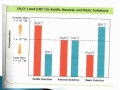
Understanding pH and pOH Concepts

Interactive Video
•
Chemistry
•
9th - 10th Grade
•
Practice Problem
•
Hard

Patricia Brown
FREE Resource
Read more
10 questions
Show all answers
1.
MULTIPLE CHOICE QUESTION
30 sec • 1 pt
What happens to water molecules during self-ionization?
They evaporate into steam.
They form hydrogen and oxygen gas.
They dissociate into hydrogen and hydroxide ions.
They become solid ice.
2.
MULTIPLE CHOICE QUESTION
30 sec • 1 pt
What is the value of the ion product constant (KW) for water at 25°C?
1 * 10^-10
1 * 10^-7
1 * 10^-14
1 * 10^-4
3.
MULTIPLE CHOICE QUESTION
30 sec • 1 pt
In a neutral solution, how do the concentrations of hydrogen and hydroxide ions compare?
They are equal.
There are no ions present.
Hydroxide ions are greater.
Hydrogen ions are greater.
4.
MULTIPLE CHOICE QUESTION
30 sec • 1 pt
If the concentration of hydrogen ions is greater than 1 * 10^-7, what can be said about the solution?
It is gaseous.
It is basic.
It is neutral.
It is acidic.
5.
MULTIPLE CHOICE QUESTION
30 sec • 1 pt
What does a pH value less than 7 indicate about a solution?
The solution is basic.
The solution is acidic.
The solution is neutral.
The solution is solid.
6.
MULTIPLE CHOICE QUESTION
30 sec • 1 pt
How is pH calculated from the concentration of hydrogen ions?
By multiplying the concentration by 10.
By adding the concentration to 7.
By taking the negative logarithm of the concentration.
By dividing the concentration by 10.
7.
MULTIPLE CHOICE QUESTION
30 sec • 1 pt
What is the relationship between pH and pOH in a solution?
They are always equal.
They are inversely proportional.
They are unrelated.
They are directly proportional.
Access all questions and much more by creating a free account
Create resources
Host any resource
Get auto-graded reports

Continue with Google

Continue with Email

Continue with Classlink

Continue with Clever
or continue with

Microsoft
%20(1).png)
Apple

Others
Already have an account?

