
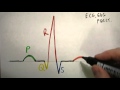
ECG Wave Characteristics and Functions

Interactive Video
•
Biology
•
9th - 10th Grade
•
Practice Problem
•
Hard

Patricia Brown
FREE Resource
Read more
10 questions
Show all answers
1.
MULTIPLE CHOICE QUESTION
30 sec • 1 pt
What does the isoelectric line represent in an ECG tracing?
A constant level of electrical activity
The peak of electrical activity
The lowest point of electrical activity
A random fluctuation in electrical activity
2.
MULTIPLE CHOICE QUESTION
30 sec • 1 pt
Which wave in the ECG represents atrial myocardial depolarization?
R-wave
T-wave
Q-wave
P-wave
3.
MULTIPLE CHOICE QUESTION
30 sec • 1 pt
What is the primary characteristic of the Q-wave in an ECG?
No deflection from the isoelectric line
Downward deflection from the isoelectric line
A double peak deflection
Upward deflection from the isoelectric line
4.
MULTIPLE CHOICE QUESTION
30 sec • 1 pt
Which wave follows the R-wave in an ECG tracing?
Q-wave
P-wave
T-wave
S-wave
5.
MULTIPLE CHOICE QUESTION
30 sec • 1 pt
What does the T-wave in an ECG represent?
Atrial depolarization
Ventricular depolarization
Ventricular repolarization
Atrial repolarization
6.
MULTIPLE CHOICE QUESTION
30 sec • 1 pt
What is the significance of the QRS complex in an ECG?
It shows ventricular repolarization
It marks the end of the cardiac cycle
It represents atrial contraction
It indicates ventricular depolarization
7.
MULTIPLE CHOICE QUESTION
30 sec • 1 pt
Why is the QRS complex larger than the P-wave?
Because it represents a longer duration
Because the atrial mass is greater
Due to the greater mass of the ventricular myocardium
Due to the higher frequency of atrial depolarization
Access all questions and much more by creating a free account
Create resources
Host any resource
Get auto-graded reports

Continue with Google

Continue with Email

Continue with Classlink

Continue with Clever
or continue with

Microsoft
%20(1).png)
Apple

Others
Already have an account?

