
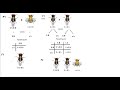
Genetics and Fruit Fly Experiments

Interactive Video
•
Biology
•
9th - 10th Grade
•
Practice Problem
•
Hard

Patricia Brown
FREE Resource
Read more
10 questions
Show all answers
1.
MULTIPLE CHOICE QUESTION
30 sec • 1 pt
What was the primary focus of Thomas Hunt Morgan's experiments with fruit flies?
To understand the 9:3:3:1 ratio in plants
To develop new fruit fly species
To map the location of genes on chromosomes
To study the behavior of fruit flies
2.
MULTIPLE CHOICE QUESTION
30 sec • 1 pt
Why did Morgan's team find that fruit fly traits did not follow Mendelian genetics?
The fruit flies were genetically modified
The traits were linked on the same chromosome
The traits were on different chromosomes
The experiments were conducted incorrectly
3.
MULTIPLE CHOICE QUESTION
30 sec • 1 pt
Why do linked genes not separate as easily as those on different chromosomes?
They are physically closer together
They are more stable
They are on different chromosomes
They are not affected by genetic recombination
4.
MULTIPLE CHOICE QUESTION
30 sec • 1 pt
What was the result of crossing true-breeding fruit flies with different traits?
The F1 generation was genetically diverse
The offspring were genetically identical to the parents
The offspring showed a 9:3:3:1 ratio
The F1 generation was heterozygous and phenotypically similar
5.
MULTIPLE CHOICE QUESTION
30 sec • 1 pt
What did the F2 generation reveal about genetic variability?
It demonstrated only parental phenotypes
It showed a 9:3:3:1 ratio
It was genetically identical to the F1 generation
It showed a 3:1 ratio resembling a monohybrid cross
6.
MULTIPLE CHOICE QUESTION
30 sec • 1 pt
What was the main observation when crossing the F1 generation?
Four different gametes were formed
Only two different gametes were formed
The offspring were identical to the F1 generation
The offspring showed new traits not seen in the parents
7.
MULTIPLE CHOICE QUESTION
30 sec • 1 pt
What did the limited genetic variability in the F2 generation suggest?
A genetic mutation
A monohybrid cross pattern
A 9:3:3:1 ratio
A new species of fruit fly
Access all questions and much more by creating a free account
Create resources
Host any resource
Get auto-graded reports

Continue with Google

Continue with Email

Continue with Classlink

Continue with Clever
or continue with

Microsoft
%20(1).png)
Apple

Others
Already have an account?


