
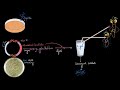
Blue-White Screening Concepts

Interactive Video
•
Biology
•
9th - 10th Grade
•
Practice Problem
•
Hard

Patricia Brown
FREE Resource
Read more
10 questions
Show all answers
1.
MULTIPLE CHOICE QUESTION
30 sec • 1 pt
What is the primary advantage of using blue-white screening over using two antibiotic-resistant genes?
It is more cost-effective.
It is more accurate in identifying colonies.
It uses more advanced technology.
It requires fewer steps and is quicker.
2.
MULTIPLE CHOICE QUESTION
30 sec • 1 pt
Why is it necessary to screen bacterial colonies during gene cloning?
To ensure all cells have the same genetic makeup.
To identify cells that have successfully taken up the desired insert.
To increase the growth rate of all bacterial colonies.
To eliminate all cells that have taken up any plasmid.
3.
MULTIPLE CHOICE QUESTION
30 sec • 1 pt
What role does the lacZ gene play in blue-white screening?
It enhances the growth of bacterial colonies.
It marks the cells with a fluorescent tag.
It produces an enzyme that digests lactose.
It provides resistance to antibiotics.
4.
MULTIPLE CHOICE QUESTION
30 sec • 1 pt
How does insertional inactivation help in blue-white screening?
It prevents the production of beta-galactosidase in cells with the insert.
It activates the lacZ gene.
It increases the resistance to antibiotics.
It enhances the digestion of lactose.
5.
MULTIPLE CHOICE QUESTION
30 sec • 1 pt
What is the function of X-gal in blue-white screening?
It acts as an antibiotic.
It provides nutrients to the cells.
It enhances the growth of bacterial colonies.
It is a chromogenic substrate that turns blue when digested.
6.
MULTIPLE CHOICE QUESTION
30 sec • 1 pt
Why do colonies with the insert appear white in blue-white screening?
They do not produce beta-galactosidase, so X-gal is not digested.
They produce a different enzyme that turns them white.
They are stained with a white dye.
They are naturally white due to the type of bacteria used.
7.
MULTIPLE CHOICE QUESTION
30 sec • 1 pt
What is a chromogenic substrate?
A substrate that fluoresces under UV light.
A substrate that changes color when digested by an enzyme.
A substrate that enhances bacterial growth.
A substrate that provides antibiotic resistance.
Access all questions and much more by creating a free account
Create resources
Host any resource
Get auto-graded reports

Continue with Google

Continue with Email

Continue with Classlink

Continue with Clever
or continue with

Microsoft
%20(1).png)
Apple

Others
Already have an account?


