
Hydrogen Bonding and Intermolecular Forces

Interactive Video
•
Chemistry
•
9th - 10th Grade
•
Practice Problem
•
Hard

Patricia Brown
FREE Resource
Read more
10 questions
Show all answers
1.
MULTIPLE CHOICE QUESTION
30 sec • 1 pt
Which of the following elements is NOT typically involved in hydrogen bonding?
Oxygen
Carbon
Fluorine
Nitrogen
2.
MULTIPLE CHOICE QUESTION
30 sec • 1 pt
What role does hydrogen bonding play in the structure of DNA?
It holds DNA strands together.
It has no role in DNA structure.
It dissolves DNA strands.
It breaks DNA strands apart.
3.
MULTIPLE CHOICE QUESTION
30 sec • 1 pt
In hydrogen fluoride, which atom is slightly negative?
Both are neutral
Both are negative
Fluorine
Hydrogen
4.
MULTIPLE CHOICE QUESTION
30 sec • 1 pt
How do water molecules orient themselves to optimize hydrogen bonding?
They do not orient themselves.
Positive poles face each other.
Positive and negative poles attract each other.
Negative poles face each other.
5.
MULTIPLE CHOICE QUESTION
30 sec • 1 pt
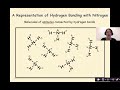
Which molecule is used as an example of hydrogen bonding with nitrogen?
Ammonia
Hydrogen fluoride
Water
Methane
6.
MULTIPLE CHOICE QUESTION
30 sec • 1 pt
Why do molecules with hydrogen bonding have high boiling points?
They are non-polar.
They are very light.
They have low molecular mass.
They have strong intermolecular forces.
7.
MULTIPLE CHOICE QUESTION
30 sec • 1 pt
Which intermolecular force is responsible for water's high boiling point?
Metallic bonding
Covalent bonding
Ionic bonding
Hydrogen bonding
Access all questions and much more by creating a free account
Create resources
Host any resource
Get auto-graded reports

Continue with Google

Continue with Email

Continue with Classlink

Continue with Clever
or continue with

Microsoft
%20(1).png)
Apple

Others
Already have an account?

