
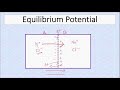
Ion Movement and Membrane Potential

Interactive Video
•
Biology
•
11th - 12th Grade
•
Practice Problem
•
Hard

Patricia Brown
FREE Resource
Read more
10 questions
Show all answers
1.
MULTIPLE CHOICE QUESTION
30 sec • 1 pt
What happens when an ion moves across a membrane without a counter ion?
The membrane becomes impermeable.
There is no change in charge.
A charge separation occurs.
The ion returns to its original side.
2.
MULTIPLE CHOICE QUESTION
30 sec • 1 pt
Which ion's movement is primarily discussed in the initial setup of the compartments?
Calcium
Potassium
Chloride
Sodium
3.
MULTIPLE CHOICE QUESTION
30 sec • 1 pt
What is the equilibrium potential?
The potential where electrical and chemical gradients are equal and opposite.
The potential at which ions move freely.
The potential where only chemical gradient exists.
The potential where only electrical gradient exists.
4.
MULTIPLE CHOICE QUESTION
30 sec • 1 pt
Which equation is used to calculate the equilibrium potential of an ion?
Goldman equation
Nernst equation
Michaelis-Menten equation
Henderson-Hasselbalch equation
5.
MULTIPLE CHOICE QUESTION
30 sec • 1 pt
In the example calculation, what is the valency of sodium used?
0
+2
+1
-1
6.
MULTIPLE CHOICE QUESTION
30 sec • 1 pt
What is the significance of the concentration gradient in determining membrane potential?
It has no effect on membrane potential.
It is less important than absolute numbers.
It is more important than absolute numbers.
It only affects the electrical gradient.
7.
MULTIPLE CHOICE QUESTION
30 sec • 1 pt
What happens to the equilibrium potential if the concentration on both sides of the membrane is equal?
It becomes infinite.
It becomes zero.
It becomes negative.
It becomes positive.
Access all questions and much more by creating a free account
Create resources
Host any resource
Get auto-graded reports

Continue with Google

Continue with Email

Continue with Classlink

Continue with Clever
or continue with

Microsoft
%20(1).png)
Apple

Others
Already have an account?

