
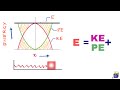
Kinetic and Potential Energy in Oscillations

Interactive Video
•
Physics
•
9th - 10th Grade
•
Practice Problem
•
Hard

Patricia Brown
FREE Resource
Read more
10 questions
Show all answers
1.
MULTIPLE CHOICE QUESTION
30 sec • 1 pt
What principle explains why the total energy in a simple harmonic motion system remains constant?
Law of Universal Gravitation
Law of Inertia
Law of Conservation of Energy
Newton's Third Law
2.
MULTIPLE CHOICE QUESTION
30 sec • 1 pt
Which expression represents the potential energy stored in a spring?
mv^2
1/2 mv^2
1/2 kx^2
kx
3.
MULTIPLE CHOICE QUESTION
30 sec • 1 pt
How is the kinetic energy of a block connected to a spring expressed?
1/2 mω^2a^2 cos^2(ωt + φ)
1/2 mω^2a^2 sin^2(ωt + φ)
1/2 mv^2
1/2 kx^2
4.
MULTIPLE CHOICE QUESTION
30 sec • 1 pt
What is the total mechanical energy of a spring-mass system in terms of mass and angular frequency?
mω^2a^2
1/2 kx^2
kω^2a^2
1/2 mω^2a^2
5.
MULTIPLE CHOICE QUESTION
30 sec • 1 pt
What happens to the potential energy when the mass is at the equilibrium position?
It is half of the total energy
It is maximum
It is zero
It is equal to kinetic energy
6.
MULTIPLE CHOICE QUESTION
30 sec • 1 pt
At which point is the kinetic energy of the mass maximum during its oscillation?
At the extreme left
At the extreme right
At the midpoint between equilibrium and extreme positions
At the equilibrium position
7.
MULTIPLE CHOICE QUESTION
30 sec • 1 pt
What does the graph of x versus potential energy (PE) and kinetic energy (KE) show?
PE and KE are always equal
Total energy is variable
PE is maximum at equilibrium
KE is zero at extreme positions
Access all questions and much more by creating a free account
Create resources
Host any resource
Get auto-graded reports

Continue with Google

Continue with Email

Continue with Classlink

Continue with Clever
or continue with

Microsoft
%20(1).png)
Apple

Others
Already have an account?

